
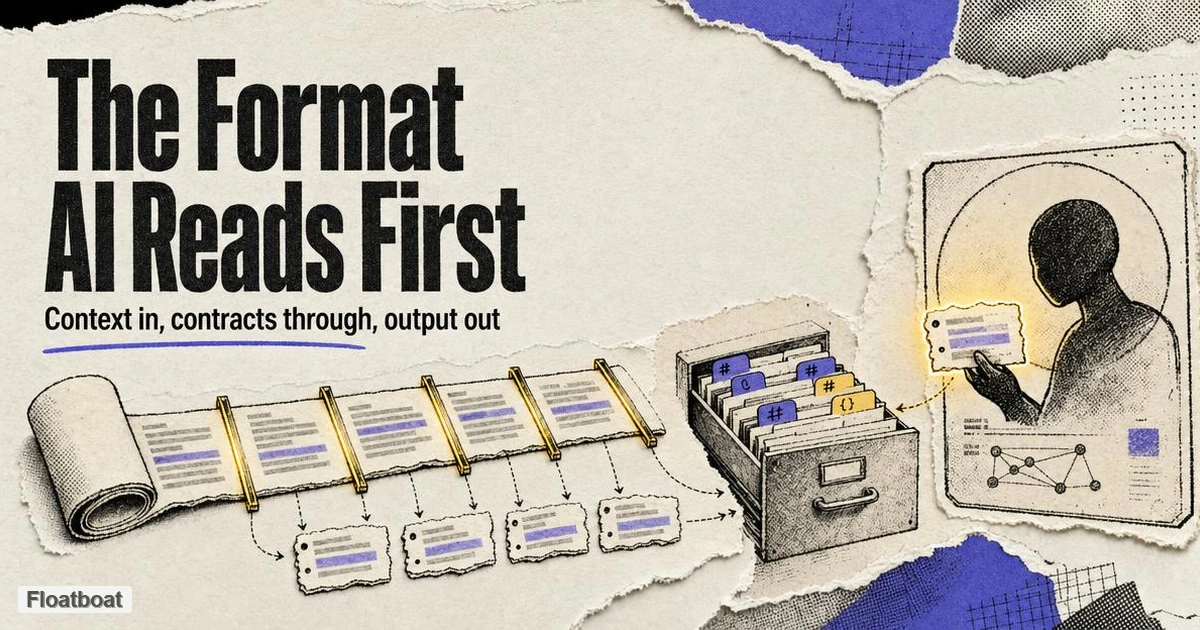
1. The Input Side: What LLMs Read Efficiently
Ask a model to consume a document and the format of that document changes what the model can do with it. Plain prose buries structure in transition sentences. HTML spends most of its tokens on scaffolding — wrappers, attributes, style properties — that is noise to a language model. Markdown sits in the sweet spot: the markup tokens are the structure.
A heading is the clearest example. ## Pricing costs three characters and tells the model, unambiguously, that a section boundary occurred and what it bounds. The equivalent signal in unstructured prose has to be inferred; the equivalent in HTML is wrapped in tags whose names the model must first ignore. When documents are long — and context windows, which have grown large enough to hold entire documentation sets, reward long inputs — the cumulative savings of cheap structural signals compound into measurably better section-level comprehension.
There is also a training-distribution argument. The public text the current generation of models learned from — repositories, documentation sites, technical blogs — is saturated with Markdown. A format the models have seen organized this way millions of times is a format they parse with few surprises. This is an observation about training data, not a spec sheet claim; no standards body ratified Markdown as an AI input format, and none needed to.
The input-side advantage compounds in a way that is easy to underestimate. Because a heading is both cheap and unambiguous, models use it as an anchor: a question about refunds gets answered by locating the section signal first, then reading within its bounds. Fake structure defeats the anchor — a line of bold text carries emphasis, not hierarchy — so a model trained on millions of real outlines treats it as mere typography, while one honest #/##/### outline pre-indexes the document for the reader on the other side of the API.
2. Markdown, JSON, or XML: What Each Hop of the Pipeline Speaks
The pipeline does not speak one format end to end, and it does not need to. Documents and inter-agent state tend to move as Markdown; programmatic contracts — function calls, structured extraction, API payloads — move as JSON; and some providers' prompting guidance still recommends wrapping prompt sections in XML tags. The useful question is not which format wins but which hop each format serves. Markdown's home turf is prose that a human or a model should read.
Token overhead favors Markdown. Practitioner measurements circulated since 2024 put it meaningfully ahead of JSON for the same payload — community reports cluster in the 15 to 35 percent range depending on schema verbosity — because every JSON field pays for quotes, braces, and repeated key names that carry no meaning, and XML pays a similar tax twice on each tag. Exact figures vary by tokenizer and payload shape, and they are practitioner reports rather than standardized benchmarks; the direction has been consistent across public measurements as of 2026.
Parsing tolerance splits the formats the other way. JSON is strict — one trailing comma or unescaped quote and the payload fails to parse, which is why vendors built constrained-decoding modes and schema validators — while XML is forgiving to parse but verbose to write. Markdown has the most graceful failure mode in the set: a malformed fragment still reads as text, and a renderer that meets an unfamiliar construct usually displays it rather than breaking. For documents whose worst-case consumer is a human skimming raw output, that degradation is a feature no schema replaces.
3. The Retrieval Side: Chunking Learns to Read Headings
Retrieval-augmented generation has a dirty-first-step problem: before anything can be retrieved, documents must be split into pieces small enough to embed and match. Split them badly — mid-thought, mid-section — and the retriever serves fragments that mislead the model no matter how good the model is.
The 2026 state of the art converged on structure-aware splitting, and Markdown is the structure it reads. Engineering guides on chunking published across the vector-database and data-pipeline ecosystem — from Firecrawl's comparison of chunking strategies, to Weaviate's chunking guide, to Atlan's complete 2026 RAG chunking guide — treat heading-aware splitting as a baseline strategy rather than an advanced technique, as of their 2025–2026 updates. The pattern they describe is consistent: split on section boundaries first, keep sections coherent, attach the heading path as metadata so every chunk knows what it is about.
Markdown makes that strategy nearly free, because the section boundaries are explicitly marked. A document written in clean Markdown — one idea per section, descriptive ## headings, no decorative nesting — converts into retrievable chunks with no extra preprocessing. A document written as unstructured prose, or exported from a word processor into tag soup, needs parsing heuristics that will guess wrong at the boundaries. This is the strongest argument for the documentation habits described in what makes Markdown the interface format: the discipline pays out twice, once for human readers and once in retrieval quality.
There is a corollary that documentation-site operators tend to discover late: a Markdown documentation site is already a retrieval corpus. If the content lives in a Markdown source repository, the corpus indexes itself — clone it, run the ingestion, done — while content trapped in a CMS's rendered HTML has to be reverse-engineered back into structure before any of it is retrievable. The pipeline does not care how polished the pages look; it cares where the headings are.
4. Three Chunking Strategies, One Document
The difference between splitting strategies is easiest to see on a single concrete document, so consider a short API reference written the way most are: a title, three sections, one table.
# Billing API Reference
Last updated: 2026-08-30

## Authentication
Send the key in the Authorization header as a bearer token.
Keys are environment-scoped and rotate through the dashboard.

## Rate Limits
The API allows 120 requests per minute per environment.
Burst traffic above the cap returns HTTP 429.

## Error Codes
| Code | Meaning |
| ---- | ------- |
| 402  | Payment required |
| 429  | Rate limit exceeded |
Fixed-size splitting slices the file every N characters or tokens, regardless of what falls at the boundary. Weaviate's chunking guide describes the weakness bluntly: the method does not respect the semantic structure of the text, cutting mid-sentence or mid-word, and the standard mitigation is overlap — carrying 10 to 20 percent of each chunk's text into the next — which papers over the worst seams at the cost of embedding the same sentences twice. On the sample, with a 200-character limit, the damage is concrete.
chunk 1: "Billing API Reference ... Send the key in the Authorization"   cut mid-sentence
chunk 2: "header as a bearer token ... The API allows 120 requests"       two topics fused
chunk 3: "per minute per environment ... | 429 | Rate limit exceeded |"   table stripped bare
Recursive splitting tries separators in priority order — paragraphs first, then lines, then sentences — and only falls back to harder cuts when a piece still exceeds the size limit. On the sample it keeps every paragraph whole, which is why the guides position it as a solid default for prose with no markup at all. Its blind spot is section membership: nothing inside a paragraph says which section it belongs to, so the tail of Authentication can share a chunk with the head of Rate Limits, and the embedding now averages two topics.
Header-aware splitting starts a new chunk at each heading and attaches the heading path — Billing API Reference > Rate Limits — as metadata on every chunk it produces. On the sample this yields exactly the units a human would name: one chunk per section, the table kept with its section, no seam cutting a sentence. Both the Firecrawl and Weaviate guides position this document-based strategy as the natural choice for structured formats, and its one failure mode is a document whose headings do not tell the truth — an authoring problem, not a pipeline problem. When a size budget is also needed, the guides converge on a principle rather than a number: small enough that a chunk's embedding matches one specific question, large enough to carry that question's context.
5. Frontmatter as a Retrieval Signal
Frontmatter is the block of YAML at the top of a Markdown file that human readers skip and machines read first: title, date, tags, category, audience. In a retrieval pipeline those fields do quiet but heavy work — the title becomes a prefix on every chunk from that file, the date drives recency ranking and "only documents updated this quarter" filters, and tags scope a search to one product area before any similarity comparison runs. None of this requires the semantic search to be clever; it is plain database filtering, and it is the cheapest relevance win in the stack.
---
title: "Billing API Reference"
date: 2026-08-30
tags: [billing, api]
audience: developers
---
The mechanics are unglamorous. Ingestion parsers strip the frontmatter before chunking and re-attach its fields as metadata on every chunk the file produces, so a filter like tags = billing AND date > 2026-06-01 narrows the candidate set before embeddings are compared. Vector databases from Weaviate to Pinecone expose this kind of filtering alongside similarity search, and ingestion frameworks ship extractor modules that try to infer a title or keywords when a document does not declare one. Inference is a guess; frontmatter is the author supplying the right answer for free, and as of 2026 most pipelines prefer the declaration.
The discipline that matters is consistency, because metadata only filters when its values come from a vocabulary someone actually queries. Free-text tags that drift — api, API, apis — fragment one topic into filters that each miss part of the corpus. Teams running an LLM knowledge base as a solo operator, or a shared one at ten times the size, converge on the same rule: keep the field set small and every value inside a vocabulary you would still defend in six months.
Dates deserve their own caution because they do double duty in retrieval. A date that never changes marks when a document was born, while an updated field that moves only on substantive edits lets a pipeline prefer fresh material without treating every typo fix as news. Feeds that rewrite date on every save poison their own recency ranking — nothing in the corpus ever looks older than last Tuesday.
6. The Contract Side: Files That Talk to Agents
The second role is less discussed and more visible once you look for it. A growing set of files in every serious repository are Markdown files whose entire purpose is to instruct machines: README.md for humans-who-are-also-agents, CONTRIBUTING.md for automation, and the newer generation — CLAUDE.md, AGENTS.md — written specifically so an agent that opens the repository knows how to behave in it.
These files work because Markdown is a contract both parties already speak. The agent parses it without a special reader; the human maintains it without learning a config format; and the diff between versions is reviewable in a pull request like any other code change. When the HTML-versus-Markdown question gets decided for machine-facing documents, it usually lands on Markdown for exactly this reason — the file's job is to be diffed, versioned, and parsed, and HTML is worse at all three.
The same contract logic runs inside agent products. Agents that hand work to other agents pass Markdown-structured state; tools that ingest web pages or PDFs emit Markdown as the canonical cleaned form (the conversion step has become its own tooling category, covered in how to convert HTML to Markdown). In a pipeline with three systems and two humans, Markdown is the format every hop can consume without negotiation — and the traffic runs both ways, since pull-request descriptions and release notes that agents draft are read by reviewers first and by automation second.
7. The Agent Memory File Ecosystem
The contract role stopped being a loose convention and became named, dated artifacts across 2025 and 2026. The first landmark was CLAUDE.md: when Anthropic launched its Claude Code coding agent in February 2025, the agent shipped with a project-memory file of that name, and the convention spread with the tool. Anthropic's Claude Code documentation now describes a small hierarchy of memory — user-level, project-level, and local files that are concatenated rather than overridden, plus automatically maintained notes — and every layer of it is a plain Markdown file.
The second landmark generalized the idea beyond one vendor. AGENTS.md was published in August 2025 as an open specification, self-described as "a README for agents," and it has since been handed to the Agentic AI Foundation under the Linux Foundation for neutral stewardship. The specification counts more than 60,000 open-source projects using the file and names over twenty supporting tools, from OpenAI Codex and Google's Gemini CLI to Cursor, Devin, Zed, and GitHub Copilot's coding agent; as of 2026, Claude Code itself reads AGENTS.md when a repository provides one in place of CLAUDE.md. A vendor convention became a de facto interchange standard.
The third lineage shows both the fragility of undocumented conventions and the same Markdown endpoint. The .cursorrules file spread through the Cursor editor's community during 2024 as an informal instruction file, with no specification and no stable schema. Cursor has since moved project rules into a .cursor/rules/ directory of .mdc files, and its rules documentation is explicit that a plain .md file there is ignored because it has no frontmatter — the description, globs, and alwaysApply fields decide when each rule loads. Even the format invented for agent instructions ended up needing frontmatter.
Step back and the pattern is convergent evolution: three ecosystems, three names, one answer. Instructions for agents are written in Markdown, checked into the repository next to the code they govern, and reviewed in pull requests by the humans they serve. That is what the broader ecosystem of agentic AI tools standardized on — a file format whose best property is that neither party had to learn anything new — with build commands, conventions, and boundaries as the recurring inventory, kept short because every line rides into context on every session.
8. The Output Side: Why Agents Default to It
Given the input and contract roles, the output role follows naturally. An agent that emits Markdown produces something the requesting human can read immediately in any renderer, the requesting pipeline can chunk and index, and the next agent can consume without conversion. All three consumers, one format.
This is also why the format debate of mid-2026 — agents defaulting to HTML for human-facing deliverables — resolved into a division of labor rather than a winner: deliverables for humans moved toward HTML, while anything destined for another machine, a repository, or a retrieval index stayed Markdown. The decision framework in HTML versus Markdown for AI output is, in pipeline terms, a routing table.
There is a property worth naming on top of that routing table: round-tripping. A report an agent writes this morning is chunked into the knowledge index by afternoon and quoted back by a colleague's agent by evening — output, then corpus, then context, with no conversion at any edge. Formats only one consumer can read are boundaries where pipelines leak value; Markdown's three roles are the absence of those boundaries.
9. Writing Markdown That Pipelines Well
If your documents will be read by machines — and as of 2026, assume they will be — four habits carry most of the value.
Use real heading hierarchy, and keep it shallow: ## for sections, ### for subsections, no skipping levels, because chunkers key on those levels. Put one topic per section, because a chunk that mixes topics retrieves badly no matter how well it was split. Prefer tables and lists that survive flattening — a chunker may strip your table formatting, so a table whose meaning dies without rendering is a table the pipeline will lose. And keep machine-facing metadata in frontmatter, where parsers expect it, instead of prose asides at the bottom of the file.
The cost of these habits is close to zero for a human writer; they are mostly the same habits good documentation already follows. That asymmetry — near-free for the author, compounding for every downstream machine — is the whole argument.
The Four Habits, Applied to a Real Document
The habits are easier to trust once seen repairing a real file. Below is a composite of the onboarding documents that circulate inside small companies: friendly, useful to humans, and nearly opaque to a chunker.
Onboarding Notes (v3, final-FINAL)

**About this doc**  Everything a new hire needs, updated when we remember.

**Getting set up**  Laptop, badge, Slack. Payroll needs your bank
details by Thursday or your first payment slips a month.

**Money stuff**  We reimburse up to $60/night for hotels; anything
over needs pre-approval from finance; payroll runs on the 25th;
expenses go in Ramp; per-diem caps: city | hotel | meals (wide table)

Last reviewed by Dana in March 2026. Keywords: hr onboarding payroll
expenses laptop. Internal only.
Walk the four habits through it and the damage becomes specific. The bold labels are not headings, so header-aware splitting — the strategy section 4 showed winning — finds no section boundaries at all. "Money stuff" fuses hotel caps, pre-approval rules, payroll timing, and a software tool into one block, so any chunk cut from it retrieves badly for every one of those topics, and the Thursday bank-details deadline hides inside "Getting set up," where no payroll answer is ever found. The per-diem table's meaning lives entirely in the rendering, and the review date, keywords, and audience — the exact fields retrieval wants — sit in a closing aside where no parser looks.
The repaired version changes the structure, not the content.
---
title: "Engineering Onboarding"
date: 2026-03-14
tags: [hr, onboarding]
audience: new hires
---

# Engineering Onboarding

## First Week Setup
Laptop, badge, and Slack access are ready on day one.

## Payroll
Payroll runs on the 25th. Bank details are due the Thursday
before your first cycle, or the payment slips a month.

## Expenses and Travel
We reimburse up to $60 per night for hotels; anything above
that needs pre-approval from finance. File expenses in Ramp.
After the repair, the header-aware chunker produces four clean chunks with heading paths, the date filter can exclude stale versions, and the tags land in metadata instead of floating in prose. Nothing was rewritten for the machine's benefit alone — honest headings, one topic per section, a table that fits, and declared metadata also make the document easier for a nervous new hire to skim. Retrofitting a whole corpus follows the same order: headings first, then one topic per section, then survivable tables, then metadata lifted into frontmatter; a hundred documents can be hand-repaired in an afternoon, and the result is verifiable by running a splitter before and after.
10. Conclusion
Markdown did not win the AI pipeline because a committee standardized it. It won because it was already the format of the text machines trained on, because its structure signals are cheap enough to matter at context scale, and because every consumer in the pipeline — models, retrievers, agents, and the humans supervising them — can read it without conversion. The pipeline runs on Markdown the way plumbing runs on standard pipe widths: not because anyone mandates it, but because everything connects.
Write accordingly: clean headings, one topic per section, honest frontmatter. Your next reader may not have eyes.
https://floatboat.ai/blog/markdown-for-ai-pipelines