What Is Voice Dictation for AI Agents? — Defined
Voice dictation for AI agents turns speech into agent prompts—not chat replies. Learn the definition, five job shapes, and how it differs from voice mode.
1. Why Voice Input for AI Agents Is a Category Now
The bottleneck in working with AI agents is rarely model quality anymore. It is intent transfer: how quickly and completely you can tell the agent what you want, with enough context that it can act without three rounds of clarification. Typing caps most knowledge workers around 40–60 words per minute; comfortable speech often runs 120–150 words per minute. That gap matters when you are describing a multi-step bug, narrating a product brief, or dictating five annotation notes across a long document.
What changed in 2025–2026 is not raw transcription accuracy alone. Vendors began shipping native voice input inside agent surfaces—Claude Code's push-to-talk, OpenAI Codex dictation in terminal workflows, and cross-app layers like Monologue that pipe speech directly into whatever agent window is focused. The speech still becomes text before the agent reasons, but the UX is optimized for agent prompts, not for producing a polished memo in Word. That shift is large enough to deserve its own label: voice dictation for AI agents.
This article defines that label, separates it from neighboring concepts, and introduces a job-shape taxonomy you can use when evaluating tools. For a head-to-head of voice mode versus dictation inside agent products, see voice mode vs dictation for AI agents. For ranked product coverage once you know your job shape, see best voice dictation for AI agents.
2. Voice Dictation for AI Agents Defined
2.1 The Core Definition
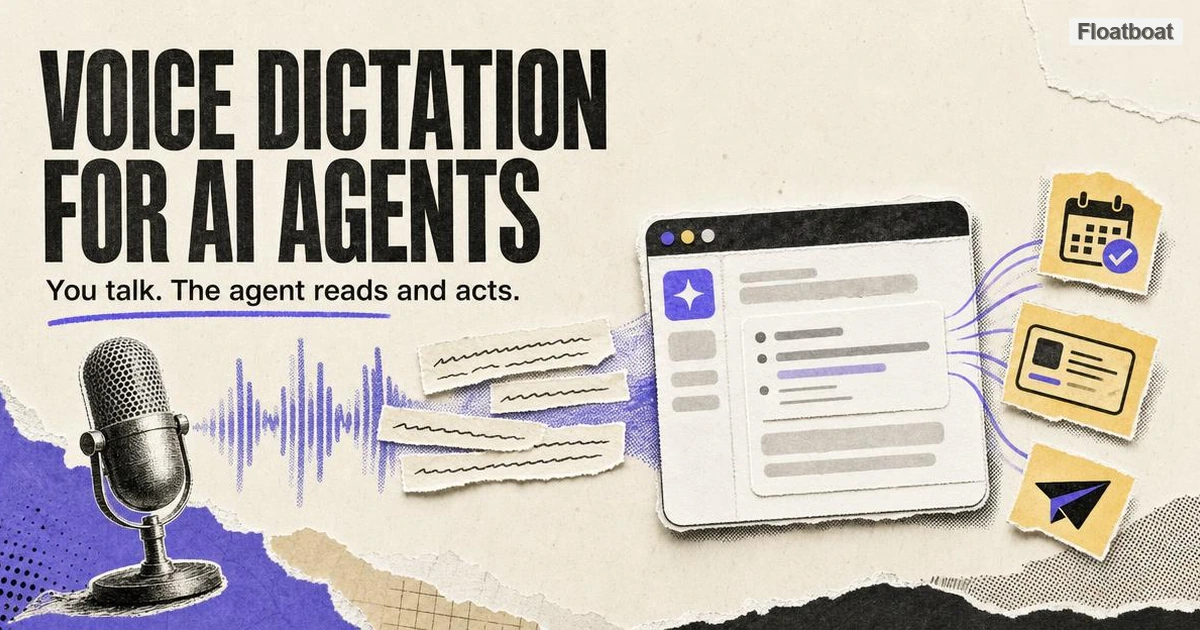
Voice dictation for AI agents is speech converted to text that becomes the input layer of an AI agent workflow—the prompt, instruction bundle, or contextual note the agent consumes before it plans, calls tools, or writes output. The human speaks; automatic speech recognition (ASR) produces a transcript; that transcript (often refined by a language model) is handed to the agent as text. The agent's reply is typically rendered as text, tool actions, or file edits—not as spoken audio back to the user.
The defining constraint is directionality: one-way voice in, agent processing out through non-voice channels. You are not holding a phone conversation with the model. You are accelerating how fast you can populate the agent's context window. When developers describe "talking to Claude Code," they usually mean this pattern—even if the product marketing says "voice mode."
2.2 Five Defining Properties
Agent-bound, not app-agnostic. System-wide dictation tools insert text wherever the cursor lives—email, Slack, a spreadsheet cell. Voice dictation for AI agents targets a specific agent runtime: a coding harness, a desktop agent workspace, or a chat thread wired to tools. The integration assumption is that an agent will interpret, disambiguate, and act on messy speech.
Intent-tolerant transcription. Traditional dictation optimizes for literal fidelity—every "um," every false start. Agent-oriented dictation often adds a refinement pass: an LLM strips fillers, resolves self-corrections ("ship Tuesday—wait, Wednesday"), and preserves technical vocabulary the ASR layer mangled. The agent downstream is expected to be a semantic error corrector, which is why imperfect raw transcripts remain usable in ways they were not in the regex era.
Prompt-scale utterances. Utterances tend to be task descriptions, not dictation of final copy. "Refactor the auth middleware to use the new token schema and add tests for expired tokens" is a prompt. "Dear Sarah, thank you for your patience regarding the invoice…" is document dictation—a related but different job shape (Type C in §5). Agent dictation optimizes for instruction density, not publish-ready prose.
Tool-adjacent context. The best implementations know what the agent can see: open files, calendar events, prior chat turns, MCP-connected systems. Voice input that lands in a vacuum is weaker than voice input that arrives with workspace context already attached. This is where calendar-driven and document-centric agents gain an edge over a bare chat box.
Human remains the approval gate. Even when speech triggers multi-step agent runs, the category assumes human review before irreversible external actions—send email, merge PR, charge a card. Voice dictation accelerates instruction; it does not eliminate accountability. Products that blur this line are drifting toward Type B voice agents or fully autonomous agents, not dictation.
2.3 What Voice Dictation for AI Agents Is Not
It is not voice mode (two-way spoken AI). Voice mode—ChatGPT Advanced Voice, Gemini Live, OpenAI's realtime speech-to-speech APIs—optimizes for conversational turn-taking: you speak, the model speaks back, often with low latency and barge-in. The product goal is dialogue, not populating a text agent harness. Both use microphones; the interaction contract differs. The dedicated comparison article walks through latency, UX loops, and when each modality wins.
It is not a voice agent. A voice agent (defined in what is a voice agent) is a full spoken interface: speech in, reasoning, speech out, often with telephony or realtime audio sessions. OpenAI's voice agents guide describes speech-to-speech and chained STT→LLM→TTS architectures for that purpose. Dictation for agents stops at the text boundary unless the product explicitly adds TTS for replies.
It is not system-wide OS dictation. macOS Dictation, Windows Speech Recognition, Wispr Flow, and Superwhisper excel at putting words in fields. They are input method editors for the whole OS. They do not know which thread is an agent, which tools are wired, or how to bundle five voice annotations into one agent pass. Many users run Type E alongside Type A; they are complementary, not interchangeable.
It is not "agentic dictation" as a marketing synonym for autonomy. Several 2026 explainers use agentic dictation to mean "voice that triggers workflows." That conflates speech input with agent execution. Dictation is an modality; agency is a behavior. You can dictate into a passive chatbot (no agency) or type into a proactive calendar agent (agency without voice). Keep the axes separate when you read vendor pages.
3. The Technology Stack
Voice dictation for AI agents is three layers plus an optional fourth—not a monolithic "voice AI" product.
3.1 Capture and ASR
The capture layer handles microphone access, push-to-talk vs always-on, noise suppression, and streaming partial transcripts. ASR may run on-device (privacy, offline) or cloud (accuracy, dialect coverage). Latency targets for agent use are tighter than for offline memo dictation because users often chain speech → immediate agent run. Sub-800ms end-to-end to visible text is a common product claim among 2026 dictation keyboards; agent-native integrations sometimes trade raw speed for better vocabulary models in technical domains.
3.2 Refinement and Intent Normalization
The refinement layer is where "agentic" products diverge from literal transcription. A language model receives the raw ASR string and outputs what the user meant: merged corrections, stripped fillers, punctuation tuned to code vs prose vs bullet lists. LumeVoice's public architecture description calls this a reasoning step, not spell-check—a useful distinction. The LLM pass is cheap relative to the agent run that follows, so vendors increasingly default it on for agent-facing modes.
3.3 Agent Runtime and Tool Surface
The transcript lands in an agent harness that can plan, call APIs, edit files, or query connected systems. This is the same stack as text-only agents—MCP tools, function calling, workspace memory—with voice as an alternate input API. Coding agents (Claude Code, Codex, Cursor-style flows) were early adopters because hands-free prompting while reviewing diffs is an obvious fit. Calendar-driven agents add another hook: the event on your schedule selects which workspace and skill bundle receive the dictated prompt.
3.4 Optional Feedback Channel
Some products add textual streaming or lightweight audio cues (chime, earcon) but stop short of full voice mode. The optional feedback channel confirms the agent received the prompt; it does not replace reading the diff. When TTS readback becomes primary, you have crossed into Type B.
4. How It Compares to Related Concepts
4.1 Versus Voice Mode (Two-Way Spoken AI)
Voice mode optimizes dialogue: natural turn-taking, emotional tone, sometimes vision-in-the-loop on mobile. The user experience goal is "talk to the AI like a person." Voice dictation for AI agents optimizes throughput into a text-native agent where the valuable output is often a plan, a patch, or a structured artifact—not a spoken paragraph.
Choose voice mode when the task is exploratory conversation, language practice, or hands-busy Q&A where hearing the answer matters. Choose agent dictation when you already work inside an agent harness and need to inject intent faster than typing—especially for long, structured prompts. Hybrid products exist; the test is whether the default loop ends in spoken audio or in text/tool effects. OpenAI's split between GPT-Live sessions and composer dictation is a concrete example; see ChatGPT voice mode vs dictation for product-level detail.
4.2 Versus System-Wide Dictation
System-wide dictation is field-agnostic: it shines when you need clean prose in Notion, Gmail, or a CRM note without opening a specific agent. Agent dictation is runtime-aware: it assumes messy speech, accepts prompt-shaped utterances, and pairs with tool use. Wispr Flow and similar tools are excellent Type E layers; they are not substitutes for Type C document-agent co-authoring unless you manually bridge each dictation chunk into an agent thread.
A common solo-founder stack in 2026: Type E for quick replies, Type A in the coding agent for feature specs, Type C inside a workspace product when the deliverable is a long doc with iterative agent edits. Voice agent vs voice dictation for work walks employment scenarios; here the boundary is technical: does speech terminate in a text field anywhere, or in an agent context graph?
4.3 Versus Meeting AI and Type D Capture
Meeting note-takers (Otter, Fireflies, Fathom) optimize the recording lifecycle: join call, transcribe, summarize after. Type D meeting voice for agents includes live capture that feeds during-call plans—action items while the call still runs. That overlaps document-centric flows when the meeting output is a checklist in the same file you edit. It differs from Type A prompt dictation because the primary input is multi-speaker dialogue, not a single user's instruction.
4.4 Versus Chat-Only Agents Without Voice
If you paste typed prompts into ChatGPT or Claude, you already use the same agent runtime voice dictation would feed—just slower. Adding speech is an input modality upgrade, not a new agent paradigm. The paradigm shift appears when voice pairs with proactive triggers—calendar events, open files, batch annotations—so you dictate into context the agent already holds. That pairing is why voice dictation shows up in calendar-driven products: speech reduces friction; the calendar supplies structure. For the broader chat-vs-calendar framing (scheduling context only when relevant), see Calendar-Driven AI vs Chat-Based AI.
5. Job-Shape Taxonomy: Five Ways Voice Meets Agents
Most buyer confusion comes from comparing products that solve different jobs. This taxonomy—original analysis, P2, as of August 2026—sorts the landscape into five shapes. Use it before reading feature matrices or ranking lists.
| Shape | Name | Voice direction | Primary output | Typical user | Example pattern |
|---|---|---|---|---|---|
| A | Prompt dictation for agents | Speech → text prompt | Agent text, code, tool effects | Developers, power users | Talk into Claude Code; agent returns patch |
| B | Voice agent (two-way) | Speech ↔ speech | Spoken replies, realtime dialogue | Mobile Q&A, accessibility, phone bots | Advanced Voice Mode session |
| C | Document-centric co-authoring | Speech → in-doc text + agent edits | Living document, versioned draft | Writers, operators, consultants | Dictate while selecting spans for agent rewrite |
| D | Meeting voice for agents | Multi-speaker capture → agent | Live plan, tasks, briefs | Founders, PMs, client services | During-call checklist generation |
| E | System-wide dictation layer | Speech → any focused field | Text in arbitrary apps | Everyone | OS dictation, cross-app voice keyboard |
Type A is the canonical meaning of voice dictation for AI agents in this glossary. Type B is what people colloquially call "voice mode." Types C and D share microphones but optimize artifact location—the doc or the meeting plan—not generic prompt injection. Type E underpins all of them but lacks agent semantics alone.
When a vendor says "agentic dictation," map the claim to a row. If they trigger workflows from voice but reply in audio, they span A and B. If they polish prose across apps without tool use, they are mostly E with optional chat paste. Clarity here prevents paying for a meeting bot when you needed a coding harness mic button.
5.1 Where Document-Centric Flows Fit
Type C deserves extra attention because it is the fastest-growing shape among desktop agent products. Instead of dictating into a side chat, you dictate into the document while the agent edits selections, accepts batched voice annotations, and tracks versions. Floatboat's Introducing Flow Mode announcement describes this pattern: continuous speech into a draft, in-place agent refinement, bundled voice notes, and live meeting plans in the same file—distinct from both Type A terminal dictation and Type E cross-app keyboards.
Type C is not "more advanced Type A." It changes the center of gravity from prompt/response to co-owned artifacts. Many solo founders need C for memos and A for repos; ranking them against each other without naming the job shape produces nonsense conclusions.
6. Where the Category Is Heading
Three forces will keep expanding voice dictation for AI agents through 2026–2027, even though the label itself is still settling.
First, agent harnesses are becoming the default IDE for knowledge work. As coding agents generalize into "do work on my files and integrations," voice input stops being a developer novelty and becomes the fastest way to specify multi-step tasks. Expect tighter push-to-talk defaults, not optional plugins.
Second, refinement models will specialize by workspace context. Generic filler removal is table stakes; the next step is formatting dictated prompts differently when the active surface is a test file versus a investor email draft versus a calendar-triggered prep brief. Context-aware refinement blurs the line between Type A and Type C but does not merge them with Type B.
Third, privacy and locality splits will harden. On-device ASR (Superwhisper-style) versus cloud refinement versus fully local agent loops will segment buyers by compliance needs. Agent dictation for regulated industries may standardize on local capture + redacted cloud refinement—a configuration rarely discussed in consumer roundups.
None of this requires every agent to speak back. The category's growth is input-side: making text-native agents feel as fluid as conversation without forcing spoken output.
7. Conclusion
Voice dictation for AI agents names a specific job: use speech to fill the text input layer of an agent, then let the agent respond through text, tools, or files—not through a voice conversation. It is not voice mode, not a voice agent, not generic OS dictation, and not the same as meeting transcription—though real products combine shapes A through E.
Use the five-row taxonomy when you shop: prompt dictation (A), two-way voice agents (B), document co-authoring (C), meeting capture (D), system layer (E). Match the row before comparing prices or reading ranked lists. The companion pieces on voice mode versus dictation and ranked tools for each job shape extend this glossary once your row is clear.
https://floatboat.ai/blog/what-is-voice-dictation-for-ai-agents