Calendar-Driven AI vs Chat-Based AI: Which Trigger Fits the Work?
Compare calendar-driven and chat-based AI by trigger, context, approvals, failure modes, and cost—and learn when to use either one or combine both.
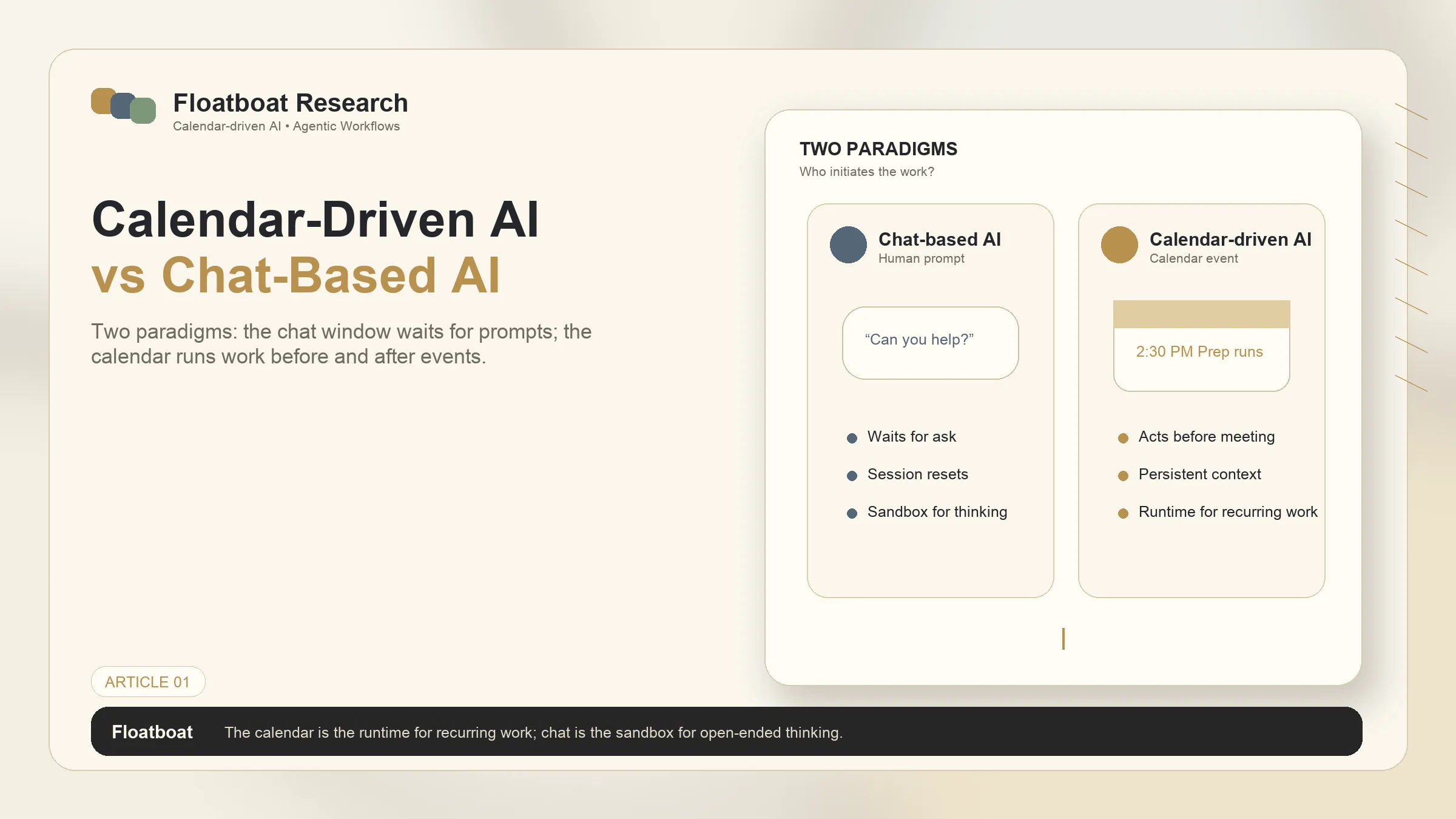
Calendar-driven AI and chat-based AI are not rival model categories. They are two ways to start and scope work. Chat begins when a person asks. Calendar-driven work begins when a dated event, deadline, or recurring schedule becomes eligible to run.
That difference changes what context is available, when approval is possible, and how failure appears. Chat is better for ambiguous exploration and exceptions. A calendar trigger is better for repeatable work whose timing is part of the specification. Most mature workflows use both.
Information checked October 13, 2026. Scheduled-task and connector availability varies by product, plan, region, and administrator policy. Verify current controls before automating consequential work.
The shortest useful comparison
| Decision | Chat-based AI | Calendar-driven AI |
|---|---|---|
| Start condition | A person sends a request | Time, event, or recurrence reaches a rule |
| Best input | An evolving question | A stable job with known timing |
| Context | Supplied during conversation or retrieved on demand | Predefined from the event and connected sources |
| Human role | Directs while work unfolds | Designs the rule and reviews exceptions or output |
| Common failure | Forgotten prompt or incomplete instructions | Wrong trigger, stale context, silent repeat failure |
| Best use | Analysis, drafting, diagnosis, one-off decisions | Briefings, reminders, recurring reports, timed preparation |
Neither column guarantees autonomy. A scheduled reminder can be calendar-driven but not agentic; a chat agent can execute a long task with tools. The comparison is about initiation and recurrence, not intelligence.
Chat is a conversation contract
Chat is strongest when the user does not yet know the final task. They can add evidence, challenge an assumption, narrow the audience, or stop when the direction changes. This makes it suitable for strategy, diagnosis, sensitive judgment, and novel work.
The contract is explicit: no message, no task. That is also the weakness. Repetitive work depends on someone remembering the correct prompt at the correct time. Conversation history may help, but it does not by itself define a reliable schedule, source policy, or escalation route.
Use chat when:
- the problem is genuinely new;
- the instructions will change during the run;
- a human must inspect each intermediate step;
- timing is flexible;
- failure is obvious because the user is present.
Calendar-driven AI is a timing contract
A calendar-driven workflow treats time as part of the input. An event can supply start time, attendees, description, recurrence, attachments, and an expected preparation window. A rule then determines whether to retrieve context, draft an artifact, ask for clarification, or do nothing.
This pattern is broader than one product. Anthropic documents recurring Cowork tasks that can use connected tools, skills, and plugins. OpenAI supports scheduled tasks and connected-app events for eligible users. Microsoft and Google attach meeting context and artifacts to calendar experiences. These implementations differ, but they establish the same design fact: a task can begin from state change or time, not only a fresh prompt.
See Anthropic's scheduled-task documentation and OpenAI's connected-app guidance for current boundaries.
Use a calendar trigger when:
- the job repeats on a known cadence;
- the time window changes what “relevant” means;
- the required sources and output format are stable;
- late or missing output can be detected;
- an owner exists for exceptions.
Same job, different behavior: preparing for a client meeting
In chat, the user asks, “Prepare me for tomorrow's Acme call.” The AI must identify the event, ask which sources are allowed, retrieve recent history, and draft the brief. The user can redirect it immediately. If nobody asks, nothing happens.
In a calendar-driven flow, a rule detects an eligible external meeting two hours before start. It retrieves only approved sources, drafts a brief, and notifies the attendee. If the event lacks an agenda or has inaccessible files, it opens an exception instead of generating filler. The user reviews the artifact rather than remembering the task.
The detailed retrieval and evidence pipeline is described in AI meeting preparation. The calendar version is not automatically better: it has more opportunities to run at the wrong time or on the wrong event.
The hidden design work in a calendar trigger
Scheduling a prompt is easy. Operating a timed workflow requires answers to six questions:
- Eligibility: which events should trigger, and which must never trigger?
- Lead time: how long before or after the event should work begin?
- Context window: how recent must email, files, tasks, or records be?
- Permission identity: whose access controls govern retrieval and actions?
- Approval: may the system only draft, or can it send and update records?
- Recovery: what happens after a missed run, changed event, or unavailable source?
Without those rules, “proactive AI” is simply an unattended prompt. For a definition of the broader category, see what an agentic calendar is.
Failure modes are different
Chat failures are usually local: a bad answer appears in front of the user, who corrects it. Scheduled failures can compound. A stale template may run every Monday; a duplicated event may trigger twice; a timezone change may move execution; a revoked connector may quietly empty the source set.
Every calendar-driven workflow needs observability:
- next scheduled run and last completed run;
- sources accessed and permissions used;
- artifact version and approval status;
- reason a run was skipped or failed;
- retry and escalation policy;
- an immediate pause control.
These are operational requirements, not interface polish.
Cost follows frequency, not just model choice
A chat task consumes resources when someone invokes it. A recurring task consumes resources whenever its rule fires, including low-value runs. Estimate monthly cost as eligible events multiplied by retrieval, model, tool, and review cost per run. Then subtract avoided manual preparation time—but only for outputs people actually use.
Measure cancellation rate, ignored artifacts, false triggers, review time, and useful decisions supported. If half the briefs are never opened, the solution is usually a narrower trigger rather than a cheaper model.
Use both in one workflow
The strongest design is often calendar-to-chat:
- the event triggers a bounded draft;
- the system exposes sources and gaps;
- the user opens a conversation to question or revise it;
- consequential actions wait for approval;
- confirmed results return to the project or next event.
This combines reliable timing with human direction. It also gives ambiguous cases somewhere to go instead of forcing the scheduled path to improvise.
For a concrete example of time-driven preparation and follow-through, see what happens when a calendar can run itself.
Bottom line
Choose chat when the task is novel, conversational, or judgment-heavy. Choose a calendar trigger when timing is part of a repeatable specification and failure can be monitored. Combine them when recurring work still needs human interpretation.
The important question is not “proactive or reactive?” It is: what starts the job, what evidence may it use, who reviews the result, and how will a failed run become visible?
Related posts
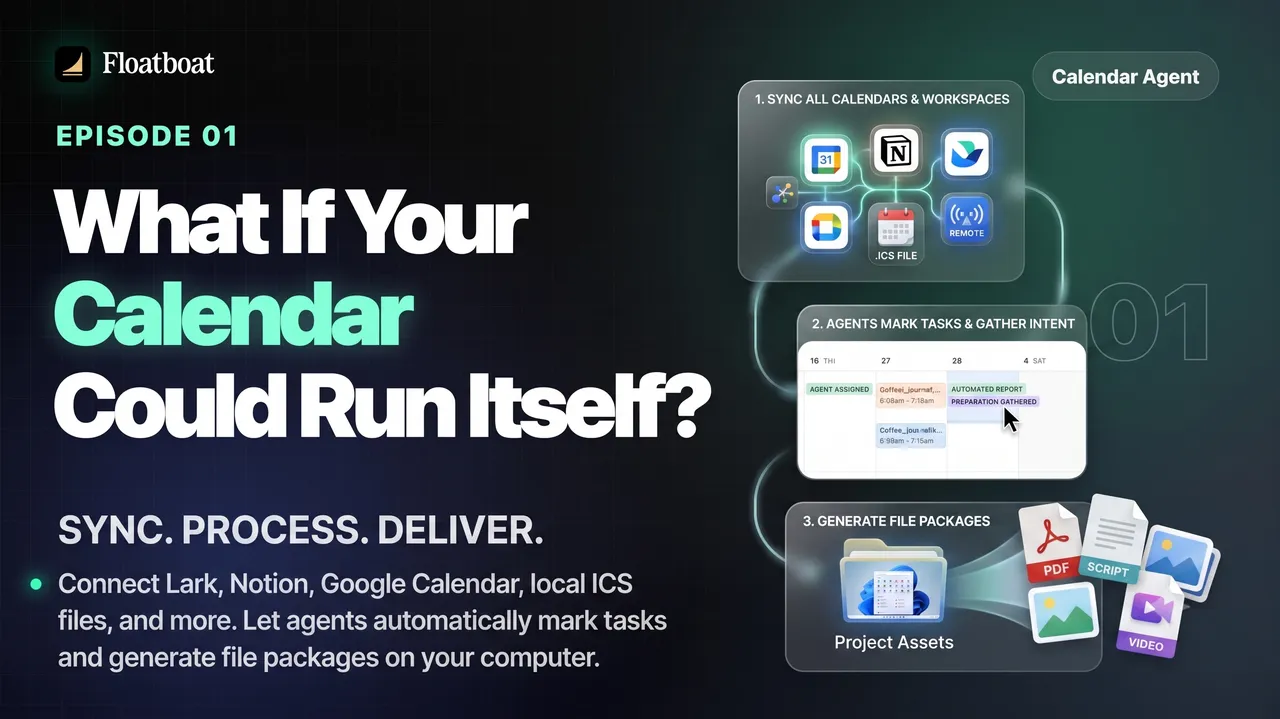
What If Your Calendar Could Run Itself? Calendar-Driven AI
Explore calendar-driven AI as a design pattern: events trigger reviewable preparation or follow-up workflows, with explicit permissions,…

Where Was the World Cup 2026 Held? All 16 Host Cities
The 2026 FIFA World Cup was held across 16 host markets in Canada, Mexico, and the United States. See every city and stadium, the country…

World Cup 2026 Bracket: Complete Knockout Results and Final Path
The completed 2026 World Cup bracket from the Round of 32 to the final: every knockout result, Spain's title path, bracket rules, and…
https://floatboat.ai/blog/calendar-driven-ai-vs-chat-ai