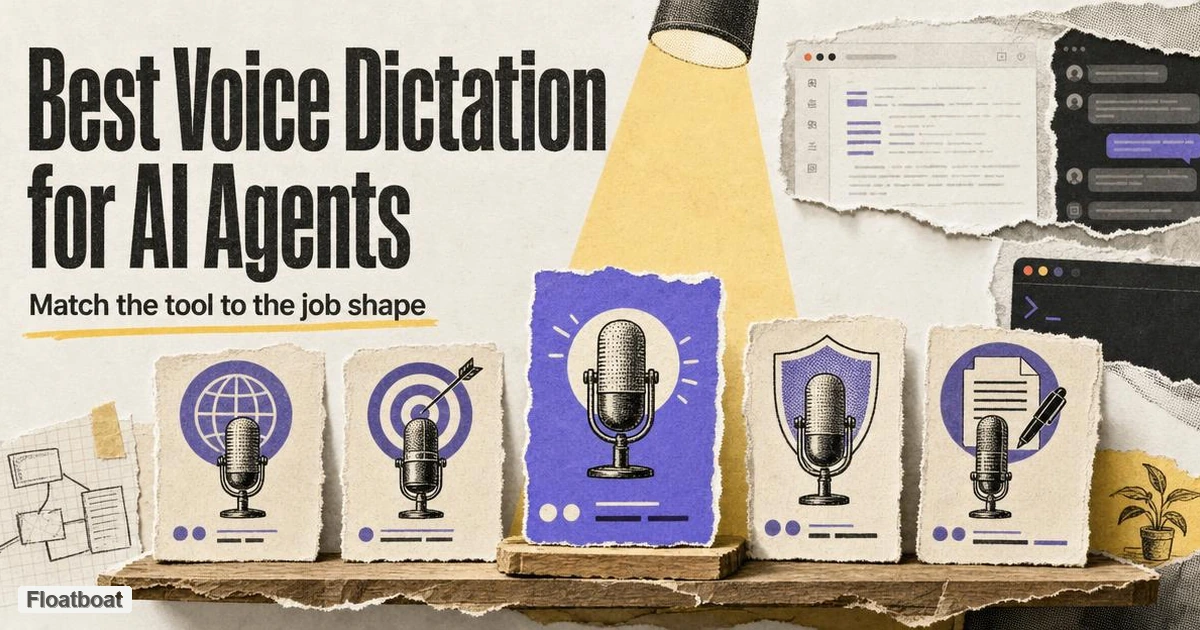
Best Voice Dictation for AI Agents — Ranked by Job Shape
Best voice dictation for AI agents, ranked by job shape — Wispr Flow, Aqua Voice, Superwhisper, built-in agent voice, and Flow Mode.
1. Why People Search for Voice Dictation for AI Agents
If you have spent an afternoon "vibe coding" — narrating a refactor into Cursor, approving a diff, dictating a follow-up into Slack, then opening Claude Code in the terminal — you already know why this category exploded in 2026. Typing long, context-rich prompts into agentic tools is slow. Holding a key and talking is faster. The bottleneck moved from "can speech-to-text work?" to "which layer actually fits an agent workflow?"
Most SERP results still treat dictation as a single category: install an app, speak, text appears. That framing breaks the moment you work with AI agents rather than plain text fields. Agents expect structured prompts, file references, technical vocabulary, and rapid iteration across surfaces. A microphone inside one IDE panel does not help when your next action is a terminal command, a GitHub PR description, or a client email. Conversely, a polished system-wide dictation tool may be excellent at inserting prompts but weak at co-editing a long memo with an Agent inside one document.
The search intent behind best voice dictation for AI agents is therefore practical and fragmented. Developers want accuracy on camelCase and framework names. Solo founders want one shortcut that follows them across tools. Privacy-conscious teams want audio that never leaves the laptop. Power users of Claude Code or Cursor want to know whether built-in voice is enough. Document-heavy operators — consultants, founders drafting launch copy, operators turning meeting talk into plans — need dictation that stays inside the file, not only at the cursor in a chat box.
This article answers that search with a job-shape taxonomy and a ranked listing. We cover five named products plus two built-in agent voice modes as reference rows. We do not declare a universal champion; we map tools to the work shape they actually solve, acknowledge tradeoffs, and point to complementary options when your week spans more than one shape.
2. How This Ranking Works (Job Shape, Not Keywords)
Rankings that sort purely by "accuracy" or "price" mislead agent users. Accuracy on a Gmail sentence is not the same as accuracy on a Supabase schema description. Privacy requirements differ between a solo MacBook and a regulated team. Built-in agent voice can be the right default until you alt-tab out of the host app — at which point a system layer wins without contest.
We rank by job shape: the recurring unit of work you are trying to accelerate. Each shape has a primary fit, at least one honest limitation, and often a complementary second tool. The ranked section covers the three system-wide layers that most agent users evaluate first. Reference rows cover in-agent built-ins and document-centric Flow Mode, because those are frequently compared but solve narrower perimeters.
2.1 Job-shape taxonomy
The table below is the lens for the rest of this article. Use it before reading product blurbs — it prevents buying the wrong tier of tool for your actual week.
| Job shape | What you are doing | Primary fit | Common misfit |
|---|---|---|---|
| Cross-app prompt dictation | Same push-to-talk shortcut in Cursor, Claude Code, terminal, Slack, Gmail, Notion | System-wide layer (Wispr Flow) | Built-in IDE mic that stops at the app border |
| Technical / AI-prompt accuracy | Dictating code symbols, CLI flags, framework names, long agent prompts | Cloud specialist model (Aqua Voice) | General on-device Whisper without custom dictionary |
| On-device privacy & offline | Air-gapped, local-only, or HIPAA-sensitive environments | On-device hybrid (Superwhisper) | Cloud-only dictation with no offline fallback |
| In-agent terminal dictation | Push-to-talk only inside Claude Code CLI or extension | Claude Code /voice (reference) | Expecting the same mic in Cursor or SSH sessions |
| In-IDE agent control | Voice input to Cursor Agent / Composer panel only | Cursor Agent voice (reference) | Dictating into terminal, inline edit, or other panels |
| Document-centric co-authoring | Long draft + in-place Agent edits + meeting-to-plan inside one file | Floatboat Flow Mode (complementary) | System dictation that treats each insertion as isolated text |
Two clarifications belong upfront. First, voice mode (agent listens and responds in a conversational loop) is not the same as dictation (speech becomes text in an input field). That distinction matters when comparing Claude Code /voice to tools like Wispr Flow; we treat it in depth in voice mode vs dictation for AI agents. Second, several products overlap — Aqua and Wispr both work system-wide; Superwhisper also reads screen context. The ranking reflects which job shape each product optimizes first, not whether it can occasionally do another job.
3. The Best Voice Dictation for AI Agents, Ranked
The three ranked entries below are system-wide or specialist dictation layers — the tools readers most often mean when they search for voice input that follows an agent workflow across apps. Built-in agent voice and document-centric Flow Mode appear afterward as reference and complementary rows, not as ranked substitutes for cross-app input.
1. Wispr Flow — Best for cross-app prompt dictation
Wispr Flow is the default answer when your agent workflow is defined by context switching, not by a single IDE. Flow installs as a system-wide voice layer on Mac, Windows, iPhone, and Android. Hold a shortcut, speak, release — polished text lands wherever the cursor lives: Cursor's Agent panel, a Claude Code prompt, a terminal, Slack, Gmail, or a browser tab. That universality is the product's core strength, and it is why Flow appears in so many "vibe coding" setups alongside Cursor even when the IDE ships its own microphone.
Flow's second strength is AI-polished output, not raw transcript. Filler words, false starts, and mid-sentence corrections are cleaned as you speak — "5 pm, no actually 6 pm" becomes "6 pm." For agent prompts, that cleanup matters: you spend less time editing before you hit Enter. Flow also learns personal vocabulary, supports voice shortcuts for repeated blocks (stand-up templates, scheduling links, bug-report skeletons), and advertises developer-oriented features such as syntax-aware formatting and file tagging in Cursor and Windsurf on its developer page. Cross-device sync keeps dictionary terms consistent when you move from desktop to phone.
Flow is not the best fit when offline or on-device processing is mandatory — audio is processed in the cloud. Teams with strict data residency may prefer Superwhisper or an enterprise tier elsewhere. Flow also optimizes for insertion at the cursor, not for long-form co-authoring inside one persistent document with bundled Agent annotations; if your bottleneck is a 3,000-word memo with mid-stream rewrites, a document-centric layer (see Flow Mode in §4) may serve you better than treating Flow as the entire writing stack. Pricing is subscription-based (as of mid-2026, commonly cited around $15/month on competitor comparison pages); verify on Wispr's site before purchase.
Best for: Solo founders and developers whose agent sessions jump across Cursor, Claude Code, chat tools, email, and messaging — one shortcut, every surface.
Skip if: You require fully offline transcription, or your work stays inside a single long document where Agent collaboration on selections matters more than cross-app paste-in.
2. Aqua Voice — Best for technical vocabulary and AI prompts
Aqua Voice targets a narrower but harder problem: technical speech into AI tools. Its proprietary Avalon model runs in the cloud with real-time streaming and screen-context awareness — the app reads the active window so dictation in an editor behaves differently from dictation in Messages. Aqua publishes benchmark claims on coding and AI terminology (including AISpeak-style technical-term suites) and ships a large custom dictionary on Pro plans (up to 800 entries) for project-specific names.
For agent users, Aqua's sweet spot is the prompt box in Cursor, Claude Code, ChatGPT, or Gemini when prompts are dense with API names, framework jargon, and multi-step instructions. Push-to-talk works at the OS layer on Mac, Windows, and iOS, similar in motion to Wispr, but the accuracy investment is tilted toward developer vocabulary rather than general cross-platform polish. At roughly $8/month for Pro (as of August 2026), Aqua undercuts several generalist competitors on price — with the tradeoff that architecture is cloud-only with no on-device fallback.
Aqua is not the default when privacy policy is your first filter. Audio is processed on Aqua's servers; privacy modes and enterprise attestations exist, but the product is not an offline Whisper install. Nor is Aqua built for document lifecycle inside one Agent workspace — it excels at getting the right characters into the active field, not at batch annotation bundles or version diff inside Floatboat. If your week is mostly terminal-only Claude Code with /voice already enabled, Aqua's incremental value shrinks until you leave that perimeter.
Best for: Developers and AI-heavy operators who dictate long, technical prompts and want a specialist model tuned for code and agent vocabulary.
Skip if: You need offline/on-device processing, or you want one tool that also covers mobile messaging polish and 100+ languages as the primary buying criterion.
3. Superwhisper — Best for on-device privacy and offline dictation
Superwhisper wins the job shape where audio must not leave the machine — or where offline flights and spotty Wi-Fi cannot interrupt an agent session. Superwhisper runs Whisper-class models on-device on macOS, Windows, and iOS, with optional cloud LLM post-processing modes when you choose them. Super Mode reads on-screen context similarly to Aqua's screen awareness, and the product ships dedicated AI modes (email, message, coding, custom system prompts) that format output after transcription.
In agent workflows, Superwhisper is the tool teams pick when compliance, air-gapped environments, or personal privacy preference outweigh marginal accuracy gains from a proprietary cloud model. It works system-wide — Cursor, Claude Code, terminals, browsers — and offers a lifetime license tier (often cited around $249.99) that appeals to developers avoiding another subscription. The Superwhisper vs Aqua comparison pages fairly note Superwhisper's broader offline story and 100+ language coverage via on-device models, at the cost of accuracy and speed depending on local hardware.
Superwhisper is not automatically the accuracy leader on niche developer terms compared to Avalon's published coding benchmarks — on-device general models plus your dictionary do the lifting. Latency can vary by machine. Enterprise features (SSO, HIPAA, SOC 2) exist, but buyers should validate current attestations against their own security review. And like Wispr and Aqua, Superwhisper inserts text at the cursor; it does not replace a document-first Agent workspace for live meeting plans or selection-based rewrite bundles.
Best for: Mac and Windows power users who dictate into agent tools but require on-device audio processing, offline use, or flexible post-transcription AI modes.
Skip if: You prioritize cloud-streaming latency and published technical-term benchmarks over local privacy, or you need the simplest cross-mobile onboarding with minimal setup.
Ranked listing — quick reference
| Rank | Product | Best for (job shape) | Architecture | Agent surfaces | Limitation to know |
|---|---|---|---|---|---|
| 1 | Wispr Flow | Cross-app prompt dictation | Cloud | Any text field system-wide | Cloud-only; not document co-authoring |
| 2 | Aqua Voice | Technical / AI-prompt accuracy | Cloud (Avalon) | Any text field system-wide | Cloud-only; narrower language/mobile story vs Wispr |
| 3 | Superwhisper | On-device privacy & offline | On-device + optional cloud modes | Any text field system-wide | Accuracy/speed hardware-dependent |
| — | Claude Code /voice | In-agent terminal dictation | Cloud (Anthropic) | Claude Code CLI & VS Code extension only | Perimeter stops at Claude Code |
| — | Cursor Agent voice | In-IDE agent control | Built into Cursor | Cursor Agent / Agents Window | Not system-wide; panel-scoped |
| — | Floatboat Flow Mode | Document-centric co-authoring | Floatboat workspace | Long-form docs + Agent inside Floatboat | Not system-wide dictation |
4. Complementary Tools (Not Ranked Substitutes)
The reference rows above are frequently bundled with the ranked three. Treat them as complementary, not as failures — each solves a perimeter the others intentionally ignore.
Claude Code /voice (documented in Anthropic's Claude Code voice dictation docs) is the fastest on-ramp if Claude Code is your only agent surface. Run /voice, hold Space (or your rebound key), speak, release — the transcript lands in the CLI or extension prompt. Claude Code feeds project and git-branch names as recognition hints, supports hold and tap modes, and works in agent view for background sessions. The limitation is structural: the microphone exists inside Claude Code. Switch to Cursor's composer, a plain terminal tab, GitHub, or Gmail, and you are back to typing or to a system layer like Wispr or Aqua. Built-in voice also assumes Claude.ai-account flows where documented; API-key or Bedrock deployments may not offer the same path — another reason system-wide tools persist.
Cursor Agent voice arrived with Cursor 2.0 and tightened in later releases (hold-to-talk shortcuts such as Ctrl+M in recent changelogs, batch STT for longer utterances). It is purpose-built for controlling Cursor Agent from the Agents Window — reasonable latency for paragraph-scale prompts, weaker for rapid-fire iterative dictation compared to dedicated dictation apps in early-2026 user reports. Cursor's voice does not generalize to inline edit, arbitrary terminal tabs, or non-Agent chat surfaces. If Cursor Agent is 90% of your voice input, the built-in mic is fine; if your session is multi-app, pair it with a ranked system layer rather than forcing every utterance through one panel.
Floatboat Flow Mode belongs in a different job shape entirely: document-centric co-authoring inside the Floatboat workspace. Flow Mode keeps real-time dictation, manual edits, selection-based Agent rewrites, batch voice annotations, live meeting-to-plan output, and version diff in one document — the pattern described in the Flow Mode product announcement. It complements Wispr or Aqua rather than replacing them; many users will keep system-wide dictation for Slack and email while using Flow Mode for launch memos, client briefs, and calendar-linked Agent workspaces. Flow Mode is not ranked in the top three because it does not aim to be universal OS-level dictation — and that is a feature, not a gap, for its target shape.
5. How to Choose From This Ranking
Start by logging one representative agent hour. Count how many distinct apps receive voice-eligible input. If the number is three or more, default to a ranked system layer (Wispr for breadth, Aqua for technical density, Superwhisper for on-device). If the number is one — Claude Code terminal all day — try /voice first before paying for overlap you will not use.
Second, separate dictation from voice mode. Dictation turns speech into text you still submit; voice mode implies a conversational loop with the agent. Mixing the terms leads to buying Cursor's Agent mic when you actually needed cross-app prompt insertion, or installing Wispr when you needed in-document annotation bundles. Our voice mode vs dictation for AI agents guide (§2.1) walks through that boundary with examples.
Third, stack tools intentionally. A common productive stack in mid-2026: Aqua or Wispr for prompts across Cursor and Claude Code, /voice when you are deep in terminal-only Claude sessions, and Flow Mode when the deliverable is a long doc tied to calendar-driven prep and follow-up. Paying twice is rational when the job shapes differ; paying twice for the same shape is not.
Fourth, verify privacy and auth against your deployment. Cloud dictation (Wispr, Aqua, Claude /voice, Cursor voice) sends audio to vendor infrastructure — acceptable for many solo founders, unacceptable for some regulated teams. Superwhisper's on-device path exists for that fork. Claude Code built-in voice may not appear on every auth path; system layers sidestep some of those gaps by sitting at the OS input layer.
6. What's Next for Voice Input and AI Agents
The category is converging from two directions. Agent hosts — Claude Code, Cursor, Codex — are shipping native microphones because prompt length exceeded comfortable typing. Dictation vendors — Wispr, Aqua, Superwhisper — are marketing explicitly into agent workflows with developer pages, Cursor integrations, and benchmark wars on coding vocabulary. The likely steady state is layered: built-in voice for quick paths inside one app, system-wide dictation for multi-surface days, document-centric modes for long-form co-authoring.
Watch three signals through late 2026. First, whether built-in agent voice expands beyond single panels to true system integration — most vendors have incentives not to. Second, whether cloud specialist models (Avalon-class) publish independent benchmarks beyond vendor-owned suites — buyers should demand reproducible tests on their vocabulary. Third, whether proactive Agent OS workspaces absorb dictation as one input among calendar-triggered prep and follow-up — the direction Floatboat Flow Mode signals by linking voice to event-scoped workspaces rather than isolated chat threads.
If you are new to the category, read the hub on what is voice dictation for AI agents (linked in the TL;DR) for definitions and workflow vocabulary before committing to a stack.
Conclusion
Best voice dictation for AI agents is a job-shape decision, not a trophy. Wispr Flow leads for cross-app prompt dictation when your cursor moves faster than your shortcuts can stay siloed. Aqua Voice leads when technical terms and long agent prompts dominate. Superwhisper leads when on-device privacy and offline use are non-negotiable. Claude Code /voice and Cursor Agent voice are excellent reference options inside their perimeters. Floatboat Flow Mode complements the stack when the artifact is a living document inside an Agent workspace — not a chat insertion.
Buy for the week you actually have, stack complementary tools without guilt, and re-evaluate when your agent host ships its next microphone — the shortcut landscape changes quarterly, but job shapes remain stable longer.
https://floatboat.ai/blog/best-voice-dictation-for-ai-agents