
Voice Agent vs Voice Dictation for Work — Pick the Right Layer
Voice agents execute work from speech; voice dictation turns speech into text. A solopreneur guide for exploration, prompts, co-authoring, and meetings.
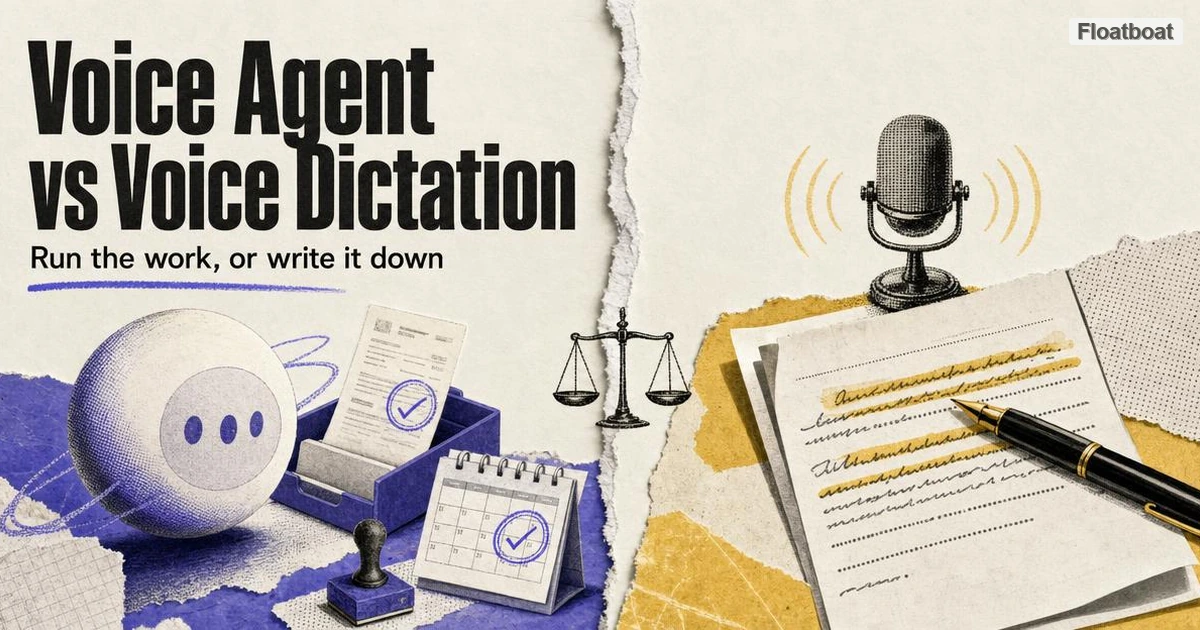
1. Why the Speech Layer Choice Matters for Solo Founders
If you run a company of one, speech shows up everywhere: dictating a launch memo while pacing, asking a model to research a niche mid-walk, annotating a contract between client calls, or trying to leave a meeting with owners on the action items—not a transcript to process on Friday. Each moment looks like "talk to AI," but the job shapes are different. One moment needs accurate text in a doc you control. Another needs the system to do something after it understands you.
The market vocabulary makes this harder. Vendors use "voice AI," "agentic dictation," "voice mode," and "voice agent" interchangeably in ads. Some products blur the boundary on purpose—a dictation app adds a command mode; a phone agent adds a summarize button. That is fine product design, but it is a bad mental model for buyers. When you conflate a voice agent with voice dictation, you either buy agency where you needed typing speed, or buy transcription where you needed tool execution.
The cost is not only subscription dollars. It is context switching and the hidden tax of rebuilding momentum after every wrong-layer misfire. A founder who pastes every spoken paragraph into chat for rewriting loses the document thread. A founder who expects a dictation tool to book meetings or reconcile invoices waits on a capability that was never in scope. The fix is not "pick the best voice app." It is pick the right speech layer for the job shape, then stack tools where they complement rather than substitute.
This guide stays at the work layer—not telephony IVR, not smart-speaker trivia. It assumes you already use AI for writing, research, and operations, and you want a clear rule for when speech should become text you own versus actions the system runs.
2. Two Speech Layers Defined (and What Each Is Not)
Category boundaries matter as much as definitions. The sections below treat voice dictation and voice agents as adjacent but not interchangeable layers in a solo founder's stack.
2.1 Voice Dictation Defined
Voice dictation for work is the practice—and the tooling—of converting spoken language into text inside a working surface: a doc, an email compose window, a code comment, a chat prompt box. Modern AI voice dictation adds a post-transcription reasoning step: filler removal, self-correction resolution, light formatting for the active field, and domain vocabulary. The canonical stack is microphone → automatic speech recognition (ASR) → optional language-model polish → text at the cursor.
The defining property is text as the primary deliverable. You remain the author. The system may clean delivery; it should not invent the argument unless you explicitly escalate to a separate agent step. Tools in this family—system-wide dictation like Wispr Flow, Superwhisper, or Aqua Voice—optimize latency and accuracy for getting words onto the page. For a deeper technology breakdown of dictation inside agent workspaces, see what is voice dictation for AI agents—the canonical definition for this layer in agent-backed workspaces.
Voice dictation is not a voice agent just because an LLM polishes the transcript. That polish step is still oriented toward your words, cleaned—what some vendors call "agentic dictation." It is a meaningful upgrade over raw ASR, but it does not, by itself, imply multi-step tool use, persistent task state, or autonomous follow-through across apps.
2.2 Voice Agent Defined
A voice agent is a system that conducts a spoken intent-to-action loop: capture audio, interpret goal and constraints, decide next steps, invoke tools or APIs, speak or display a result, and continue until the task closes or escalates. The canonical stack adds orchestration—turn-taking, barge-in, latency budgets, memory, permissions—on top of ASR and synthesis. Phone support bots, desktop "do this on my machine" agents, and multimodal voice mode experiences that browse, file, and schedule from speech all sit here.
The defining property is agency: speech triggers work, not only characters. A voice agent might read your selected screen region, draft a structured bug report, write a file, and confirm completion—actions that never required you to manually paste text between apps. For the full category definition and architecture, see what is a voice agent.
A voice agent is not a dictation shortcut. Even when the agent returns prose, the success criterion is usually task completion (ticket filed, meeting rescheduled, lead qualified), not WPM. Conflating the two leads to wrong expectations about latency, privacy, and edit control.
2.3 What Neither Layer Is
Neither layer replaces async chat as a planning surface. Typed prompts still win when structure is fragile or you need to stare at diffs. Neither layer is meeting recording alone: transcription captures what was said; dictation and agents differ in who consumes the output and what happens next. Finally, "voice mode" in a general assistant is a UI channel—it may behave like dictation, like an agent, or like a hybrid depending on settings; the product label is not the taxonomy. Voice mode vs dictation for AI agents unpacks that channel-level confusion without collapsing categories.
3. How Each Layer Works in Practice
Understanding the pipelines clarifies why the same spoken sentence produces different outcomes—and why stacking both layers is common for founders.
3.1 The Dictation Pipeline: Speech to Owned Text
Dictation begins at the cursor. ASR streams phonemes to tokens; a polish model may remove disfluencies and apply field-aware formatting (Markdown headings in a doc, plain sentences in Slack). Latency targets are aggressive because the user is mid-thought: stalls break flow worse than an occasional misheard word.
The human stays in the edit loop. You pause, delete a clause, select a paragraph for a separate rewrite pass, or ignore the model's formatting guess. Document-centric dictation—where speech, manual edits, and agent-assisted rewrites share one file—extends this pipeline without changing the core deliverable: text you can diff, version, and ship. That job shape is why dictation remains the right layer for long-form co-authoring even when agents get stronger.
Failure modes are about fidelity and placement: wrong homophone, wrong app context, over-eager polish that softens a technical term you meant literally. Mitigations are local—retrain vocabulary, switch models, edit inline—not orchestration overhauls.
3.2 The Voice Agent Pipeline: Speech to State Change
Voice agents optimize a different curve: round-trip time for understanding plus action. Spoken input enters a planner that may call search, calendar, filesystem, or CRM tools; responses must feel conversational when spoken, which imposes sub-second budgets on each turn. Echo cancellation, endpoint detection, and interruption handling matter here in ways dictation apps can ignore.
The human often exits the loop earlier. You describe intent; the agent negotiates missing slots ("Which timezone?"), executes, and reports. Success is measured by correct side effects and safe escalation when confidence drops—not by whether you would have typed the same paragraph yourself.
Failure modes are about permissions and scope: an agent books the wrong slot, deletes the wrong file, or confidently hallucinates a tool result. Mitigations are governance—scoped credentials, confirmation gates, idempotent actions, human handoff—not faster ASR.
3.3 Where the Pipelines Overlap (Without Merging)
Products increasingly expose both pipelines behind one microphone button. A long-press might dictation-fill a note; a command phrase might trigger agent mode. That overlap is useful, but the taxonomy still holds: ask what the primary success artifact is. If it is text at your cursor, you are in dictation territory even if an agent later acts on that text in a second step. If it is completed work with minimal paste-back, you are in agent territory even if the side effect is generating a document file.
4. A Scenario Matrix for Solopreneur Work
The following matrix is the article's decision core: four job shapes solo founders repeat, the layer that fits first, and the common mistake when the wrong layer is forced.
| Work scenario | Primary job | Best-first layer | Typical misfire |
|---|---|---|---|
| Hands-free exploration | Turn curiosity into structured notes, links, or outlines while away from keyboard | Voice agent (or voice mode with tool access) | Raw dictation into Notes with no retrieval or synthesis—you get fragments, not exploration |
| Precise prompts | Deliver tight instructions to a model—constraints, JSON shape, negative examples | Voice dictation into the prompt field, then edit | Full agent autonomy on a fragile prompt—you lose reproducibility and diff clarity |
| Document co-authoring | Produce shippable prose in a file you version and own | Document-centric AI voice dictation | Chat-only voice that never lands in the doc—you rebuild structure by paste |
| Meetings | Capture decisions, assign owners, emit a plan before the call ends | Hybrid: live capture + dictation-style editing in the working doc; agent for structured extraction | Post-call transcript bots alone—searchable, but late for in-room alignment |
Each row deserves a paragraph of nuance because real weeks blend scenarios.
Hands-free exploration favors agency because the output format is not known upfront. You might ask for competitor pricing patterns, a comparison table, or a rough roadmap—then want follow-up questions without returning to the keyboard. A voice agent (or a voice channel wired to tools) preserves conversation + action. Dictation alone leaves you with monologue text unless you manually prompt a model afterward.
Precise prompts favor dictation because the artifact is the prompt string. Founders tuning agent instructions, eval rubrics, or API payloads need byte-level control after speech. Speaking the prompt is faster than typing; letting an agent paraphrase your prompt before submission destroys the reproducibility that makes agent workflows debuggable. Speak, inspect, edit, send—dictation is the honest layer.
Document co-authoring is where dictation earns its keep. Launch memos, investor updates, and policy drafts are long-horizon text with mid-stream structural edits. System-wide dictation helps, but document-centric paths—where transcription, manual tweaks, and selective agent rewrites share one surface—reduce the paste loop that kills momentum. This is the job shape best voice dictation for AI agents rankings evaluate: not "best talker," but best text ownership path for agent-backed writing.
Meetings punish wrong-layer thinking most visibly. Pure dictation during a call produces awkward monologue overlap; pure phone-agent patterns ignore that founders often need a working plan in the doc while dialogue continues. The workable pattern is capture plus in-doc editing: treat utterances as lines you can revise, then optionally agent-extract checklists with owners. Dedicated note-takers like Otter still excel at search and post-call libraries; the gap for operators is during-call deliverables, not another transcript archive.
5. Choosing and Stacking Layers Without Conflation
Once scenarios are mapped, selection becomes a stacking problem rather than a winner-take-all product hunt.
5.1 Start From the Success Artifact
Ask one question before touching the microphone: When this moment ends, what file or system state proves success? If the answer is "a paragraph I sign off on," start with dictation. If the answer is "a calendar hold plus a CRM note," start with an agent. If both—"a client-ready email sent"—plan two steps: dictation to draft, agent or automation to send after explicit approval. The mistake is expecting one button to infer which outcome you meant.
5.2 Latency, Privacy, and Control Tradeoffs
Dictation tolerates slightly higher word error if edit friction is low; agents tolerate slightly slower turns if actions are trustworthy. Privacy differs too: dictation may stay local or pass through a cloud ASR provider; agents often need broader permissions to act. Solo founders should match permission scope to layer—do not grant filesystem agents to solve a typing problem.
5.3 When to Run Both Layers Deliberately
Many practitioners run dictation for composition and agents for execution—complementary, not competitive, as Cue's comparison argues for fragmented desktop days. Monday's memo is dictated; Monday's calendar triage is agent-driven. The stack works when boundaries stay explicit in your head and in your tooling defaults.
5.4 Document-Centric Dictation as a Middle Path
Some workflows need more than system-wide typing but less than full autonomy: long documents with batch voice annotations, selection-based rewrites, and version diff. That is still dictation-class—text remains central—even when an agent collaborates inside the file. Floatboat Flow Mode is positioned in this middle path: AI voice dictation inside a persistent document workspace, with edit-while-you-speak, bundled voice annotations, and live meeting lines that become checklists—without reframing the product as a phone agent. If your week is memo-heavy and meeting-dense, pair that document layer with whichever agent handles calendar-side execution; do not expect either to substitute for the other.
6. Market Direction: Convergence in Products, Separation in Design
As of mid-2026, vendors will keep marketing convergence—one mic, many modes—while architects still separate ASR, planners, and tool routers internally. "Agentic dictation" will grow as polish models improve, but polish is not agency. Enterprise voice agents will keep focusing on bounded, tool-backed workflows with explicit escalation, while solo operators mix consumer dictation with desktop agents.
For founders, the durable skill is layer literacy: recognizing which speech interface you are invoking, which success artifact you need, and where handoff to typed chat or calendar-driven automation still wins. Taxonomy articles age slowly; SKU lists age quickly—anchor on job shapes, not badge names.
7. Conclusion
Voice agent vs voice dictation for work is not a product rivalry—it is a layer choice. Dictation wins when owned text is the deliverable: prompts, paragraphs, in-meeting lines you will edit live. Voice agents win when speech should trigger multi-step work across tools with minimal paste-back. Meetings and co-authoring often need a hybrid, but hybrid means sequenced layers, not a single blurred category.
Before the next purchase or settings rabbit hole, write down yesterday's three speech moments and label each artifact: text, action, or both. That thirty-second audit beats any feature matrix. Then reach for the layer that matches—and stack the other when the job shape changes mid-week.
https://floatboat.ai/blog/voice-agent-vs-voice-dictation-for-work