
What Is a Voice Agent? Definition, Architecture, and Job Shapes
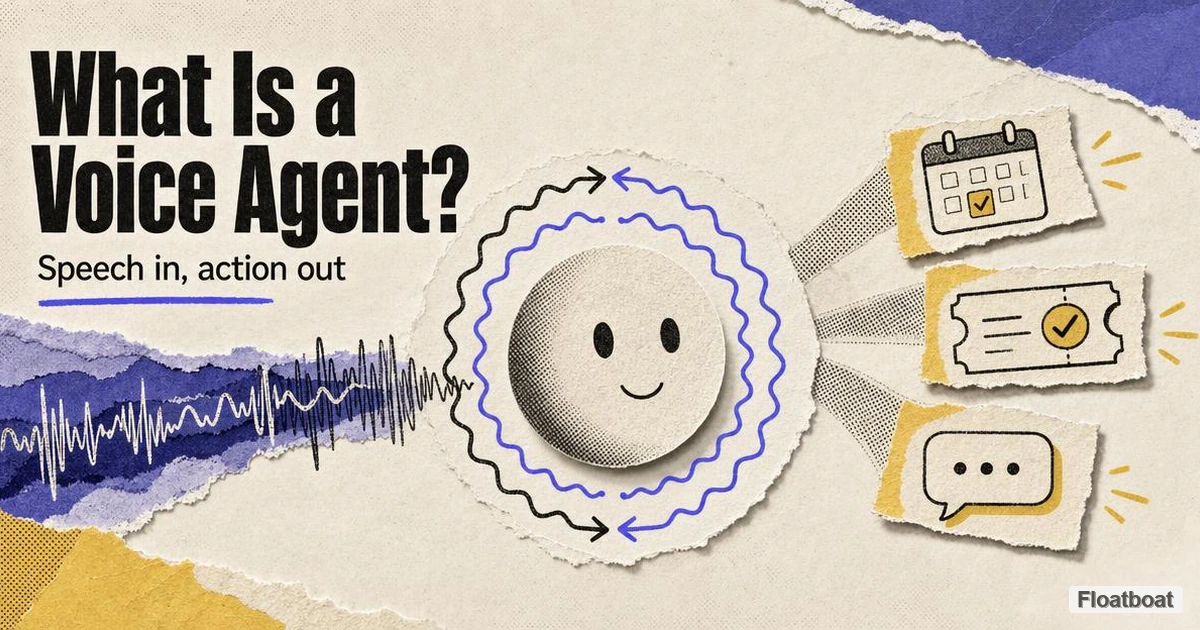
A voice agent is speech-in, speech-out AI for real-time conversation. Learn the definition, architecture, and how it differs from dictation and phone bots.
1. Why "Voice Agent" Became a Category, Not a Feature
1.1 Speech Left the Keyboard — and the Phone Tree
For a decade, "voice AI" meant one of two things in practice. Dictation software turned speech into text wherever your cursor lived — useful, fast, and deliberately dumb about meaning beyond transcription. Phone systems used speech recognition to route you to the right department — useful for enterprises, and deliberately narrow about what you could say. Neither pattern answered the question people started asking in 2024–2026: Can I talk to an AI the way I talk to a colleague, and have it think, use tools, and talk back?
That question is what created voice agents as a distinct category. The major labs shipped consumer voice modes within weeks of each other in mid-2026: OpenAI's GPT-Live on July 8, Anthropic's expanded Claude Voice Mode on July 23, xAI's Grok Voice Think Fast 2.0 on July 29, while Google's Gemini Live continued adding camera and screen context on Android and iOS. Developers got parallel surfaces — OpenAI's Realtime API with the gpt-realtime family, xAI's WebSocket voice endpoint — aimed at embedding speech-native agents into support lines, coaching apps, and in-car assistants. The products differ; the job shape is shared: audio in, reasoning, audio out, with latency low enough that conversation feels continuous.
Solopreneurs feel this shift acutely. You can rehearse a pitch on a walk, debug a decision out loud in the car, or ask follow-up questions without breaking stride — but only if the system treats speech as the primary interface, not a transcription shortcut pasted into chat. That is the bar a voice agent clears and a dictation layer does not.
1.2 The Naming Problem: Mode, Agent, Bot, API
Marketing labels blur quickly. OpenAI calls its consumer surface GPT-Live; Anthropic says voice mode; Google says Gemini Live; xAI brands Grok Voice. Engineers say speech-to-speech, realtime API, or full-duplex voice model. Searchers type what is a voice agent when they want the category definition, not a product manual.
This article uses voice agent as the umbrella term for systems where spoken conversation is the runtime — whether the agent lives inside ChatGPT, Claude, a Pixel phone, or your own app wired to a vendor API. We reserve voice dictation for AI agents for the adjacent pattern where speech feeds text into a document or desktop agent workspace, and telephony voice bot for phone-first flows built around call routing, compliance scripts, and CRM handoff. Those boundaries matter when you choose tooling: a brilliant voice agent on your phone does not automatically dictation-enable your long-form draft, and a polished phone bot is not an open-ended reasoning partner.
2. Voice Agent Defined
2.1 The Core Definition
A voice agent is an AI system designed for real-time spoken dialogue: it accepts continuous or turn-based audio input, interprets intent with a language model (often with tool or search access), and responds with synthesized speech quickly enough to sustain conversation. Unlike batch transcription, the speech channel is not an intermediate step toward a text UI — it is the UI. Unlike classic IVR, the dialogue is open-ended: the user can change topic, interrupt, ask follow-ups, and expect the model to reason rather than match a fixed script.
According to OpenAI's GPT-Live announcement, the consumer reference implementation processes input and generates output concurrently under a full-duplex architecture, making interaction decisions many times per second — whether to speak, listen, pause, or invoke a tool. Anthropic's July 2026 voice mode update emphasizes a different angle: routing spoken sessions through Opus, Sonnet, or Haiku so users can trade speed for depth mid-conversation. Google describes Gemini Live as talking with AI using just your voice, with multimodal inputs on supported devices. The implementations diverge; the contract is shared — speech in, intelligent speech out.
2.2 Five Defining Properties
Speech-native I/O. Input and output are audio streams (or their API equivalent), not typed messages with optional read-aloud. Latency budgets are measured in hundreds of milliseconds, not seconds between paste operations.
Conversational state. The agent maintains dialogue context across turns — pronouns resolve, earlier constraints persist, and follow-up questions make sense without repeating the setup. Session length can stretch to multi-minute work conversations, not single-command utterances.
Reasoning and tools. A voice agent is not a speech synthesizer wrapped around a search box. It plans, calls functions, searches, or delegates to stronger models when questions exceed what a fast voice layer handles alone — OpenAI's GPT-Live explicitly delegates deep work to GPT-5.5 in the background while keeping the voice thread alive.
Turn-taking and interruption. Production-grade voice agents support barge-in: you can cut off a bad answer, correct a misunderstanding, or redirect mid-sentence. Full-duplex systems extend that to overlapping speech; turn-based systems simulate it with stop/start boundaries. Either way, control feels bilateral.
Deployable job shapes. Consumer apps (ChatGPT voice button), mobile OS integrations (Gemini on Android), and developer APIs (Realtime API, Grok Voice WebSocket) are different packaging for the same abstract job: talk to an AI and get spoken answers that can act on your behalf.
2.3 What a Voice Agent Is Not
Boundary clarity prevents expensive mismatches — especially against two neighbors this voice cluster treats separately.
A voice agent is not voice dictation for AI agents. Dictation turns speech into editable text inside a document, form, or agent workspace; the durable artifact is writing, not a spoken thread. You might dictate a paragraph, select a sentence, and ask a desktop agent to rewrite it — but the center of gravity is the file. Our hub article on voice dictation for AI agents covers that pattern end to end. Voice agents center the conversation itself; dictation centers text capture for downstream work.
A voice agent is not a telephony voice bot in the classic sense. Phone bots optimized for contact centers prioritize deterministic flows — account lookup, payment confirmation, queue placement — with compliance scripts and explicit escalation to humans. Modern speech-to-speech APIs can power those bots, but the category default for "voice bot" still implies telephony constraints: DTMF fallbacks, carrier latency, recorded disclaimers, and narrow intent catalogs. A GPT-Live session on your phone is the opposite design point — wide intent, personal context, no PSTN leg unless you add one.
A voice agent is not text chat with text-to-speech bolted on as an afterthought. Read-aloud of typed replies misses the prosody, timing, and interruption semantics that make spoken interaction work. The best mid-2026 products train or tune audio pathways for dialogue rather than treating speech as an export format.
Finally, a voice agent is not synonymous with "any product that accepts microphone input." Meeting transcribers like Otter or Fireflies produce records of what was said; they do not generally maintain an interactive spoken reasoning loop with the user during the call. Transcription is archival; voice agency is interactive.
3. Voice Agent Architecture: From Microphone to Spoken Reply
Understanding architecture explains why two voice products with similar marketing can feel radically different in use — and why builders choose APIs instead of consumer apps.
3.1 The Speech-to-Speech Stack
At a high level, every voice agent composes four layers: capture (microphone or streamed audio frames), understanding (speech recognition or end-to-end audio encoding into model state), policy (language model reasoning, tool calls, safety filters), and rendering (text-to-speech or native audio generation). In older pipelines, ASR and TTS were separate vendors with text in the middle — fine for commands, brittle for overlap and emotion. Newer speech-to-speech models collapse understanding and rendering into one model trained on audio tokens, which is what OpenAI highlights for the Realtime API's gpt-realtime family and what GPT-Live advertises for consumers.
Turn-based architectures still appear in production — listen fully, think, then speak — and Anthropic's reported pipeline for Claude Voice Mode (as of July 2026) remains turn-based with external TTS, trading overlap for model flexibility. That is not inherently worse; it is a different latency–quality trade. Turn-based stacks can be easier to audit for enterprise telephony; full-duplex stacks win on naturalness for coaching and brainstorming.
3.2 Full-Duplex vs Turn-Based Interaction
Full-duplex means the model can process incoming audio while generating outgoing audio — enabling backchannels ("mhmm"), graceful pauses, and rapid corrections without rigid "your turn / my turn" gates. GPT-Live is OpenAI's consumer-facing expression of this pattern. Turn-based dialogue enforces clearer segments: the user finishes, the model responds. Developers simulate interruption with endpoint detection and cancel tokens, but the cognitive model differs.
When evaluating products, ask whether interruption is a first-class feature or a hack. Consumer reviews of Gemini Live, GPT-Live, and Grok Voice in August 2026 consistently rank time-to-first-audio and barge-in reliability above raw benchmark scores — because voice UX is timing-sensitive in ways text chat is not.
3.3 Delegated Reasoning and Tool Use
Voice layers are often too small or too fast to carry frontier reasoning alone. Delegated reasoning sends hard queries to a stronger text model or tool runner while the voice surface keeps talking — summarizing progress, asking clarifying questions, or filling dead air productively. GPT-Live's delegation to GPT-5.5 is the clearest public example; Claude Voice Mode's model picker (Haiku vs Sonnet vs Opus) achieves a related goal by letting users upgrade intelligence mid-session rather than mid-stack.
Tool access completes the "agent" half of the name. Anthropic's July 2026 update routes voice through connected apps like Gmail and Slack on paid plans — spoken requests that trigger real actions, not monologues. OpenAI's Realtime API exposes function calling and remote MCP servers for developers building support agents that look up orders or book appointments during a call. Without tools, you have a voice assistant; with durable actions across sessions, you approach voice agency — though product marketers use both words loosely.
4. Major Voice Products at Category Level (Mid-2026)
None of these entries is a buying guide; they map how each lab packages the same abstract job shape so you can orient in search results and engineering docs.
4.1 OpenAI: GPT-Live and the Realtime API
GPT-Live is OpenAI's consumer voice product inside ChatGPT — full-duplex conversation with GPT-Live-1 and a lighter GPT-Live-1 mini tier on free plans, as described in the company's July 2026 launch post. It delegates heavy reasoning to GPT-5.5 behind the scenes. Video and screen sharing were not supported in GPT-Live at launch; legacy Advanced Voice Mode remained available for some multimodal features.
For builders, the programmable surface is the Realtime API and gpt-realtime model family — WebSocket or WebRTC audio, tool calling, SIP phone calling in GA announcements — not GPT-Live itself, which remains a ChatGPT app feature without a public API model ID as of August 2026. If you are architecting a custom voice agent, you likely target Realtime; if you are a solopreneur rehearsing a talk on a walk, you likely use GPT-Live.
4.2 Anthropic: Claude Voice Mode
Claude Voice Mode targets longer spoken working sessions — practicing pitches, comparing offers, thinking through process aloud. Through mid-2025 it ran on Haiku for speed; the July 23, 2026 update added Opus and Sonnet via an in-session model picker so users can escalate intelligence without restarting. Paid tiers unlock broader model access and more connected tools; free tier users remain on Haiku with limited connectors.
Third-party reporting notes Anthropic did not ship a new speech-native foundation model for this release — the upgrade is routing and tool access for existing Claude models through a voice pipeline with external TTS. That makes Claude Voice Mode feel closer to "smart chat, spoken" than to a single end-to-end audio transformer — a legitimate design choice that favors reasoning depth over duplex theatrics.
4.3 Google: Gemini Live
Gemini Live is Google's long-running consumer voice surface inside the Gemini app on Android and iOS, positioned as conversational access to Gemini with voice as the primary input. Relative to GPT-Live and Grok Voice in mid-2026 comparisons, Gemini Live's differentiated strength is device-integrated multimodality — camera and screen sharing on supported phones — so users can show an object or UI and continue talking about it. Language breadth and Google Search grounding are recurring themes in Google's positioning; exact language counts vary by release and should be verified against current help docs before you rely on them in production copy.
For Android-heavy solopreneurs, Gemini Live is often the lowest-friction voice agent already on the device; for cross-platform desktop-first workflows, it is one option among several tabs.
4.4 xAI: Grok Voice
Grok Voice — including the Think Fast 2.0 model xAI shipped in late July 2026 — emphasizes low latency and developer-accessible speech-to-speech with per-minute billing rather than token-only pricing in public materials. xAI exposes voice through API endpoints aimed at builders who want phone-grade responsiveness in custom apps, distinct from Grok's text chat brand.
In category terms, Grok Voice competes with OpenAI's Realtime API for embeddable voice agents, while GPT-Live and Gemini Live compete for default consumer voice buttons. Grok's consumer app integration exists, but the API story is the architectural headline for teams shipping their own voice products.
5. Voice Agents vs Voice Dictation vs Telephony Bots
The voice stack splits into three job shapes that share a microphone icon but optimize for different outcomes. Confusing them leads to the common failure mode: expecting a document dictation tool to coach you through a negotiation, or expecting a phone bot to brainstorm freely.
Voice agents optimize interactive spoken reasoning. Success looks like a coherent multi-turn call with the AI where you think out loud, interrupt, and get substantive answers — optionally with tools. Latency and turn-taking dominate UX evaluation. Products: GPT-Live, Claude Voice Mode, Gemini Live, Grok Voice (consumer); Realtime API and Grok Voice API (developer). For OpenAI's split between two-way Voice Mode and composer Dictation inside one app, see ChatGPT voice mode vs dictation.
Voice dictation for AI agents optimizes text production inside a workspace. Success looks like accurate transcription into the artifact you are editing, with agent assistance on selected spans — refine this paragraph, batch-annotate these highlights — without leaving the document. Latency still matters, but the durable output is writing, not a transcript of AI speech. For a structured comparison of when voice mode beats dictation inside agent workflows, see voice mode vs dictation for AI agents.
Telephony voice bots optimize call completion metrics on phone networks — containment rate, average handle time, compliant disclosures, CRM logging. Success is often a finished payment, a booked appointment, or a qualified handoff to a human agent. Open-ended reasoning may be explicitly scoped out to reduce liability. Modern speech-to-speech models can upgrade these bots, but the operational wrapper (carriers, recording, PCI flows) defines the category as much as the model does.
Work-context framing matters for solo operators choosing daily tools. Our companion piece voice agent vs voice dictation for work walks through practical scenarios — walks vs desk drafts, meetings vs memos — without collapsing the categories.
| Dimension | Voice agent | Voice dictation for agents | Telephony voice bot |
|---|---|---|---|
| Primary output | Spoken dialogue (+ optional actions) | Editable text in a workspace | Call outcome (ticket, payment, routing) |
| Interaction model | Open-ended conversation | Speech → text → edit/agent pass | Structured intents + escalation |
| Typical latency focus | Time-to-first-audio, barge-in | Transcription accuracy, edit loop | ASR slot-filling, script adherence |
| Best-fit example | Rehearse strategy on a walk | Dictate a proposal while refining sections | After-hours billing support line |
| Representative products | GPT-Live, Claude Voice, Gemini Live | Flow-style doc dictation layers | Contact-center platforms + Realtime API |
The table simplifies — hybrid products exist — but if you cannot place your task in one column, you probably need two tools, not one mislabeled "voice AI."
6. Job Shapes: Where Voice Agents Earn a Slot in Your Stack
Voice agents shine when speed of thought beats precision of keyboard and when the task tolerates conversational exploration rather than pixel-perfect editing. Three job shapes recur for solopreneurs and solo founders in mid-2026.
Thinking partner on the move. Strategy, rehearsal, and decision framing benefit from speech because walking and driving already occupy your hands. Claude Voice Mode's marketing explicitly targets practicing pitches and comparing offers; GPT-Live targets continuous back-and-forth. The deliverable is often clarity, not a formatted document — you may still capture notes afterward, but the voice session did the cognitive work.
Just-in-time research with follow-ups. Voice agents with search or tool access support chained questions — "What changed in the policy since March?" followed by "How would that affect a two-person LLC?" — faster than typing on a phone keyboard. Gemini Live's search grounding and GPT-Live's delegation pattern both target this shape, with different ecosystem lock-in.
Embedded customer-facing agents (builder shape). Developers use Realtime API or Grok Voice to put voice agents inside their own products — tutoring, internal help desks, appointment triage — where branding and data boundaries require custom hosting. That is not a solopreneur default unless you ship software; it completes the category map.
Where voice agents do not replace other tools: long-form writing with citations, legal-grade precision, or collaborative editing still favor keyboard-first workflows or dictation into documents. That is the boundary where voice dictation products — not voice agents — lead. Floatboat's Flow Mode, described in our Flow Mode announcement, sits firmly on the dictation side: speech feeds a living document while a desktop agent collaborates on selected text. Floatboat is not a voice agent product — it does not position speech-in/speech-out conversation as the primary runtime. If your job is to ship a written brief before a client call, dictation plus agent editing may beat a spoken brainstorming session that still requires transcription cleanup.
7. Conclusion
A voice agent is best understood as speech-in, speech-out AI built for real-time dialogue — reasoning aloud with you, not merely writing down what you said or routing your phone call. Mid-2026's consumer landscape — GPT-Live, Claude Voice Mode, Gemini Live, Grok Voice — and parallel developer APIs converge on that job shape while differing on duplex architecture, model routing, multimodal inputs, and embeddability.
The practical takeaway is taxonomic before it is vendor-specific. Need interactive spoken thinking with tools? Reach for a voice agent. Need speech to become durable text inside a workspace an agent can edit? That is voice dictation for AI agents, documented in our cluster hub. Need to finish phone calls at scale with compliance? Telephony voice bots — increasingly powered by speech-to-speech models — remain the right frame. Mixing labels wastes money and momentum; matching job shape to category does not.
https://floatboat.ai/blog/what-is-a-voice-agent