
Organize Receipts with AI: A Tax-Ready Invoice Filing Template
Organize receipts with AI: date-vendor-amount filenames and tax-year folders your accountant can read — and verify every amount before you approve.
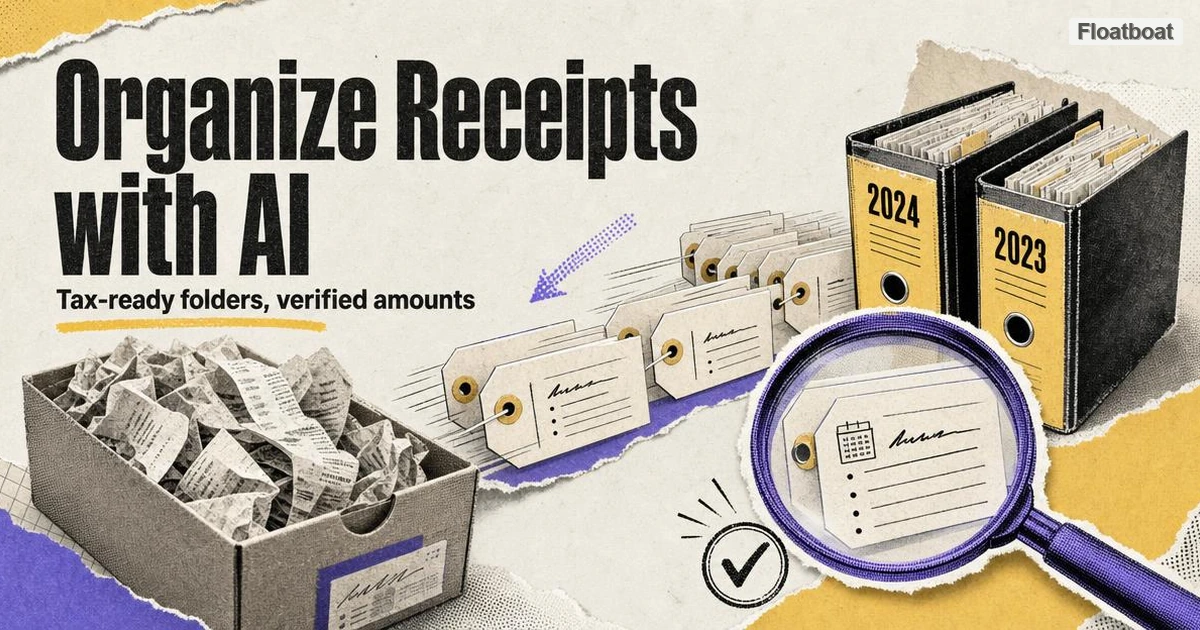
1. What Most People Get Wrong About Organizing Receipts
The most common mistake is treating receipt organization as a folder problem when it is really a naming problem. Two folders called Receipts and Invoices do nothing for you if the files inside are still named download(7).pdf, scan_0041.jpg, and Invoice_from_Acme(2).pdf — none of those names tells you the vendor, the amount, or the date, so every search degrades into opening files until you recognize one. The filename is effectively the database row of a personal archive: once it carries the fields your accountant checks — vendor, date, amount, type — the folders organize themselves and retrieval becomes a one-step search.
The second mistake is outsourcing the work to a scanner that only produces images. A phone scanning app that turns a paper receipt into IMG_4471.jpg has not organized anything: the text is locked in pixels, the file is named by a camera counter, and you have simply recreated the paper pile in digital form. Tools that OCR a pile into a single searchable PDF have the same weakness — the structure is one undifferentiated blob. A receipt organizer is only doing its job when the output filename and location encode the details a bookkeeper would ask for — which is why useful tools read content and propose names rather than flattening pages into images.
The third mistake is treating this as an annual spring-cleaning instead of a monthly rhythm. A tax-season marathon exhausts you and gets abandoned by February; a five-minute close-out each month becomes a habit and keeps the archive audit-ready year-round. That distinction matters because financial filing is structurally different from a general-purpose tidy-up: cleaning up your downloads folder with AI is about reclaiming space and cutting visual noise, while financial filing builds a durable archive whose structure a tax preparer can follow without an explanation. If you are a freelancer or solopreneur, the second one has a deadline attached, and that changes the system you need.
2. Name by Content, Not by Extension
A file extension tells you which program opens the file — nothing else. invoice.pdf and receipt.pdf are both PDFs, and IMG_4471.jpg gives no clue whether the picture is a taxi fare, a hardware purchase, or a photo of your dog. The fields bookkeeping actually cares about live inside the document: the transaction date, the vendor or merchant, the amount, any invoice or receipt number, and the tax charged. So the organizing rule is to name files from what is printed on the page, not from the file type or the camera counter that produced the name.
An AI file organizer makes this automatic: it opens each document, reads the text, and proposes a filename built from the extracted fields instead of leaving whatever the downloader called it. Once you adopt the habit, each field in the name has a job. The ISO-8601 date comes first because 2026-09-14 sorts chronologically on every operating system. The vendor comes second because it creates a virtual folder — searching "acme" returns that supplier's whole history in date order. The amount enables what bookkeepers call glanceable verification — matching a bank-feed line to the right PDF without opening a single file. When the document is an invoice rather than a receipt, the invoice number matters most, because vendors, dates, and amounts all repeat while INV-2026-041 does not; it is the primary key tying the PDF to a ledger line. These are the invoice-naming conventions recommended across bookkeeping tooling as of 2026.
The mental shift is simple: you are not naming files for yourself to recognize next week. You are naming them so your accountant, your software, and your future self at tax time can answer "what is this, when, who with, and how much?" from the file list alone — a filename that answers those questions is portable, because its meaning is not stored anywhere else.
3. The Receipt & Invoice Filing Template (Copy-Paste)
Everything here is method-neutral: it works with any AI file organizer or content-reading renamer, including a manual workflow. You need two artifacts — a filename template and a folder tree — and both are copy-paste ready.
# Primary template — works for almost every receipt and invoice
{YYYY-MM-DD}_{Vendor}_{Amount}_{Type}.pdf
2026-09-14_Acme-Inc_142.83_Invoice.pdf
2026-07-19_Amazon-Business_89.40_Receipt.pdf

# Client invoices you issue — add the invoice number as the primary key
{YYYY-MM-DD}_{Vendor}_{InvoiceNumber}_{Amount}_{Type}.pdf
2026-08-02_Apex-Studio_INV-2026-041_2750.00_Invoice.pdf

# Multi-currency — add the three-letter currency code before the type
{YYYY-MM-DD}_{Vendor}_{Amount}_{Currency}_{Type}.pdf
2026-07-19_AWS_184.30_USD_Receipt.pdf
Keep the primary template as the default and add a field only when it earns its place. The invoice number goes in when you issue invoices yourself, because it is the number on your books, on the client's purchase order, and on the payment that eventually arrives — it is how the file will be found during reconciliation. The currency code goes in the moment you touch more than one currency; 184.30 alone is ambiguous between a USD and an EUR transaction, and ambiguity in a financial archive causes the mistakes nobody notices until tax time.
# Folder tree — grouped by tax year, then document type
Finance/
└── 2026/
    ├── 01-Invoices-Out/        # invoices you sent to clients
    ├── 02-Receipts-In/         # supplier bills and purchases
    ├── 03-Statements/          # bank and credit-card statements
    ├── 04-Contracts/           # signed agreements and quotes
    └── 05-Tax-Forms/           # 1099s, W-2s, VAT records

# Multi-client freelancers — add a client root above the year
Clients/
├── Apex-Studio/2026/Invoices/
└── Northwind-Co/2026/Invoices/
The year-first structure is not an aesthetic choice. Tax preparation and bookkeeping are organized by filing period, and accountant-focused file organizers have converged on the same shape — route each document by tax year and type, exactly as the CPAs and bookkeeping workflows built on this pattern expect as of September 2026. When your accountant asks for "2025 vehicle expenses," they are asking for a folder, not a search.
Three hygiene rules make the scheme survive contact with reality. First, normalize vendor names: decide the canonical form is Acme-Inc, and let every alias — "Acme Inc.", "ACME inc.", "Acme Incorporated" — resolve to it, so a search for "acme" returns everything. Second, keep filenames free of spaces and special characters: use hyphens inside names, underscores between fields, plain-digit amounts with two decimals, and no ampersands or parentheses. Third, when a receipt has no distinguishing features — two identical $4.00 coffee receipts — accept a collision rule such as appending -2, rather than inventing data that is not on the document. The rules are simple; the value is applying them to every file, every time, which is exactly what automation is good at.
4. What the AI Reads — and How to Verify It
Modern organizers do not guess from filenames; they read the document — and that works differently for the two kinds of input you actually have. Electronic invoices and receipts — the PDFs arriving from Stripe, Shopify, QuickBooks, vendor portals, and most SaaS billing systems — contain a text layer, so the extractor reads vendor, date, amount, currency, and line items almost as reliably as a human skimming the page. Paper receipts you photographed or scanned have no text layer until OCR runs, and thermal paper, folds, handwriting, and low-contrast ink degrade that pass noticeably. Expect near-certain extraction from digital PDFs, and treat extraction from scans as a strong draft that deserves a look.
Extraction quality hides in details that are easy to miss. The date on an invoice may be an issue date, a due date, or a paid date — decide which one drives the filename and stay consistent. Amounts carry currency symbols and decimal conventions that differ by region, so 142.83 and 142,83 are different numbers until the extractor knows the locale. Vendor names arrive in a dozen spellings of the same company, which is why normalization is part of reading, not a separate step. And the amount should be the total printed on the document, not a sum the model computed from line items — line items are exactly where vision models drop a digit. This is also where a plain filename renamer stops being enough: it cannot recover a vendor or amount that was never in the filename, which is the practical difference between a file organizer vs. a file renamer and a file sorter.
Preview, verify, approve
Because a misread amount is worse than an ugly filename, the workflow treats verification as part of the job, not an optional extra. The pattern: the organizer proposes a name from the fields it read; you preview the proposal, check the amount against a source you trust — the confirmation email, the card statement, the vendor portal — and only then approve the rename and the move. The two-second check costs less than discovering in April that a $142.83 receipt was filed as $1,428.30 or attributed to the wrong vendor. Verification matters most for scans and for receipts in a foreign currency, and any organizer worth using lets you do it before files move rather than after.
Floatboat's AI File Organizer demonstrates the same shape in practice. You point it at the folder where receipts live — Downloads, a client folder, an external drive — and it reads each file's content on your device, then proposes a full folder tree and names like 2026-09-14_Acme-Inc_142.83_Invoice.pdf in plain chat. You review the plan, tweak the grouping in conversation, verify the extracted amounts in the preview, and click approve — files are renamed and moved in one pass, with a single undo that rolls the batch back in reverse order. Because the reading and renaming models run locally, the receipts never leave your machine. Any organizer that offers preview-then-approve and content-based naming gives you the same discipline; the template and the check are the system, and the tool is interchangeable.
5. Scenario Recipes: Six Financial File Types, One System
The core template covers every document, but each financial file type has a field that deserves emphasis and a characteristic failure mode. These six recipes cover what most freelancers and micro-businesses collect; apply the base template and add the extra field in the last column.
| Scenario | Filename recipe | Double-check this |
|---|---|---|
| Client invoices you issue (accounts receivable) | 2026-08-02_Apex-Studio_INV-2026-041_2750.00_Invoice.pdf | Invoice number and the client's legal name — it may differ from the trading name |
| Supplier bills and subscriptions (accounts payable) | 2026-07-19_AWS_184.30_USD_Receipt.pdf | Vendor aliases ("AWS" vs. "Amazon Web Services") and recurring monthly amounts |
| Travel and meals | 2026-03-14_Uber_24.80_Receipt.pdf | Business purpose and who was present, kept as a note beside the file |
| Bank and credit-card statements | Chase-Business_2026-08_Statement.pdf | The statement period, not the download date — this is what reconciliation needs |
| Contracts and US tax forms (1099-NEC, W-2, K-1) | Acme-1099-NEC_2026.pdf | Form type and payer, and keeping business-entity documents separate from personal ones |
| VAT/GST tax invoices | 2026-08-14_Supplier-Co_412.60_VAT-Invoice.pdf | That it is a full tax invoice — vendor tax ID and tax breakdown — if you reclaim input tax |
Two scenarios deserve more than a table row. Travel-and-meals receipts are what tax authorities scrutinize most: the amount is rarely the problem, but the business purpose and attendees cannot be reconstructed from a filename in February, so add a short note when you file rather than promising to remember. Tax forms are different because the issuer — not you — controls the content: a folder of thirty files all named 1099.pdf becomes thirty cleanly named forms only when the organizer reads the form type and payer off the page and routes by year, which is why they belong in their own document-type folder under the relevant tax year rather than mixed into general receipts.
The VAT and multi-currency rows are a reminder that "receipt" is not one thing. In VAT and GST jurisdictions, a simple point-of-sale receipt often does not qualify for reclaiming input tax — the tax authority wants a full tax invoice with the supplier's registration number and the tax broken out separately. An organizer will not decide that for you, but it can keep the two document flavors visibly distinct in the folder structure so you never hand a partial record to your preparer. The system stays the same in every case: content in, correct filename out, filed under the right year, verified before approval.
6. The Five-Minute Monthly Close-Out
A monthly ritual of about five minutes keeps the whole system alive, and it matters more than the initial setup. At the end of each month, point your organizer at the folders where documents have landed — Downloads, the email attachments you saved, the scanner output — and let it read everything new. Then work the preview: verify the amounts against the statements or emails you already have, approve the batch, and confirm the current tax year's folder tree exists and is filling in. The whole close-out is reading a preview list and clicking approve — the organizer sorts, renames, and files, and because it works from content, it handles files you would otherwise have to open to identify. The rhythm works because the system absorbs documents continuously instead of letting them pile into an event. Quarterly, add one deeper pass: skim the vendor-alias list for new merchants and spot-check that client invoices land under the right client root. When the year closes, freeze the completed year as a read-only archive and start the new year with an empty tree. That rhythm is what separates a tidy archive from a system that quietly decays into a second Downloads folder — and it is the discipline an accountant recognizes the moment they open your folder.
7. Where a File Organizer Stops (and Bookkeeping Starts)
It is worth being precise about the boundary, because blurring it is how people end up disappointed. A file organizer turns messy local files into a clean, searchable, consistently named archive — that is the entire job. It does not post journal entries, assign expenses to a chart of accounts with tax logic, produce expense reports, or file returns. Those jobs belong to bookkeeping tools such as QuickBooks, Xero, and Expensify, which operate on transactions and accounts; if your real problem is auto-coded deductions the moment a receipt hits your inbox, an expense app is the more direct answer — and this article is not arguing against it. The relationship between the two layers is evidence and record, and the two systems run in parallel, meeting at the folder: your invoices and receipts are the proof behind every number in the books, and an audit or tax question is answered with the document, not the journal entry — which is why the organizer's output is exactly what an accountant can consume without an afternoon of sorting. The organizer keeps the local archive clean and searchable while your accounting tool references the same archive or receives clean exports from it; if the archive lives in a cloud-synced folder your accountant can access, the handoff becomes a shared link to an organized tree instead of a ZIP of scan_0041.jpg files.
8. Why Financial Files Deserve Local Processing
Receipts and invoices are not vacation photos: a receipt carries your name, often the last four digits of a card, sometimes a business tax ID, and a bank or credit-card statement carries account numbers for an entire month of spending.
That makes financial documents the category where you should ask where processing happens first — and the answer varies, since some products read documents only after uploading them to a cloud model. Local processing changes the calculation: when the reading and naming models run on your own device, the contents of your receipts never cross the network to get organized, and the archive stays usable offline.
For a fuller treatment of where uploaded files actually go and what the cloud sees, our article on do AI file organizers upload your files walks through the data flow in detail. The short version: decide deliberately rather than by default — trusting a cloud organizer with a year of financial documents is a fine trade for convenience if it is conscious, and if it is not a trade you want, local processing gives you the same filing system without the upload.
9. Conclusion
Judge your filing system by one test: could your accountant open the folder tomorrow, with no explanation from you, and put their finger on the July Acme invoice within thirty seconds? If yes, the system works — stop tweaking it. If no, the fix is rarely discipline — it is a filename template and folder tree that encode the questions accountants ask, applied by a tool that reads content and lets you verify before anything moves. Set the structure once this month, run the five-minute close-out at month end, and the difference shows up in every retrieval between now and then, not just in the February marathon. Try the recipe on your own receipts with Floatboat's AI File Organizer, which reads and files financial documents on your machine.
https://floatboat.ai/blog/organize-receipts-and-invoices-with-ai