AI Automation Agency: Do You Need One?
AI automation agency support can help, but solo operators should compare scope, ownership, maintenance, and tool alternatives first.
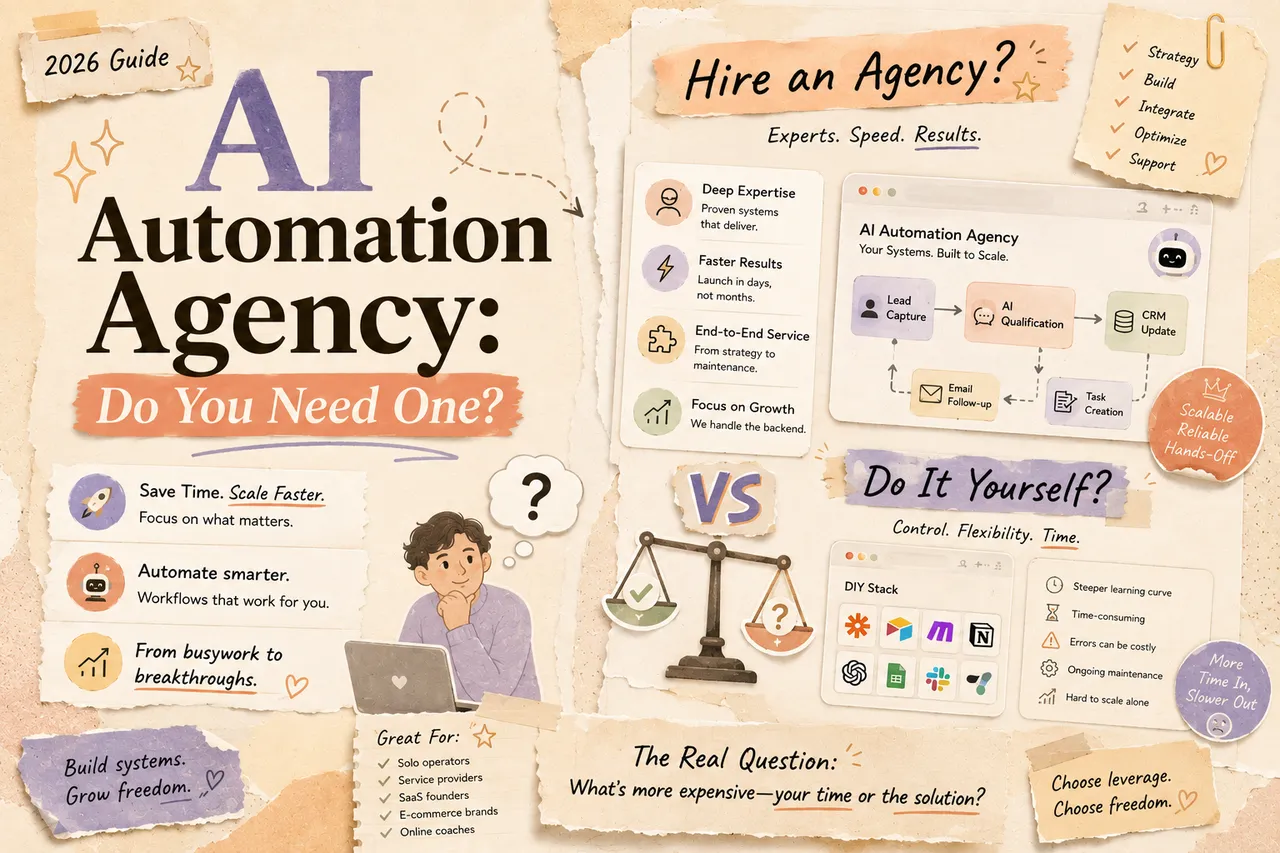
You need an AI automation agency when the work is understood, the integration is consequential, and your team cannot responsibly build and operate it. You probably do not need one when the process is still changing every week, the first useful version fits inside an existing tool, or nobody inside the business will own the result.
That distinction matters because an agency can shorten the path to a production workflow, but it cannot supply missing process ownership. This guide helps you choose among four real options—do nothing yet, build it yourself, hire an employee or contractor, or engage an agency—and then structure a pilot that leaves you with evidence rather than a persuasive demo.
Start with the process, not the promise of AI
Write down one workflow before talking to vendors. It should have a trigger, inputs, decision points, exceptions, an output, an owner, and a rough baseline. “Automate sales” is not a workflow. “When a qualified form submission arrives, enrich the company record, draft a personalized reply, route uncertain cases to an owner, and record the outcome” is close enough to investigate.
The baseline does not need a speculative ROI forecast. Record observable facts:
- how often the work occurs;
- how long a normal case and an exception take;
- which systems and data categories are involved;
- what an error costs operationally;
- what must be reviewed before an action becomes final;
- who responds when the workflow stops.
If those facts are unavailable, run the process manually for another cycle and instrument it. Paying an agency to discover a process can be legitimate, but the discovery deliverable should be reusable: a process map, prioritized requirements, risks, and an implementation brief that another supplier or internal team could understand.
The four-way decision: wait, DIY, hire, or use an agency
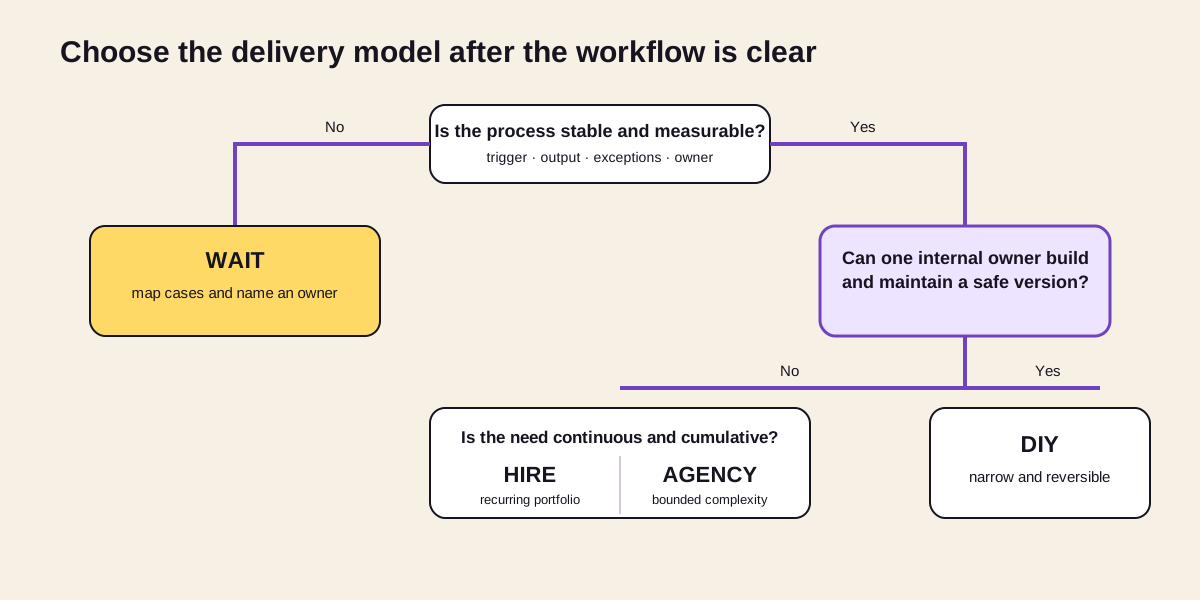
Choose based on process stability, ongoing ownership, and delivery complexity—not on how impressive the demo looks.
Wait when the workflow is not stable
Automation hardens a process. If the team still disagrees about the input, desired output, or exception rules, implementation creates more places for that disagreement to hide. Wait when volume is low, the process changes frequently, success cannot be observed, or the underlying problem can be removed instead of automated.
Waiting should have an exit condition. For example: document 30 cases, identify the five most common exceptions, and name the person who will own the workflow. Without an exit condition, “wait” becomes indefinite avoidance.
DIY when the boundary is narrow and reversible
Build internally when one capable owner can use existing products, the integration touches a small number of systems, errors are easy to detect, and actions can remain in draft mode. A form-to-spreadsheet flow, a scheduled report, or a draft-only follow-up can be a reasonable first project.
DIY still includes maintenance. APIs change, credentials expire, prompts drift, and business rules move. The decision is not “free versus paid”; it is whether your own learning and maintenance time is preferable to external delivery. A no-code agent builder can reduce implementation work, but it does not remove testing or ownership.
Hire an employee or long-term contractor when the work is continuous
An internal automation engineer or operations specialist makes more sense when the backlog is ongoing, workflows share a common architecture, domain knowledge is difficult to transfer, and the business needs frequent iteration. The person becomes part of the operating system rather than a temporary implementation team.
Hiring takes longer and creates management responsibility, but it retains context. A long-term contractor can bridge the gap when the workload is substantial but not yet a full-time role. In either case, avoid creating a single point of failure: require documentation, peer review, shared credentials, and a recovery path.
Use an agency when integration risk and delivery concentration are both high
An agency is strongest when a defined project needs several skills at once: process design, integration, AI evaluation, security, deployment, training, and change management. It can also be appropriate when a launch window is fixed and the internal team cannot assemble those capabilities in time.
The use case should be important enough to justify formal delivery, but bounded enough to accept. Cross-system workflows, high-volume document processing, and workflows with material exceptions can fit. An undefined request for “an AI transformation” usually cannot.
Compare the options using total operating responsibility
| Decision factor | DIY | Employee / long-term contractor | Agency |
|---|---|---|---|
| Best fit | Narrow, reversible workflow | Continuing automation portfolio | Bounded, complex delivery |
| Speed to first prototype | Often fast | Slower hiring, then repeatable | Fast if scope is ready |
| Domain knowledge | Already inside the team | Accumulates internally | Must be transferred deliberately |
| Specialist breadth | Limited to current team | Depends on hire | Multiple disciplines can be available |
| Maintenance | Internal owner | Internal role | Must be contracted or handed over |
| Lock-in risk | Tool and individual | Individual and architecture | Supplier, platform, and credentials |
| Management burden | Build and operate | Recruit, manage, retain | Procure, govern, accept |
There is also a hybrid: hire an agency to design and deliver the first bounded workflow while an internal owner works alongside it. The agency supplies concentrated expertise; the owner learns the system and takes over operations. This costs internal time, but that is the point—handover cannot happen to an empty chair.
If the process itself is the uncertain part, a dynamic workflow or workspace approach may be preferable to encoding every branch in a fixed automation too early.
What an AI automation agency should actually deliver
A finished project is not a live demo. Define acceptance around artifacts and observable behavior.
A working, bounded workflow
The workflow should run in an environment you control, against agreed inputs, with known limitations. Its tool list, system dependencies, models, prompts, data stores, schedules, and human checkpoints should be identifiable. If a component is proprietary, record what happens when access ends.
Test evidence
Require a test set that reflects ordinary cases, important exceptions, malformed input, unavailable dependencies, and denied permissions. Results should show the expected output and the observed output, not merely “passed.” For generative steps, define review criteria and unacceptable failure types instead of pretending one exact answer is always available.
NIST’s Generative AI Profile recommends documented testing, evaluation, validation, and verification before deployment, and calls out added privacy, security, and intellectual-property risks from third-party AI integrations. That is a useful baseline even for small projects: test against the way the system will actually be used.
Operational documentation
The runbook should explain normal operation, dependencies, alerts, common errors, safe retry behavior, rollback, escalation, and shutdown. A separate architecture and data-flow record should show where information enters, which processors receive it, where it is stored, and when it is deleted.
Client-controlled access and assets
Production accounts, repositories, domains, cloud projects, automation workspaces, billing relationships, and primary credentials should normally be created under the client’s control. Agencies can receive role-based access. Shared passwords and agency-owned production accounts make both offboarding and incident response harder.
Training and handover
Training should use the actual runbook and include a controlled failure. The client operator should be able to pause the workflow, diagnose a known error, rotate a credential, and restore service. Record unresolved limitations and the owner of each follow-up.
Cost: compare the full operating model, not a project quote
There is no universal agency price list. Scope, geography, seniority, compliance needs, integration depth, data quality, and support terms make public ranges unreliable for an individual decision. Obtain comparable written quotes against the same brief and evaluate total cost of ownership:
first-year cost = discovery + build + software and model usage + security/compliance work + internal time + support + change requests + expected migration cost
Separate fixed and variable costs. Ask which third-party subscriptions are required, who pays usage charges, what volume assumptions underlie the estimate, how overruns are approved, and whether post-launch monitoring is included. A cheap build with an opaque monthly dependency can cost more than a larger handover-ready implementation.
Use the detailed AI automation agency pricing guide to normalize proposals, but insist that every number in your decision comes from a current quote or an account you can inspect. Do not use a vendor’s promised hours saved as the business case. Measure the pilot against your own baseline.
Screen the supplier before sharing production access
A polished prototype proves very little about delivery discipline. Request evidence matched to the project:
- A redacted handover package. Look for a real runbook, architecture diagram, test record, and open-issues list—not only a case study.
- Named delivery roles. Confirm who sells, architects, builds, reviews security, and supports production. Ask which work will be subcontracted.
- Relevant technical depth. Ask the team to explain one likely failure mode in your stack and how it would be detected and recovered.
- Security and supplier controls. Review access practices, credential storage, incident response, change management, and sub-processors. CISA publishes a practical vendor assessment resource for small and medium-sized businesses for this purpose.
- Reference boundaries. A reference should confirm a similar type of delivery and handover. It does not prove the same outcome is available to you.
- Exit behavior. Ask the supplier to describe offboarding before the engagement begins: export formats, credential rotation, deletion confirmation, remaining licenses, and transition support.
Do not request confidential artifacts from another client. A responsible agency should redact sensitive information or show a purpose-built sample rather than disclose a former customer’s systems.
Run a paid pilot that can fail safely
A pilot is not a discounted full transformation. It is a bounded test of the riskiest assumptions.
Choose one workflow, one accountable owner, a limited data set, and a fixed review date. Keep consequential actions in draft or sandbox mode at first. Agree on three classes of acceptance criteria:
- Functional: required inputs are accepted, expected artifacts are produced, and named exceptions route correctly.
- Operational: alerts arrive, retries do not duplicate actions, an operator can pause and recover the workflow, and logs support diagnosis.
- Risk: permissions stay within scope, sensitive data follows the agreed path, untrusted input does not bypass approvals, and revocation works.
Evaluate a representative sample, including failures. Record false positives, false negatives, manual corrections, latency, usage cost, and operator effort. Do not turn a small pilot into a universal productivity claim. Its job is to decide whether to stop, revise, or expand.
An effective acceptance session is performed by the future operator—not only by the agency. If the internal owner cannot execute the runbook while the delivery team watches, the project is not handed over.
Put ownership, data, and exit terms in writing
This is practical procurement guidance, not legal advice; applicable requirements depend on jurisdiction and data type. Have qualified counsel review consequential agreements.
The statement of work should identify deliverables, excluded work, dependencies, milestones, acceptance tests, change control, support period, rates for additional work, and what happens when a dependency changes. Avoid “production-ready AI workflow” as an acceptance criterion; name observable tests instead.
The commercial and data terms should address:
- ownership or license rights for code, prompts, configurations, documentation, and custom assets;
- client ownership of accounts and production credentials;
- approved data categories, purposes, locations, retention, deletion, and model-training restrictions;
- the agency’s sub-processors and process for adding or changing them;
- confidentiality, security measures, incident notice, audit evidence, and cooperation;
- warranties and liability allocation appropriate to the risk;
- export format, transition assistance, credential rotation, data return or deletion, and termination timing.
Where UK GDPR applies and the agency processes personal data on the client’s behalf, the ICO’s current controller–processor contract guidance describes required terms including documented instructions, confidentiality, security, sub-processors, assistance, audits, and end-of-contract return or deletion. Do not paste those terms into every project regardless of jurisdiction; use them as a concrete example of why the data relationship must be classified before signing.
Red flags that should pause procurement
- The proposal starts with a platform and cannot explain the workflow or failure path.
- The agency promises a percentage return before seeing your baseline data.
- The demo uses clean sample inputs but the test plan omits exceptions.
- Production accounts, repositories, or credentials must remain under agency ownership.
- “Unlimited automations” hides usage fees, support boundaries, or change-request charges.
- The supplier cannot name its models, hosting locations, sub-processors, or retention rules.
- Approval and rollback are described as future enhancements.
- The project has no internal owner, but the agency claims handover will still be easy.
- The contract says “AI solution” while acceptance depends on subjective satisfaction.
One red flag may be fixable through scope or contract changes. Several together usually mean the engagement is not ready.
A practical decision in 30 minutes
Before booking agency calls, answer these questions in writing:
- Can we name one stable workflow and its owner?
- Do we know the baseline volume, effort, errors, and review requirements?
- Could an existing feature or a small internal build solve most of it?
- Will this become a continuing portfolio of work that needs an internal hire?
- Does the project require several specialist skills at the same time?
- Can we define a pilot whose failure is contained?
- Will we control production accounts, artifacts, and the exit path?
If the first two answers are no, wait and map the process. If the third is yes, prototype internally. If the fourth is yes, evaluate a hire or long-term contractor. If the process is ready, delivery is bounded, and specialist concentration is the real constraint, an agency may be the right choice.
Whatever path you choose, someone inside the business must own the workflow. The method in building AI agents for repeated work is useful because it starts from repeatability, exceptions, and verification rather than from a vendor category.
The bottom line
An AI automation agency is a delivery model, not a shortcut around operational responsibility. Hire one when you have a stable, consequential workflow; need concentrated expertise; can support a proper pilot; and have an internal owner ready to accept the system.
Wait or build internally when the process is still being discovered, the risk is low, or existing tools can answer the need. Consider a hire when automation is becoming a permanent organizational capability. The right decision is the one that leaves you with a working workflow, observable controls, maintainable knowledge, and a credible way out.
https://floatboat.ai/blog/ai-automation-agency-do-you-need-one