Information checked October 13, 2026. DeepSeek model aliases and integrations change; verify the linked official documentation before configuring a production agent.
A DeepSeek Agent is not one official product. It is an agent system whose reasoning model is supplied by DeepSeek. The complete system also needs a harness to manage messages and tools, code that executes approved actions, state or storage, and operational controls such as permissions, retries, logs, and human review.
Model versus agent
The model proposes text or structured tool calls. The harness decides which context and tools the model sees, executes the loop, and enforces boundaries. Calling a model through a chat interface does not automatically create an agent; the system becomes agentic when it can select tools, observe results, and continue toward a goal under defined controls.
DeepSeek’s current models and pricing page lists deepseek-flash as V4.1 Flash and deepseek-v4-pro in the catalog as V4-Pro-0813. Both support tool calls, JSON output, Responses API, and Anthropic-format access. DeepSeek also announced temporary routing of the Pro alias to V4.1 Flash while V4.1-Pro is pending, so the model name should be logged rather than treated as a permanent checkpoint.
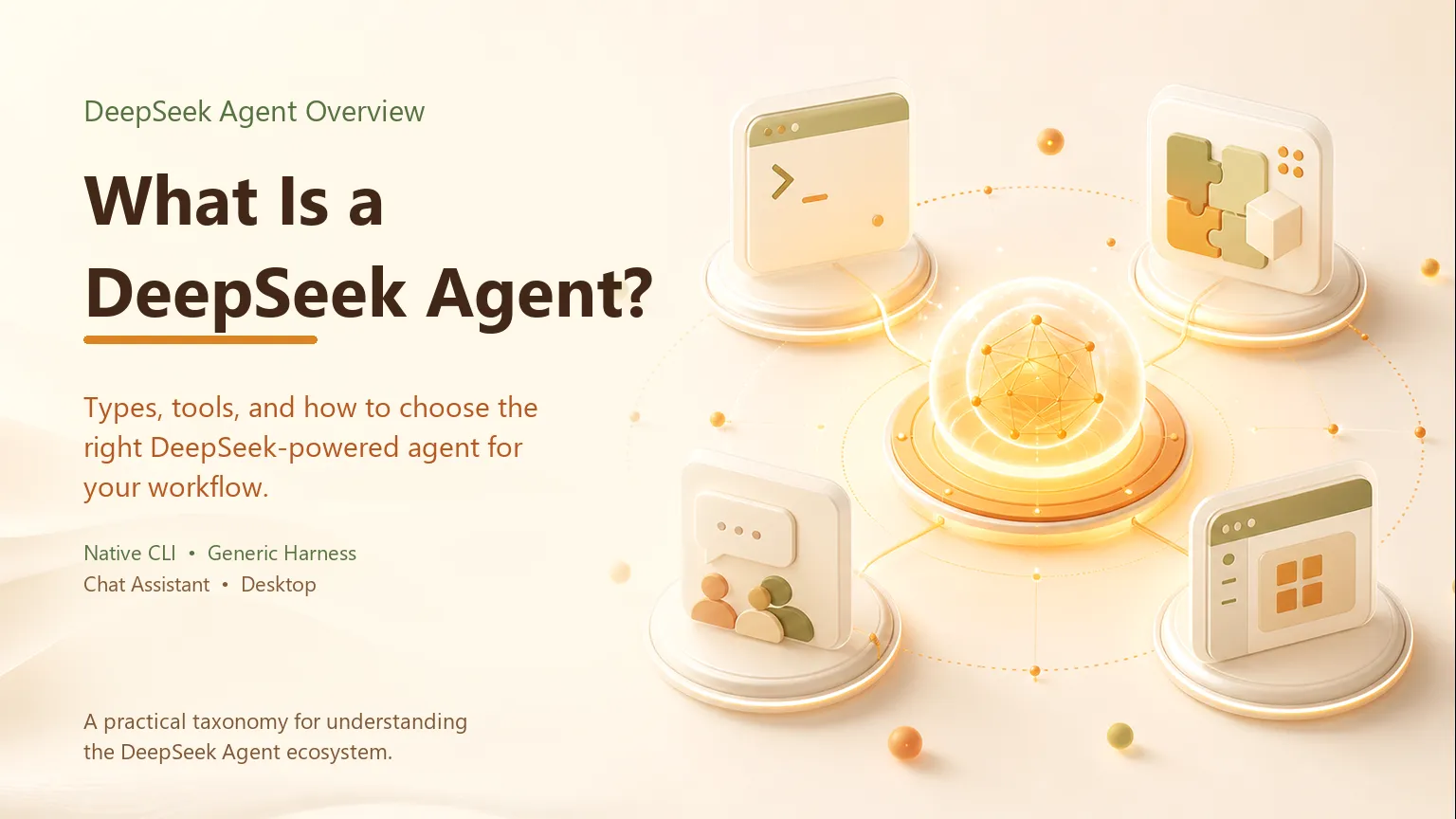
Four common DeepSeek Agent forms
- Existing coding harness with DeepSeek. DeepSeek publishes official integration guides for Claude Code and Codex. Here, the harness supplies the workflow and DeepSeek supplies inference.
- DeepSeek-oriented coding client. Tools such as Deep Code configure their loop around DeepSeek models. Feature and security claims belong to each client, not to the model provider by implication.
- Custom tool-calling agent. Your application defines JSON schemas, executes validated calls, returns results, and stops at an approval or completion condition.
- Business or messaging integration. A bot or workflow connects DeepSeek to a channel, database, or internal service. The integration’s permissions and retention policy determine its operational risk.
These are categories, not a quality ranking. A terminal client, a custom service, and a messaging bot may use the same model but expose different tools and failure modes.
What tool calling contributes
DeepSeek’s tool-calling guide documents the OpenAI-compatible pattern: send tool definitions, receive tool_calls, execute them in your application, return matching tool results, and ask the model to continue. The model does not execute your database query or filesystem operation by itself. Your code owns validation, authorization, timeouts, idempotency, and error handling.
For implementation details, see DeepSeek Agent function calling. If you need a complete minimal loop rather than a concept map, follow how to build a DeepSeek Agent.
How to choose a form
Choose an existing harness when its approvals, sandbox, session management, and integrations already fit. Build a custom loop when the workflow is narrow, the tool surface is small, and you need explicit business rules. Choose a channel integration only after verifying where credentials, prompts, tool results, and conversation history are stored.
Evaluate with representative tasks and record accepted-task rate, reviewer corrections, retries, latency, model and tool cost, and unsafe or unauthorized attempts. Public model benchmarks do not measure your harness policy or data quality. If the shortlist includes another fast-moving provider, apply the same date-and-version discipline used in our Grok 4.6 status review rather than comparing model-family labels without a checkpoint.
Production checklist
- Use least-privilege credentials and separate read from write tools.
- Validate every argument against a schema and business rule.
- Require approval for destructive, financial, external-message, and access-control actions.
- Add idempotency keys for retried writes.
- Limit turns, parallelism, time, and spend per task.
- Log the model alias, tool calls, results, approvals, and final disposition.
- Test missing data, malformed arguments, duplicate events, and tool outages.
The useful definition is therefore simple: a DeepSeek Agent is DeepSeek inference inside a controlled agent loop. The model affects capability and cost; the harness and policies determine what the system can safely do.
Related posts
What Is Gemini Agent? Google's Universal Work Agent Explained
Gemini Agent is Google's universal work agent for persistent tasks, multi-agent coordination, model routing, and work across business…
AI Agent Connectors Explained: MCP, OAuth, and Permissions
Learn how AI agent connectors use MCP, OAuth, scopes, resource permissions, and approval gates—and how to evaluate a connector before it…
What Is an Agent Harness? Architecture, Loops, and Safety
Learn what an AI agent harness does, how its execution loop, context, tools, sandbox, approvals, tracing, and recovery fit together, and…
https://floatboat.ai/blog/what-is-deepseek-agent