
Gumloop Review 2026: Powerful, But Is It Right for You?
A 2026 Gumloop review of flows versus agents, runtime identity and permissions, current cost structure, run visibility, failure recovery, and a reproducible adoption pilot.

Gumloop is best understood as a visual operations layer for repeatable, multi-step work. It combines deterministic flows, AI nodes, agents, triggers, interfaces, and app connections on one canvas. That makes it more capable than a simple trigger-action tool—but a successful deployment still needs process design, permission controls, tests, and an owner.
The short verdict: Gumloop is a strong candidate when a team can describe the inputs, decisions, side effects, and acceptable outputs of a recurring process. It is a weaker fit for one-off work, loosely defined “AI employee” ambitions, or automations whose risk cannot be bounded. This review provides a reproducible way to decide, not a universal score.
Information checked October 13, 2026: This review uses Gumloop's official product documentation, pricing announcement, and support documentation. Features and billing can vary by plan; confirm the controls in your workspace before production use.
What Gumloop is in 2026
Gumloop has two execution models. In a flow, connected nodes receive inputs, apply parameters, and pass outputs along an explicit path; Gumloop's official flow tutorial also documents reusable subflows. In an agent, the model selects among permitted tools while working toward a goal, as described in the current Agents guide. Current trigger documentation covers scheduled, webhook, app-event, and one-time starts. Because the old Interface documentation now redirects to Hosted Pages, this review does not assume that the legacy feature remains available under the same name or plan.
Agents add a different execution model. A fixed flow says which step follows which. An agent chooses among enabled tools at runtime. Gumloop can also place an Agent Node inside a deterministic workflow. That hybrid matters: predictable parts remain explicit, while a bounded agent handles the step that genuinely requires interpretation.
“Has agents” does not mean every process should become agentic. If a routing rule can be expressed as an if/else branch, the fixed branch is usually easier to test, audit, and repair.
How a production flow is built
A deployable flow normally has six layers:
- Trigger and identity: what starts the run, and which account owns it?
- Input contract: which fields are required, optional, or rejected?
- Transformation: which steps are deterministic, and which use a model?
- Decision control: what threshold, branch, or approval applies?
- Side effect: what may be written, sent, created, or changed?
- Evidence: what logs and records make the result reviewable?
The visual canvas makes these relationships inspectable; it does not remove the design work. Someone must still handle malformed inputs, duplicates, partial failures, rate limits, model variability, and upstream schema changes.
Templates are scaffolding, not production proof. Rename nodes by business purpose, isolate repeated logic in subflows, and document the expected input and output beside every AI step. A future maintainer should not have to reverse-engineer prompts to understand why the flow exists.
Connectors, credentials, and permissions
Gumloop documents integrations for Google Workspace, Slack, Salesforce, Airtable, GitHub, Outlook, and other systems. Connector count is a poor evaluation metric: one connector may expose a narrow read action, while another can modify a large data surface. Evaluate the exact operation you need.
For every connection, record the authentication method, requested scopes, readable and writable resources, credential owner, reuse permissions, offboarding behavior, and rotation procedure. Gumloop's MCP documentation shows that teams can enable or disable individual tools for an agent. Use that granularity. A research agent that only retrieves a presentation should not also receive creation tools; an email workflow should save drafts during its pilot before it can send.
Trigger choice can also change which identity and credential set a run uses. Gumloop's current team rollout guidance distinguishes direct Slack mentions that can run under the message author's identity from channel triggers that run under the trigger owner's identity. Treat that as an access-control decision, not a user-interface detail, and verify the behavior for every delivery channel you enable.
Workspace collaboration improves shared ownership, but shared assets also widen the blast radius of a bad configuration. Treat flows, agents, connections, and templates as production assets. Separate builders from approvers where a workflow can publish, pay, delete, or contact customers.
What Gumloop costs now
Older reviews quote fixed Solo and Team prices or estimate flows in legacy credits. Those numbers are not a safe basis for a 2026 decision. Gumloop's August 2026 transparent pricing announcement says model tokens and compute are passed through at cost, with a base 8% orchestration fee. Task breakdowns separate compute, inference, tools, and orchestration.
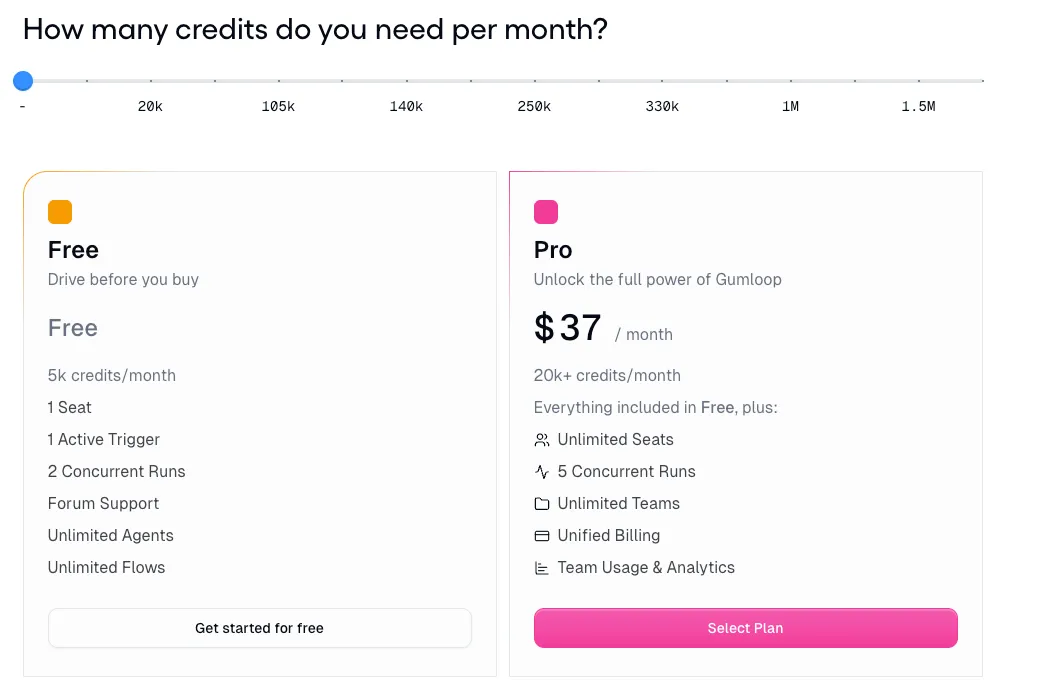
Some support material still uses “credits” for shared usage. For example, Gumloop's shared-agent billing guidance explains organization pools and a Slack-trigger exception. Because billing terminology and plans can transition, inspect the breakdown in your own workspace rather than importing an old price table.
The useful unit is cost per accepted outcome:
(compute + inference + paid tools + orchestration + review/rework) ÷ accepted outputs
Measure the median and the expensive tail. A cheap happy path can become costly when a flow loops, processes oversized inputs, calls a premium model unnecessarily, or produces outputs people reject. During the pilot, cap input size, track tool calls, test a smaller model, and assign an owner to review the monthly budget.
Observability and failure recovery
Gumloop documents per-node logs, failure email notifications, and an Error Shield flow-control node. These are useful building blocks, not a complete reliability policy.
| Failure test | What to verify |
|---|---|
| Missing or malformed input | The run stops safely and names the rejected field |
| Connector timeout or rate limit | A retry cannot duplicate a write or message |
| Invalid model output | Validation blocks the next side effect |
| Revoked permission | The failure is visible and reaches an owner |
| Partial batch failure | Successful and failed records can be reconciled |
| Workflow change | A known test set still passes |
Give business objects an idempotency key when possible. Put irreversible actions—sending, publishing, deleting, paying—behind approval or deterministic validation. Decide whether each failure should retry, wait for a person, or invoke a compensating action. A red error badge is not recovery.
Also test plan-dependent questions: history retention, export, version recovery, audit visibility, and alert routing. If the organization cannot reconstruct a disputed action, the automation is not production-ready.
A reproducible Gumloop pilot
Choose one workflow with a stable source, measurable output, and reversible destination—for example, classify inbound requests and draft, but do not submit, a ticket.
- Define the contract. Collect 20–30 representative cases, including empty fields, duplicates, odd formats, ambiguity, and at least three cases that must be rejected. Write expected and forbidden outcomes first.
- Build the smallest closed loop. Use fixed nodes for parsing, validation, and routing. Add AI only where rules are insufficient. Require structured output and use least-privileged credentials.
- Run in shadow mode. Keep the existing process as reference. Measure completion, accepted-without-edit rate, false actions, median and p95 runtime, cost per accepted outcome, and review minutes.
- Force recovery. Revoke a credential, send invalid data, simulate a timeout, and replay a duplicate. Confirm an owner can recover without corrupting the destination.
- Make a go/no-go decision. Proceed only if written thresholds are met and an owner is named. If savings disappear into tuning, exceptions, and review, narrow the scope or stop.
Who Gumloop fits—and who it does not
Gumloop tends to fit when the process repeats, inputs and outputs can be specified, AI judgment is bounded, required actions exist in nodes/MCP/APIs, shared ownership matters, and value can be measured per accepted output.
Look elsewhere when a native rule already solves the task; every case has a different objective; data cannot pass through the proposed services; mistakes create irreversible harm without review; required code-level testing or portability cannot be demonstrated; or nobody owns failures.
Use the same pilot cases when comparing platforms. Our guides to Gumloop alternatives, Lindy versus Gumloop, and Relevance AI versus n8n can form a shortlist, but the winning tool is the one that passes your permissions, recovery, and accepted-output tests.
Original visual references
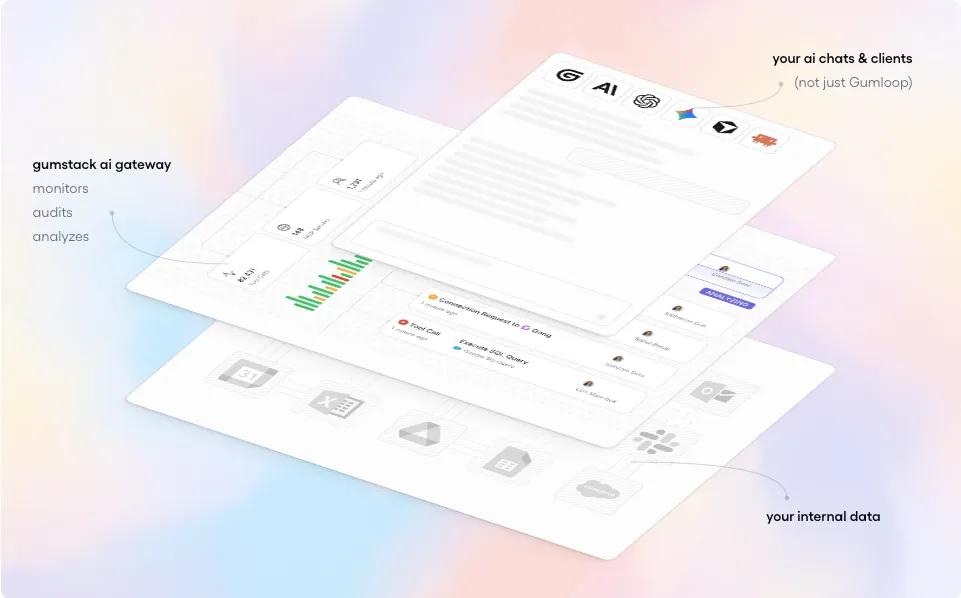
These images are restored from the article's original publication to preserve interface, workflow, and comparison context. Any product UI, pricing, benchmark result, or model availability shown is a historical capture; verify current official information before making a decision.

Final verdict
Gumloop's appeal is not simply “no-code AI.” It is the combination of explicit workflow logic with AI or agentic steps, delivered through triggers and interfaces. That is valuable for teams willing to operate automations as systems rather than demos.
Ignore inherited pricing tables, connector counts, and claims that natural-language building eliminates maintenance. Test one bounded workflow, inspect its real cost breakdown, restrict credentials, force failures, and measure accepted outcomes. If Gumloop survives that trial, you have a defensible reason to adopt it.
https://floatboat.ai/blog/gumloop-review-2026