
AI Agent vs AI Assistant: Control, Tools, and Risk
Compare AI agents and AI assistants by who chooses the next step, how tools and permissions work, what state persists, where humans supervise, and how each system should be evaluated.
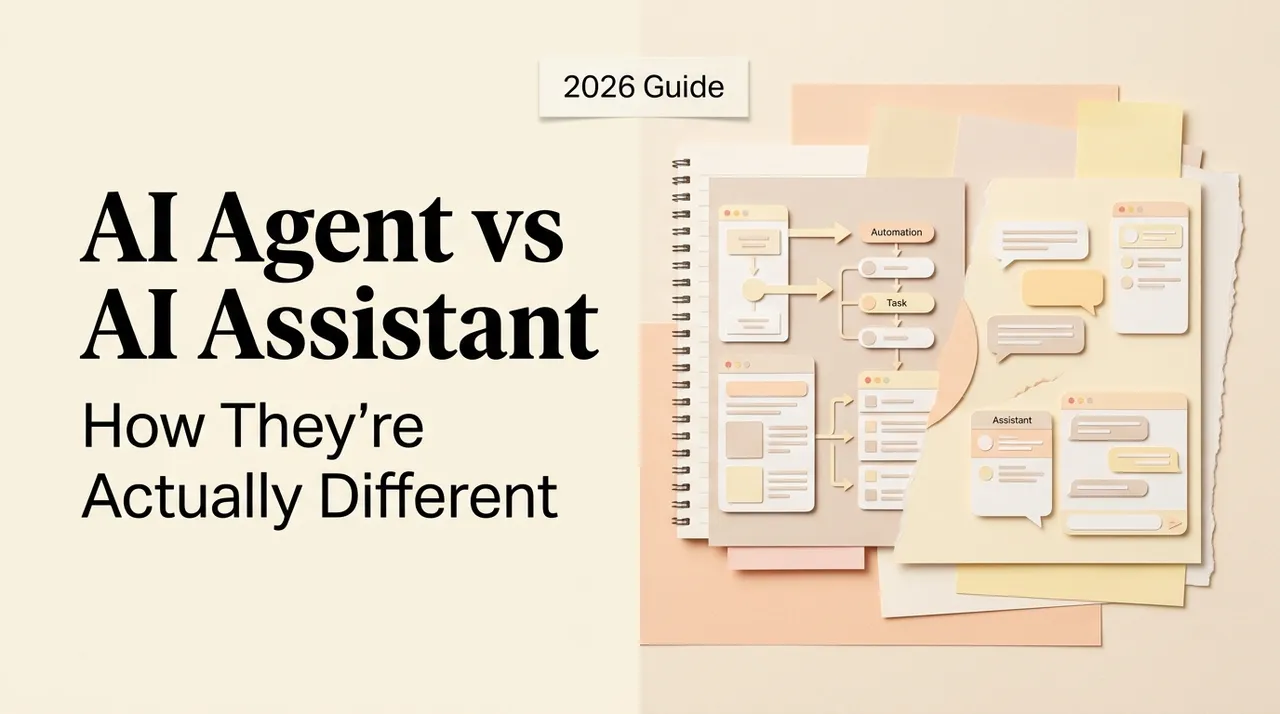
An AI assistant helps a person perform a task. An AI agent can be delegated an outcome and choose actions toward it within a defined environment. The boundary is not the chat interface, model name, memory feature, or product label. It is who controls the next step and what authority the system can exercise.
Compare assistants and agents through their interaction model, triggers, tools, permissions, state, supervision, risk, and evaluation. For the broader differences between chatbot, workflow, and agent architectures, see the AI agent vs chatbot guide.
Verified October 13, 2026: Product labels remain inconsistent. The comparison below classifies systems by control, authority, and supervision rather than vendor naming.
Working definitions
An AI assistant provides support in response to a user: drafting, summarizing, explaining, recommending, or preparing a proposed action. The person generally decides what happens next and remains the active operator.
An AI agent directs some of its own process and tool use to pursue an assigned goal. Anthropic defines agents as systems in which the model dynamically directs its process and tool usage, in contrast with workflows whose code paths are predetermined. NIST similarly emphasizes autonomous action and interaction with external systems in its current agentic AI work.
Microsoft’s current Copilot and agents overview demonstrates how the two can coexist: an assistant can be the interface through which a person invokes specialized agents. Therefore, “assistant” and “agent” may describe different layers of one product.
The comparison that matters
| Dimension | AI assistant | AI agent |
|---|---|---|
| Primary relationship | Person uses AI during work | Person delegates a bounded outcome |
| Trigger | Usually a direct user request | User request, event, schedule, or system condition |
| Next step | User normally requests or confirms it | Model may select it within policy |
| Tool use | Often user-initiated or previewed | May be selected repeatedly in an execution loop |
| Authority | Commonly read, analyze, or draft | May include scoped writes and external actions |
| State | Conversation and working artifacts | Run status, checkpoints, approvals, tool results, external IDs |
| Supervision | Continuous, interaction by interaction | Checkpoints, exceptions, approvals, and monitoring |
| Main risk | Bad advice or incorrect content accepted by a person | Compounding errors or unauthorized side effects |
| Evaluation | Response and human usefulness | Outcome plus full trajectory and environmental effects |
These are tendencies, not legal categories. A powerful assistant can use tools and memory. A tightly controlled agent may ask for approval frequently. Evaluate behavior and authority, not branding.
Trigger: who starts the work?
An assistant normally waits for the person to open an interface and make a request. It may suggest a reply or surface information, but the user remains in the interaction loop.
An agent can also start with a user request, but agent systems may additionally respond to an event, schedule, queue item, file change, or application state. Triggering does not by itself make a system an agent: a scheduled fixed workflow is still a workflow. The agentic part is model-directed choice during execution.
Ask products:
- What can start a run?
- Can a trigger be limited by account, event type, or data class?
- Can duplicate events create duplicate actions?
- Can new runs be paused globally?
- Which trigger and policy versions are recorded?
Tools: having a connector does not prove agency
Both assistants and agents can call tools. An assistant might search files, calculate a result, or create an email draft while the person watches. An agent might search several sources, decide which evidence is missing, call another tool, update a record, and continue until the task contract is satisfied.
The important questions are:
- Does the model select the tool, or does application code choose it?
- Is the call a suggestion, a draft, or an immediate external action?
- Can the system call another tool based on the result?
- Are inputs schema-validated and outputs treated as untrusted?
- Is every write idempotent and traceable?
NIST’s tool-use work for agent systems describes autonomy as the degree of initiative or discretion exercised without user intervention. That makes tool authority a spectrum rather than a yes/no feature.
Permissions: the clearest practical boundary
An assistant that only reads selected documents and produces a draft has a small operational blast radius. An agent with permission to send, publish, pay, delete, or change access has a much larger one, even if both use the same model.
Classify each action:
| Action tier | Examples | Suitable default |
|---|---|---|
| Read | Search approved documents | Assistant or agent with least privilege |
| Draft | Prepare email, report, or proposed update | Assistant; agent with required review |
| Reversible write | Add label, create test record | Agent with narrow identity, log, and rollback |
| Consequential write | Send externally, publish, pay, delete, grant access | Explicit informed approval and strong controls |
Authorization must be enforced by the application or tool gateway, not by asking the model whether it is allowed. Approval should show the exact target, arguments, evidence, and expected effect.
State and memory are not category definitions
The old shorthand “assistants have session memory; agents have persistent memory” is inaccurate. Modern assistants can use saved preferences, chat history, projects, files, and connected sources. Agents can be stateless between runs unless a developer adds storage.
Separate three concepts:
- Context: information supplied for the current decision.
- Memory: selected facts or preferences intended for future use.
- Operational state: task phase, completed steps, approvals, retries, checkpoints, and external side-effect IDs.
An assistant may need context and memory to personalize work. An agent needs reliable operational state when a run can pause, resume, retry, or affect external systems. Conversation text alone is not sufficient state.
For a technical diagnosis of continuity failures, see why AI forgets between sessions.
Supervision: interaction versus control points
Assistant supervision is usually continuous: the person asks, reads, edits, and decides the next instruction. This can be efficient for ambiguous, high-judgment work because corrections happen before the system takes another step.
Agent supervision should be designed around control points:
- approval before high-impact tools;
- pause when confidence or required evidence is insufficient;
- escalation when policy conflicts or permissions fail;
- limits on turns, time, cost, and tool calls;
- review queue for exceptions;
- kill switch for new runs;
- resumable state after human input.
“Human in the loop” is not meaningful if a person sees only a generic approval button or receives an alert after an irreversible action.
Risk changes when output becomes action
An incorrect assistant answer can mislead a user, leak information in a draft, or produce poor analysis. Human review provides a chance to catch it, though users may still over-trust fluent output.
An agent adds system risks:
- a wrong plan can cause a chain of tool calls;
- untrusted documents can influence actions through prompt injection;
- broad credentials increase the blast radius;
- retries can duplicate side effects;
- stale state can apply an obsolete decision;
- long loops can amplify cost and error;
- unattended actions can cross organizational boundaries.
More autonomy requires stronger identity, permissions, sandboxing, logging, evaluations, checkpoints, and recovery. It does not merely require a better prompt.
Task fit: assistance or delegation?
Choose an assistant when:
- the person must shape the result interactively;
- the task is a one-off analysis, draft, explanation, or decision support request;
- ambiguity is resolved through conversation;
- each consequential next step should remain a human decision;
- producing a reviewable artifact is enough.
If that assistant would handle workplace material through a personal account, use the separate guide to personal AI assistants at work to classify data, employer policy, and account boundaries before choosing a product.
Choose an agent when:
- the desired outcome is testable;
- the path varies enough that a fixed workflow is impractical;
- useful progress requires repeated environmental feedback;
- tools and permissions can be narrowed;
- stop, escalation, and recovery conditions are explicit;
- the value justifies additional latency, cost, and operational risk.
Use a workflow rather than either label when the steps are known and should execute predictably. Anthropic’s effective agents guide recommends increasing complexity only when simpler patterns fail.
One task can use both
Consider preparing and sending a client renewal proposal.
The assistant layer can help the person inspect account history, compare terms, draft the proposal, and revise the language. The agent layer can gather approved records, validate required fields, create a versioned draft, request approval, then save and send only after authorization.
The handoff should specify:
- the accepted draft and evidence;
- target customer and permitted channel;
- policy and template version;
- approver and approval expiry;
- idempotency key;
- confirmation and failure path.
The assistant is not “less advanced.” It is the right interface for judgment. The agent is not “more intelligent.” It is the delegated execution layer with a larger control burden.
Evaluate assistants and agents differently
Assistant evaluation
Use representative prompts and score factuality, relevance, source quality, instruction following, clarity, edit effort, unsafe advice, and user ability to detect uncertainty. Measure whether the assistant improves the person’s accepted output—not merely whether users like the prose.
Agent evaluation
Evaluate the outcome and complete trajectory. Anthropic’s current agent eval guidance recommends combining task outcomes with code-based, model-based, and human graders appropriate to the work.
Measure tool choice and arguments, evidence, state changes, policy violations, approvals, intervention, duplicated side effects, recovery, latency, and cost per accepted outcome. Include normal, edge, adversarial, and interrupted cases.
A fair comparison
Give both systems the same source material and expected artifact. Let the assistant operate with a human, and let the agent use only its declared tools and approvals. Compare:
- accepted result quality;
- human time and correction effort;
- unauthorized-action attempts;
- recovery after missing data or tool failure;
- full cost and elapsed time;
- ability of a second operator to explain what happened.
The agent should win only if reduced interaction produces enough value to justify its extra control surface.
Questions to ask any product
Instead of asking whether it is “really an agent,” ask:
- What starts work, and who chooses the next step?
- Which tools can it call without confirmation?
- Whose identity and permissions does it use?
- What state persists, where, and for how long?
- Which actions require approval, and what does the approver see?
- How are source data and untrusted instructions separated?
- Can a run pause, resume, retry, and reconcile safely?
- What trace and evaluation evidence is available?
- How can an administrator stop runs and revoke access?
Those answers reveal the operating model even when the marketing label does not.
Bottom line
Use an AI assistant when you want better thinking and creation while retaining step-by-step control. Use an AI agent when you can define an outcome, narrow its authority, and operate a system that chooses and executes intermediate actions.
Many useful products combine both: an assistant is the collaborative front end; agents handle bounded jobs behind it. The right question is not which label sounds more advanced. It is where judgment ends, delegation begins, and control must become explicit.
Related posts

Local-First vs Cloud Agent Workspaces: Which Fits?
Compare local-first and cloud agent workspaces across files, privacy, background execution, connectors, reliability, and control—then…
Best Markdown Editors in 2026 — Ranked by Workflow, Not Features
Obsidian, Typora, VS Code, Zettlr, iA Writer and more, ranked by workflow fit. What each editor trades away, and where browser tools beat…
Math in Markdown: LaTeX Syntax and Where It Renders
How math in markdown works: dollar-sign LaTeX syntax, where it renders (GitHub, Obsidian, Jekyll), the KaTeX vs MathJax split, and honest…
https://floatboat.ai/blog/ai-agent-vs-ai-assistant