
DeepSeek Agent vs Claude Code: Harness, Model, Cost, and Fit
DeepSeek Agent vs Claude Code is not a model-to-model comparison. Compare the Claude Code harness, DeepSeek model routing, current prices, and a safe evaluation plan.
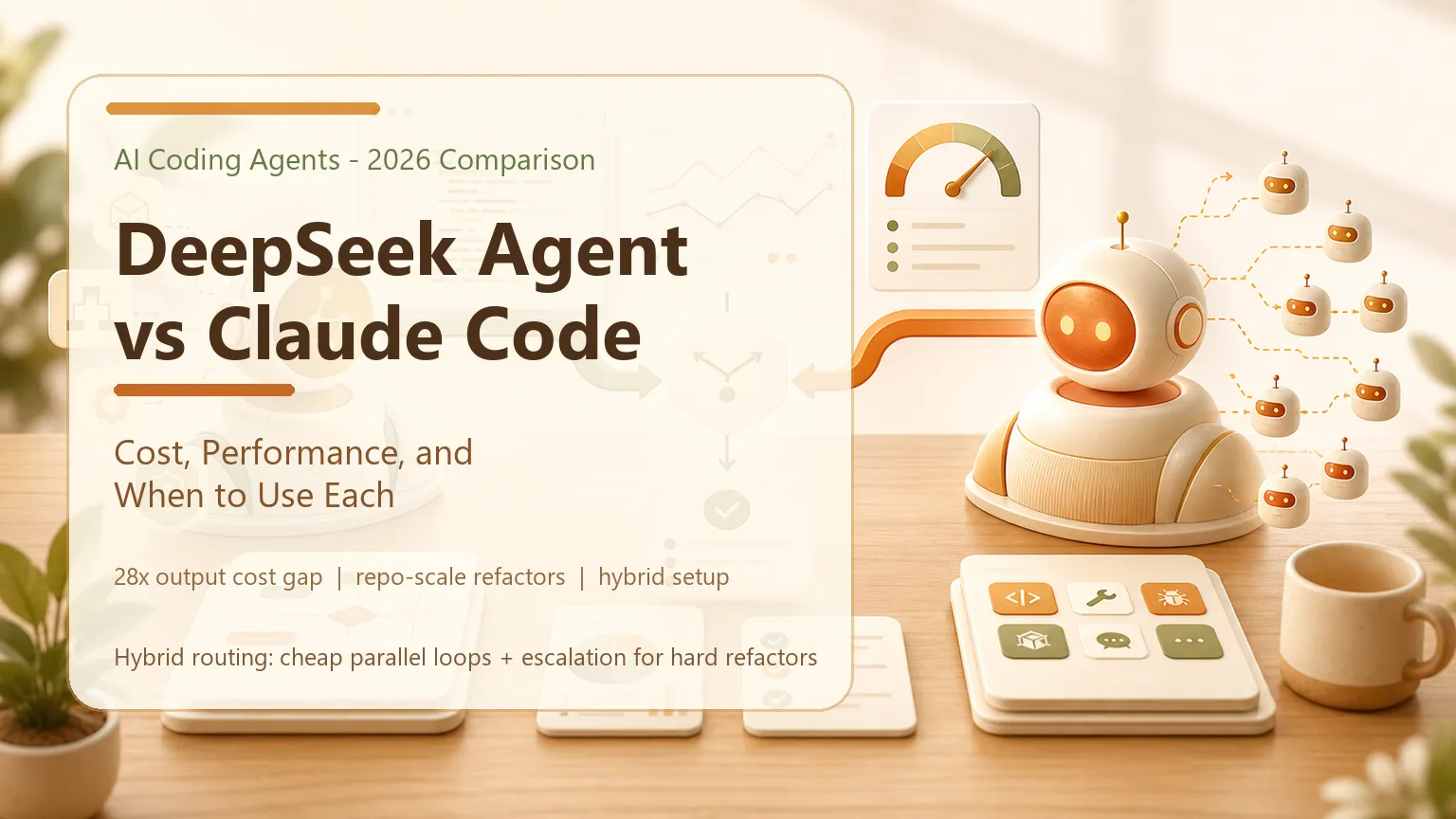
Information checked October 13, 2026. Model aliases, routing behavior, and prices can change; verify the linked vendor pages before buying capacity.
Short answer: Claude Code is a coding-agent harness. “DeepSeek Agent” usually means a coding harness powered by a DeepSeek model. DeepSeek officially documents running Claude Code against its Anthropic-compatible endpoint, so the useful buying question is often Claude Code with Anthropic models versus Claude Code with DeepSeek, not one product versus another.
What is actually being compared?
Anthropic describes Claude Code as a terminal coding assistant. Its CLI provides interactive and non-interactive modes, model selection, session resume, MCP configuration, and permission modes; the CLI reference is the authoritative feature list.
DeepSeek is the model provider in the second setup. Its official Claude Code integration guide documents https://api.deepseek.com/anthropic, the environment variables used by Claude Code, and mappings between Claude-style names and DeepSeek models. This keeps much of the harness experience while changing the model endpoint, billing, latency, and compatibility surface.
If you instead choose a DeepSeek-native client, you are comparing two harnesses as well as two models. Separate those decisions. A model benchmark cannot tell you whether a tool has the permission prompts, diff review, session recovery, policy controls, or integrations your team needs. For a broader taxonomy, read what a DeepSeek agent can mean.
Current model and price facts
DeepSeek’s models and pricing page lists deepseek-flash as DeepSeek-V4.1-Flash and deepseek-v4-pro as DeepSeek-V4-Pro-0813. Both expose a 1M context window and up to 384K output in the published table. V4.1-Flash supports vision; V4 Pro does not.
Pricing is peak-sensitive. The official table currently lists V4.1-Flash cache-miss input at $0.15 off-peak or $0.30 peak per million tokens, and output at $0.60 or $1.20. V4 Pro is $0.66/$1.32 for cache-miss input and $1.98/$3.96 for output. Cache-hit input is cheaper. DeepSeek also states that deepseek-v4-pro requests began routing to V4.1-Flash on September 14 while V4.1-Pro is pending, so an alias may not identify a fixed underlying checkpoint. That routing fact matters more than a stale “Pro versus Flash” benchmark table.
Anthropic API prices and Claude Code subscription access are separate commercial choices. Do not compare a DeepSeek API token rate with a Claude subscription allowance as if they were the same unit. Build a task-level cost comparison from your own traces: input, cache hits, output, retries, tool calls, and failed runs.
Where Claude Code remains the decision
Choose the Claude Code harness when its operational controls are the requirement: familiar terminal workflow, documented permission modes, session continuation, MCP management, and an established team configuration. Anthropic also documents LLM gateway configuration for centralized authentication, budgets, routing, and audit logging, while warning that third-party gateways are not maintained or audited by Anthropic.
Using a non-Anthropic endpoint does not guarantee full parity. Test tool schemas, prompt caching, extended thinking, web search, image input, error handling, and model-name mappings. DeepSeek’s guide documents web search and routing behavior for its endpoint, but the behavior may differ from Anthropic’s service and may generate additional token charges.
A defensible evaluation
Use the same repository snapshot and 20–30 representative tasks. Include a small fix, a multi-file refactor, a test failure, an ambiguous requirement, and a task that should be refused without approval. Record:
- task completion and reviewer acceptance;
- changed files and regression rate;
- elapsed time and retries;
- input, cached input, and output tokens;
- permission or tool-call failures;
- total cost per accepted task.
Keep the harness settings, tools, and approval policy constant. Run each task more than once if variance matters. Public coding benchmarks can inform a shortlist, but harness, prompt, and scoring differences make headline scores poor substitutes for repository-specific acceptance tests.
Which should you choose?
- Choose native Claude Code with Anthropic access when vendor-supported behavior and the Claude model stack matter more than the lowest token price.
- Test Claude Code with DeepSeek when your workloads are price-sensitive and the official compatibility endpoint covers the tools you use.
- Test a DeepSeek-native harness only when it offers a concrete workflow advantage; otherwise you are changing two variables at once.
- Avoid automatic model routing until logs show which tasks can move safely. Start with low-risk, reversible work and require review before merge.
For the API-side economics behind the DeepSeek option, see DeepSeek V4 API pricing for solo operators. The final choice should follow accepted-task cost and failure behavior, not a claimed universal winner.
Related posts

Local-First vs Cloud Agent Workspaces: Which Fits?
Compare local-first and cloud agent workspaces across files, privacy, background execution, connectors, reliability, and control—then…
Best Markdown Editors in 2026 — Ranked by Workflow, Not Features
Obsidian, Typora, VS Code, Zettlr, iA Writer and more, ranked by workflow fit. What each editor trades away, and where browser tools beat…
Math in Markdown: LaTeX Syntax and Where It Renders
How math in markdown works: dollar-sign LaTeX syntax, where it renders (GitHub, Obsidian, Jekyll), the KaTeX vs MathJax split, and honest…
https://floatboat.ai/blog/deepseek-agent-vs-claude-code