Best Claude Cowork Alternatives for Office Work
Compare Microsoft 365 Copilot, Gemini for Workspace, ChatGPT Work, Manus, and Floatboat by files, app access, approvals, and finished deliverables.
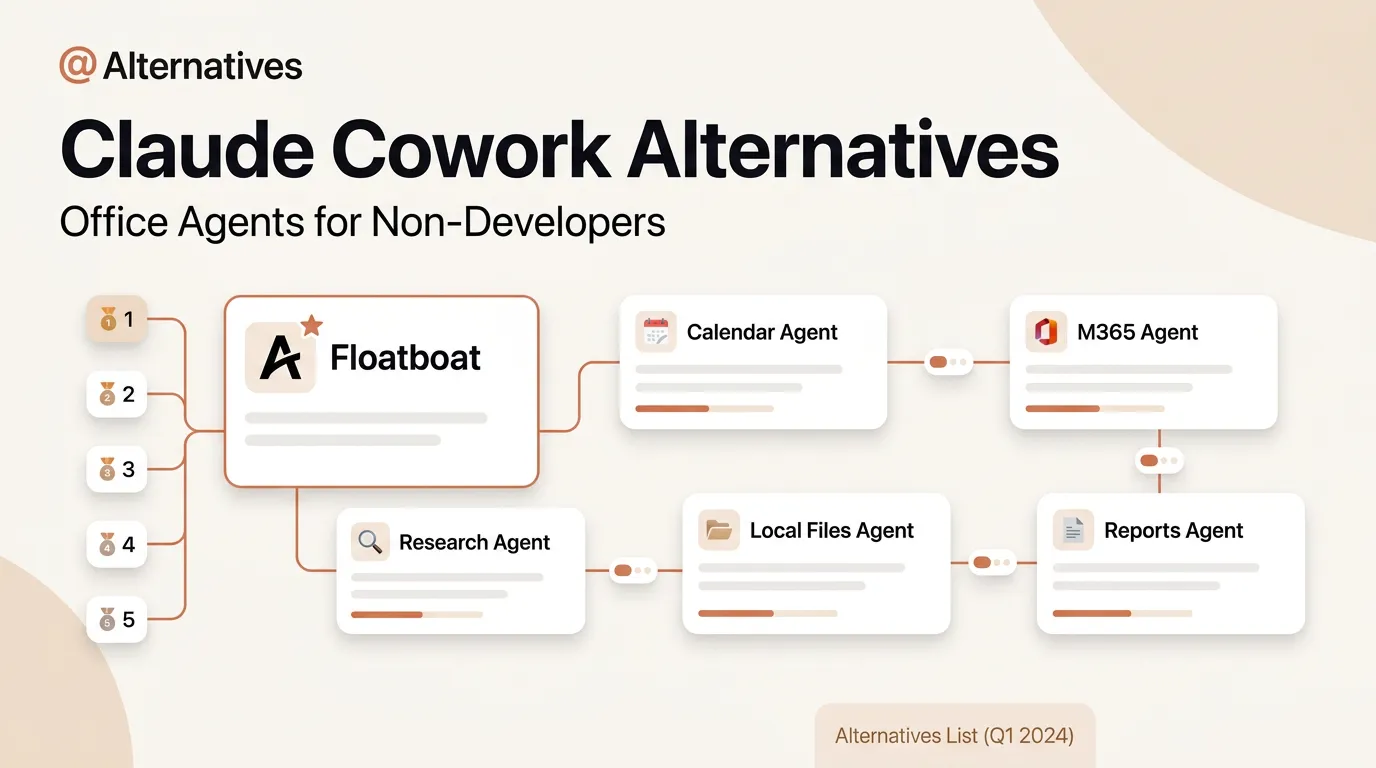
Claude Cowork is built for multi-step knowledge work across files, connected tools, and office deliverables. The right alternative is not necessarily the chatbot with the best prose. It is the system that can reach the documents you are allowed to use, produce the required artifact, pause at the right approval point, and leave enough evidence to review the work.
Cowork is only one of Anthropic's agent surfaces. The practical differences among Claude Code, Cowork, and Tag matter because a repository task, a personal office task, and a shared channel assignment require different permissions and review loops.
For Microsoft-heavy organizations, Microsoft 365 Copilot has the strongest native context. Gemini for Google Workspace is the natural choice for work centered on Gmail, Drive, Docs, Sheets, and Slides. ChatGPT Work is the broadest general-purpose option across research, connected apps, and local or cloud tasks. Manus fits cloud-first browser delegation. Floatboat is relevant when work should start from a calendar event on a desktop rather than from a chat prompt.
Cowork alternatives at a glance
| Alternative | Best fit | Data boundary | Key limitation to test |
|---|---|---|---|
| Microsoft 365 Copilot | Word, Excel, PowerPoint, Outlook, Teams | Microsoft Graph and tenant controls | Licensing and admin configuration |
| Gemini for Workspace | Gmail, Drive, Docs, Sheets, Slides | Google Workspace permissions | Cross-app features vary by edition and rollout |
| ChatGPT Work | Research plus mixed connected tools | Workspace apps and selected execution environment | App permissions and action approvals differ |
| Manus | Browser-heavy cloud delegation | Managed cloud workspace | Sensitive logins and action review |
| Floatboat | Calendar-triggered desktop workflows | Local desktop plus configured integrations | Not a suite-native document copilot |
1. Microsoft 365 Copilot: best for governed Microsoft work
Microsoft 365 Copilot is the strongest Cowork alternative when the source material already lives in SharePoint, OneDrive, Outlook, Teams, Word, Excel, and PowerPoint. Microsoft also provides specialized agents such as Researcher, which can combine work content with web research, and Analyst for data-oriented work.
Its advantage is not a generic model claim; it is identity and context. Existing Microsoft permissions can govern what a user and an agent can retrieve. That makes it a better fit for an enterprise report assembled from internal email, spreadsheets, and presentations than a separate desktop agent that first needs every source connected.
Test the exact workflow before buying seats. Confirm whether the agent can create the final file—not merely draft text—and whether your administrator has enabled the required agents. Researcher with computer use, for example, has had separate availability conditions. A feature visible in a launch post may not be enabled in your tenant.
2. Gemini for Google Workspace: best for Google-native teams
Gemini is the most direct alternative for organizations whose work graph is Gmail, Drive, Docs, Sheets, Slides, and Chat. Google describes Gemini as able to orchestrate cross-app work and produce formatted documents, structured spreadsheets, and presentations from selected Workspace context. See Google's official Workspace announcement.
Choose it when moving files out of Google Workspace would add friction or violate policy. The important evaluation is permission fidelity: use test accounts with different Drive access and confirm that citations, generated files, and sharing settings behave as expected. Also verify edition and regional availability, because Workspace features roll out gradually.
3. ChatGPT Work: best for mixed research and execution
ChatGPT Work is a broad option when a task spans web research, connected services, files, and an execution environment. OpenAI's connected-app documentation explains only the app layer: authorized services can provide information and, where supported, actions. The separate ChatGPT Work and Codex guide documents how Work handles longer research and deliverable tasks and distinguishes local and cloud execution.
This breadth is useful for teams whose documents are not confined to one office suite. It also means governance must be explicit. An app that can search data may not support writes; an action may require approval; a local task and a cloud task have different data boundaries. Inventory permissions per workflow instead of assuming every connector behaves the same way.
4. Manus: best for browser-heavy cloud assignments
Manus is oriented toward cloud execution: the agent can research, navigate web tools, and assemble outputs while the user is away. It is a candidate for market scans, data gathering, travel research, and other browser-heavy work where the primary inputs are online rather than a governed local file tree.
That same strength creates the main risk. A cloud browser may encounter login credentials, personal data, downloads, or instructions embedded in untrusted pages. Pilot with low-risk accounts, require confirmation before consequential actions, and inspect the session record. Verify current capabilities and limits in the official Manus documentation, because packaging changes faster than a static comparison article can.
5. Floatboat: best when the calendar should start the work
Floatboat addresses a narrower failure mode: the user should not have to remember to open an agent before a meeting or follow-up. Its Agent Workspace overview presents calendar events as one supported trigger for work in the desktop workspace, alongside other configured inputs.
Choose it when timing is the problem—repeated meeting preparation, client follow-ups, and work tied to a personal schedule. Do not choose it merely because you need better in-document editing. Microsoft 365 Copilot or Gemini will usually fit suite-native authoring better, while Cowork remains strong for an Anthropic-centered file-and-tool workflow.
For a deeper test of this trigger model, compare calendar-driven AI with chat-based AI: the important distinction is whether work begins because a person remembers to ask or because an event reaches its scheduled time.
When Claude Cowork remains the better fit
Cowork is still compelling when you want Claude to work across files and connected tools, produce office artifacts, and multitask from one Claude environment. Anthropic's scheduled-task documentation says recurring Cowork tasks can use connected tools, skills, and plugins and deliver reports, briefings, and summaries. Paid-plan and surface availability can vary; check the current help article.
Stay with Cowork when its connectors cover your systems, reviewers prefer Claude's workflow, and the permission boundary is acceptable. Switch only for a concrete advantage: native Microsoft or Google context, a broader mixed-tool environment, cloud-browser delegation, or calendar-triggered execution.
Run a deliverable test, not a prompt contest
Choose three recurring office jobs, such as a weekly client brief, a spreadsheet-to-slide update, and meeting follow-up. For each candidate, use the same source set and require the same final format.
Score the result on:
- Source coverage: did it find the authorized email, file, and record that mattered?
- Artifact quality: is the output a usable document, sheet, or deck rather than text to copy elsewhere?
- Permission fidelity: can a restricted user reproduce only what they are allowed to see?
- Approval design: does the agent pause before sending, sharing, purchasing, or changing records?
- Correction cost: how long does a reviewer need to verify facts and repair formatting?
- Repeatability: can the job run again without rebuilding the instructions from scratch?
Include one adversarial input containing misleading instructions in a document or webpage. The result will reveal more about the product's readiness than a polished vendor demo.
Bottom line
The best Claude Cowork alternative follows the location of the work. Microsoft 365 Copilot wins when company knowledge and artifacts live in Microsoft 365. Gemini fits a Google Workspace organization. ChatGPT Work covers a mixed toolset. Manus suits cloud-browser assignments. Floatboat is differentiated by calendar-triggered desktop work.
Start with the systems that hold your data, then evaluate the artifact, permissions, and review burden. Model preference comes after those constraints—not before them.
Related posts

Local-First vs Cloud Agent Workspaces: Which Fits?
Compare local-first and cloud agent workspaces across files, privacy, background execution, connectors, reliability, and control—then…
Best Markdown Editors in 2026 — Ranked by Workflow, Not Features
Obsidian, Typora, VS Code, Zettlr, iA Writer and more, ranked by workflow fit. What each editor trades away, and where browser tools beat…
Math in Markdown: LaTeX Syntax and Where It Renders
How math in markdown works: dollar-sign LaTeX syntax, where it renders (GitHub, Obsidian, Jekyll), the KaTeX vs MathJax split, and honest…
https://floatboat.ai/blog/best-claude-cowork-alternatives