
Vibe Coding a One-Prompt HTML Game with Kimi K3
How vibe coding ships a one-prompt HTML game: Kimi K3 in Floatboat built a walkable Art Deco town as one browser-playable file.
1. What Most People Get Wrong About One-Prompt HTML Games
Most “AI made a game” videos optimize for surprise, not for a file you can send a client. The prompt asks for Tetris or Flappy Bird — games that already exist in thousands of GitHub repos — and the model regurgitates a familiar pattern. That proves autocomplete works. It does not prove you can commission a unique, explorable world and get something playable without a second afternoon of repair.
The second mistake is treating “one HTML file” as a party trick instead of a distribution constraint. A single-file deliverable means no bundler, no node_modules, no deploy pipeline argument with your hosting team. It also means the model must keep rendering, input, audio (if any), and state inside one document. When that constraint holds, the artifact is shareable the same way a PDF is shareable: send the file, open it, play.
The third mistake is confusing vibe coding with abandoning judgment. Andrej Karpathy’s framing of vibe coding — describe the outcome in natural language and let the model produce the code — still leaves you responsible for the pass/fail bar. For browser games, that bar is concrete: Can I walk? Do NPCs move? Does lighting change? Is there something to discover? If those answers are yes after one prompt, you have a demo. If they are “almost, after I fix the camera,” you have a homework assignment.
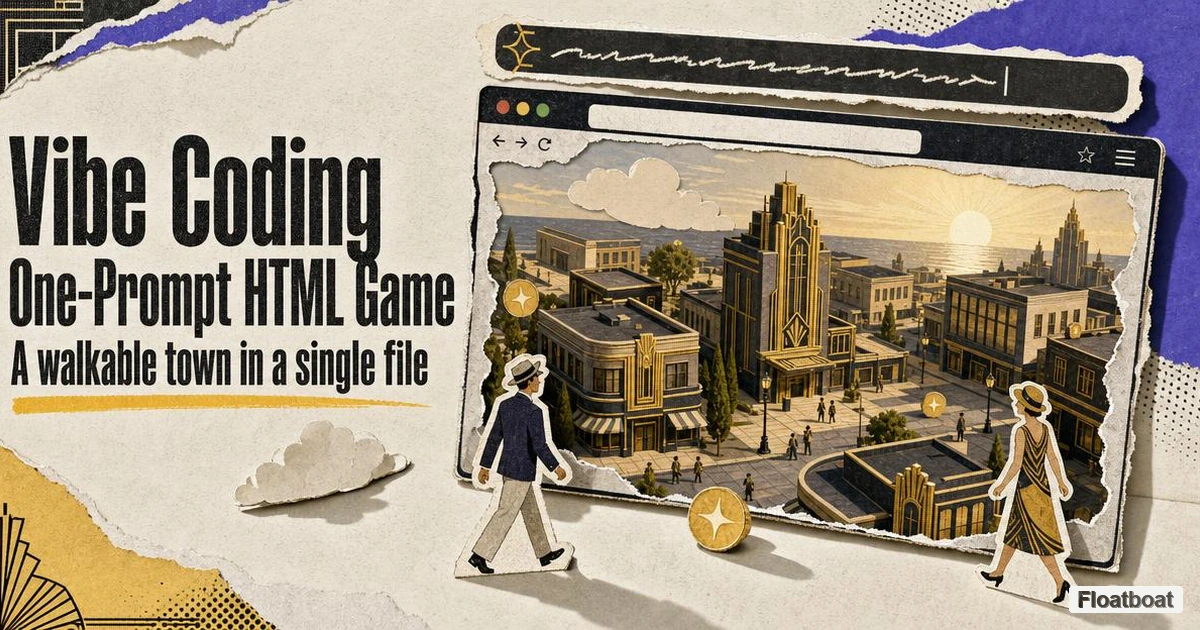
The Art Deco town demo matters because it fails the easy-regurgitation test. Isometric walkable cities with day-night lighting, volumetric cloud shadows, and collectible sparks are not the default homework problem of coding benchmarks. Watching K3 emit that stack as one HTML file inside Floatboat resets the expectation for what a vibe coding game session can ship in a single pass, as shown in Floatboat's demo.
2. The One-Prompt Game Pipeline: Four Stages
A shippable one-prompt HTML game is not “type a sentence and hope.” It is a short pipeline where each stage exists to stop a specific failure mode. Skip a stage and you get impressive screenshots that die in the browser.
2.1 Stage 1 — Constraint the World Before You Constraint the Stack
The prompt should name the player verb first: walk, collect, talk, defend. Then it should name the world type: isometric, top-down, side-scroller. Then the aesthetic: Art Deco, not “nice city.” Only after that should it mention delivery: single HTML file, no external assets, runs in Chrome. Models that are strong at frontend — Kimi K3 ranks first on Arena.AI’s Frontend Code Arena with 1,679 points — still need that order, because an unbounded “make a cool town” prompt invites decorative scenes without input loops, as reported by VentureBeat.
Why this stage matters: every missing verb becomes a feature you will hand-code later. The Art Deco demo’s verbs were walk and discover; the systems (citizens, clouds, sparks, day-night) hung off those verbs instead of floating as cinematic wallpaper.
2.2 Stage 2 — Demand Playable Systems, Not Scene Description
“Beautiful lighting” is not a system. A day-night cycle with shadow-casting volumetric clouds is. “Busy streets” is not a system. Fourteen wandering citizens with paths is. When you vibe code a browser game, force the prompt to list countable systems: N NPCs, N collectibles, named cycle, named camera. Countables are what you verify in sixty seconds after the file lands.
Why this stage matters: generative models love atmosphere. Solopreneurs need acceptance tests. Countables turn a vibe into a checklist without killing the vibe.
2.3 Stage 3 — Generate Inside a Workspace That Can Open the File
The historical failure mode of AI game demos is copy-paste theater: the model prints code into chat, you paste it into an editor, path errors appear, modules refuse to load from file://, and the demo dies. Generating inside Floatboat with Kimi K3 already selected collapses that loop — the agent workspace is where the instruction lands, where the HTML is produced, and where you open the result without provisioning a Moonshot API key or a separate coding IDE, as covered in Kimi K3 in Floatboat.
Why this stage matters: one-prompt only counts if the human steps between prompt and play stay near zero. Tooling friction is how “one prompt” quietly becomes twelve.
2.4 Stage 4 — Playtest Against the Countables, Then Decide Iterate vs Ship
Open the HTML. Walk. Wait for dusk. Watch a cloud shadow. Find a spark. If three of four systems work, you ship the demo and schedule polish. If the camera is broken, you do not rewrite the prompt from scratch — you send a surgical follow-up: “keep the town; fix collision on the north plaza stairs.” That is still vibe coding; it is just vibe coding with a regression bar.
Why this stage matters: the myth of the perfect single shot creates either fake demos or abandoned projects. Real pipelines assume a short verify step.
| Stage | Failure it prevents | Pass signal |
|---|---|---|
| Constrain world → stack | Pretty scenes with no verbs | You can name the player action in one word |
| Countable systems | Atmosphere without mechanics | N NPCs / N collectibles / named cycles |
| Generate in-workspace | Copy-paste and file:// death | File opens and accepts input |
| Playtest countables | Shipping broken demos | Walk + one system works under a minute |
The table is the whole method. Everything else — model choice, Art Deco flourishes, volumetric clouds — is payload inside those four gates.
3. What a Calendar-Driven Setup Changes for Vibe Coding
Chat-based vibe coding starts when you remember to open the chat. Calendar-driven work starts when the event arrives. That difference matters once “make a prototype” is no longer a weekend hobby but a client commitment on Tuesday at 2pm.
On an agentic calendar, a “Prototype due” or “Design review” event can trigger the same K3 visual-reasoning path that built the Art Deco town: generate or regenerate the HTML, open it, capture a frame, compare against the brief, and leave notes in the event workspace before you join the call. You are not asking the model to manage your calendar. You are letting the calendar decide when the expensive visual model runs.
That is also where cost discipline shows up. K3’s always-on max reasoning is the right tool for a one-shot world with lighting and agents; it is the wrong default for renaming buttons. Pairing K3 for the generative burst and a cheaper coding tier for follow-up fixes mirrors how you would staff a tiny studio — lead artist for the first playable, junior pass for polish — except both tiers sit in one model picker.
For a deeper map of when to reach for K3 versus K2.7 Code on ordinary meeting work, see the Kimi K3 model overview. The game demo is the stress test; the calendar routing is the daily habit.
4. Setting This Up for Your Own Workflow
If you already use Floatboat, select Kimi K3 in the agent workspace model picker. No API key, no OpenRouter detour, no separate “game mode.” Write a prompt that follows the stage order from Section 2: verb, world, aesthetic, countable systems, single-file delivery. Example shape (adapt freely):
Build a walkable isometric Art Deco town as one self-contained HTML file. Player can walk the streets. Full day-night cycle. 14 wandering citizens. Volumetric clouds casting real-time shadows. Hide 10 golden sparks to collect. No external assets. Must run by opening the file in a browser.
Then playtest with the countable checklist. If you are preparing this for a client, attach the HTML to the calendar event that owns the review, and let the next agent pass open the file before the meeting instead of during it.
If you are new to Floatboat: download the desktop app, connect the calendar you already live in, create an agent pipeline for “interactive prototype,” and set K3 as the model for that pipeline. Auto Mode can stay on for everything else so you do not burn max-reasoning tokens on triage. Treat the first week as calibration: run two short prompts with different aesthetics, keep the same countable checklist, and note which failures are prompt issues versus model noise. That log becomes your personal acceptance suite for later client work.
When not to use this path: shipping a multiplayer production game, a Unity/Unreal title, or anything that needs authenticated backends and asset pipelines. One-prompt HTML games are for explorable demos, pitchable toys, teaching tools, and client-facing prototypes. Using them as a substitute for a full studio production is how vibe coding gets a bad reputation it does not deserve.
5. From Demo Town to Repeatable Prototype Habit
The Art Deco town is a headline because it is visually dense. The durable asset is the habit: one constrained prompt, one file, one playtest, one calendar slot that owns the next review. Solopreneurs who internalize that loop stop treating interactive prototypes as “maybe next quarter” and start treating them like slide decks — something you can produce before a call when the brief is clear.
Three recurring patterns fit the same habit without pretending every brief needs a full game. A sales prototype shows a prospect the interaction instead of describing it in a deck — walkable product spaces, store layouts, or onboarding flows packaged as HTML. A design review artifact gives stakeholders something to click before opinions harden around static mockups. A teaching demo lets a workshop audience open one file and immediately feel the mechanic you are explaining. In each case the success metric is the same: someone outside your head can play the idea in under a minute.
Search demand clusters around phrases like vibe coding, one prompt game, and single file HTML game because people want proof that the loop is short. The Art Deco clip is proof. The calendar-attached HTML is the operating system. If you only chase the clip, you will regenerate towns forever. If you attach the file to the event that owns the decision, the demo becomes work product.
That is the quiet shift underneath the viral clip. The clip proves K3 can vibe-code a world. The workflow proves you can make “show me something playable” a recurring deliverable instead of a once-a-year miracle. Keep the countables. Keep the single file. Keep the model inside the workspace that already runs your week.
6. Conclusion
One-prompt HTML games are real when three things line up: a prompt that encodes verbs and countable systems, a model with native visual and frontend strength, and a workspace that can open the file without a scavenger hunt. Kimi K3 inside Floatboat cleared that bar on an isometric Art Deco town with day-night lighting, roaming citizens, cloud shadows, and hidden sparks — not as a slideshow, but as a browser-playable HTML file. Steal the pipeline, not just the aesthetic. The next prompt should be yours.
https://floatboat.ai/blog/vibe-coding-one-prompt-html-game