
GLM-5.3 Open-Weight Status: Verify Before Self-Hosting
How to verify GLM-5.3 weight availability, license terms, and self-hosting requirements before comparing them with the hosted API and Coding Plan.
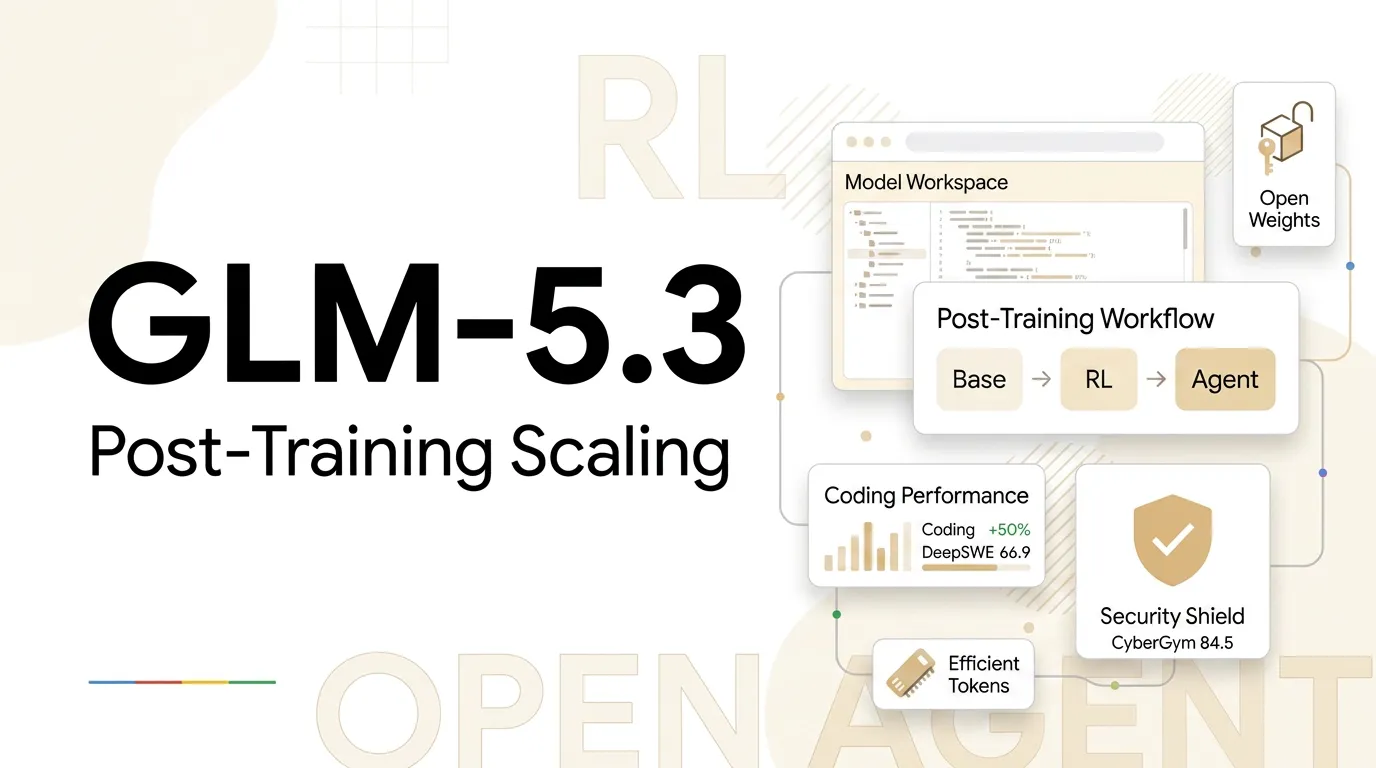
GLM-5.3 is best understood as a deployment choice, not a benchmark headline. A team can call Z.ai's hosted API, use the Coding Plan inside supported coding agents, or wait for and verify an open-weight artifact and its license before self-hosting. Those routes have different contracts, costs, and operational burdens.
Verified October 13, 2026 against Z.ai's current release material.
Three ways to run GLM-5.3
The hosted route uses model ID glm-5.3 on the Z.ai API. The official release also says GLM Coding Plan users can select it in ZCode and compatible coding agents. Those subscription quotas are not interchangeable with API token billing.
Self-hosting is a third route. The launch post said weights would follow after safety evaluation; do not treat that launch promise as proof of today's downloadable artifact or commercial terms. Before deployment, verify the linked repository, checksum, model card, and the exact license attached to the files. “Open weights” does not automatically mean OSI-approved open source or unrestricted hosted service.
The API change that can break an existing client
GLM-5.3 always uses thinking. Z.ai documents reasoning_effort values low, high, and max, with max recommended for coding. Requests that send thinking.type: disabled must be changed to enabled; otherwise migration can fail before quality is measured.
That makes an adapter test essential: validate streaming events, reasoning_content handling, tool-call JSON, cancellation, token accounting, and retry behavior. If your gateway exposes an OpenAI-compatible chat-completions channel, compatibility still has to be demonstrated field by field.
Context and agent fit are workload questions
The release focuses on long-horizon coding and reports gains over GLM-5.2 from post-training rather than a new base model. Its benchmark numbers are vendor-reported and harness-dependent. They support a test hypothesis—better sustained coding—not a production SLA.
Build a repository suite with issue reproduction, patch generation, tests, and rollback. Add one non-code tool workflow to see whether the model's planning transfers. Building an agent provides a permission-and-evaluation scaffold; building one with ChatGPT is a useful hosted-entry-point comparison; AI agent versus assistant helps decide whether autonomous execution is needed at all.
Price the route you will actually operate
Z.ai's API platform is the current source for token products and sales terms; the Coding Plan overview defines subscription access and quotas. Record the currency, input, cached-input, and output units shown at purchase time. For self-hosting, token price disappears but GPU reservation, replicas, storage, networking, observability, and on-call work replace it.
A fair comparison uses monthly accepted tasks:
hosted tokens + tool services + retries versus accelerators + idle capacity + platform labor + failure recovery.
Open-weight due diligence
Do not approve a deployment from a blog label. Archive the model card and license version; check redistribution, modification, hosted-service, and acceptable-use clauses; identify the serving stack and supported quantization; then benchmark the exact artifact. A 743B-class base or highly sparse MoE still demands serious memory and interconnect planning even when only part of the network activates per token.
Decision
Choose hosted GLM-5.3 when you want the model without operating inference. Choose Coding Plan when developer-seat access matches the workload. Consider weights only when data control or customization justifies infrastructure and legal review. The model's strongest public case is long-horizon coding, but the buying decision is deployment route plus verified task economics.
Related posts

OpenAI GPT-6 Cyber: Who Gets Access and What It Can Do
OpenAI’s GPT-6 Cyber starts with a limited Daybreak Red rollout. Check eligibility, Codex and API access, and token pricing, then see how…

GPT-6.1 Sol: Pricing, Benchmarks, Availability, and How It Compares
GPT-6.1 Sol brings near-Astra coding, computer use, and professional-work performance at one-fifth of Astra's token prices. Here is what…

What Is Jev? The AI Model That Never Writes Text
Jev is TypeSafe AI's System One model: typed probabilistic decisions instead of generated text, claimed 193.6x faster and 444.6x cheaper.…
https://floatboat.ai/blog/glm-5-3