Best Claude Tag Alternatives for Shared AI Work
Compare Agentforce in Slack, Microsoft Copilot agents in Teams, Glean, Moveworks, and FloatIM by shared context, permissions, actions, and governance.
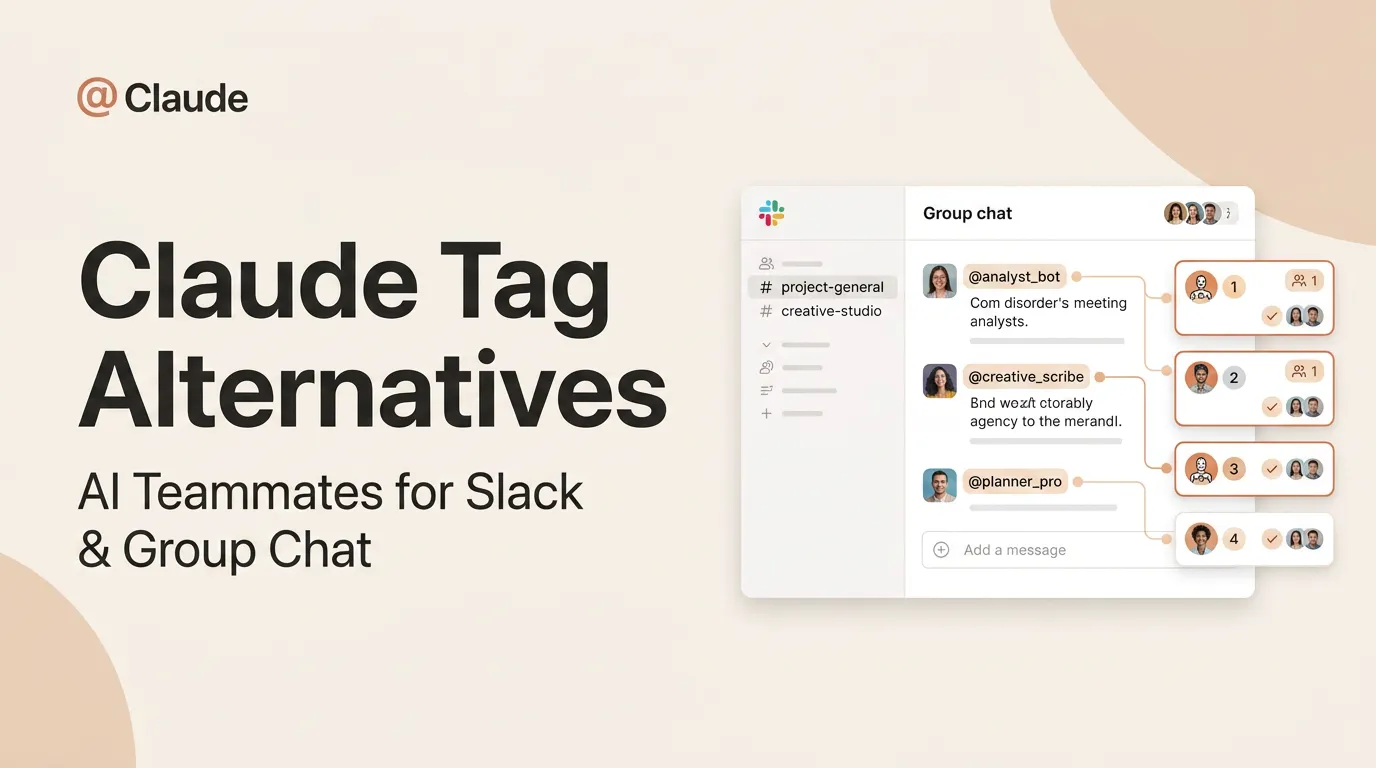
Claude Tag puts a shared Claude teammate in Slack: people can mention it in a channel, delegate work, see the response in a thread, and build context over time. Anthropic launched Tag in beta for Claude Team and Enterprise customers in June 2026 and says administrators can set spend limits and inspect activity logs.
For the product's scope, shared-context model, and rollout details, start with what Claude Tag is. This comparison focuses on the decision that follows: which other system can satisfy the same team-visible job.
An alternative should therefore be judged as a shared-work agent, not as a private chatbot. The important questions are: Does everyone see the same task? Whose permissions govern retrieval and actions? Can the agent act in the systems the team uses? Can administrators bound cost and risk?
Best Claude Tag alternatives at a glance
| Alternative | Best for | Shared venue | Distinctive boundary |
|---|---|---|---|
| Agentforce in Slack | Salesforce-centered Slack organizations | Slack channels, DMs, agent directory | Salesforce data, actions, and licensing |
| Copilot agents in Teams | Microsoft 365 organizations | Teams channels, group and meeting chats | Microsoft identity and Copilot Studio |
| Glean Agents | Enterprise search grounded agents | Slack, Teams, and Glean | Broad enterprise knowledge retrieval |
| Moveworks | Employee support and service workflows | Slack, Teams, and employee portal | IT/HR/service automation |
| FloatIM | Agent-native multi-agent rooms | Dedicated group-chat network | New collaboration surface rather than a Slack add-on |
1. Agentforce in Slack: the closest Slack-native substitute
Agentforce is the most direct alternative for a company that wants to remain in Slack but does not want its shared teammate tied to Anthropic. Organizations build purpose-specific agents in Salesforce, add them to Slack, and let authorized members interact in channels or direct messages. Slack's official usage guide says agents use the member's Slack and Salesforce permissions when producing answers.
This is a strong fit for customer, sales, onboarding, or employee-help workflows backed by Salesforce data and actions. It is not a drop-in bargain version of Tag. Slack plans require an Agentforce license, setup crosses Salesforce and Slack administration, and some users may need Salesforce access or provisional licensing. Choose it for Salesforce-native execution, not merely because it appears in the same channel.
2. Microsoft Copilot agents: best for Teams organizations
Microsoft lets organizations publish Copilot Studio agents into Teams and add them to channels, group chats, and meeting chats. Team members can mention an agent and see its response together. Microsoft documents how conversation history can be supplied as context when the collaborative scope is enabled in Copilot Studio.
The advantage is organizational fit: Entra identity, Microsoft 365 data, Teams collaboration, and admin controls can stay in one estate. It is the wrong choice if Slack is non-negotiable or if the team wants one ready-made general teammate rather than building and governing specialized agents. Preview and rollout states also matter; verify the exact Teams mode in your tenant.
3. Glean Agents: best when finding company knowledge is the hard part
Glean's core strength is enterprise search across many business systems. Its agents are relevant when a shared teammate must first locate authoritative company knowledge before drafting an answer or starting a workflow. This can fit support escalation, policy questions, account research, and engineering knowledge discovery across Slack or Teams.
Glean is less compelling for a small team with little fragmented knowledge, or when the primary need is an autonomous coding teammate. During a pilot, inspect source citations, permission trimming, stale-content handling, and what actions are available after retrieval. Use Glean's official Agents overview to confirm current channels and integrations.
4. Moveworks: best for employee service workflows
Moveworks focuses on employee support across IT, HR, finance, and other service functions. It belongs on this list when “tag an AI teammate” really means “resolve an access request, answer a policy question, or move an internal service workflow forward” from Slack or Teams.
That specialization is valuable but narrower than Tag's general delegation story. Evaluate resolution quality, handoff to a human, identity propagation, and auditability for each workflow. If the team wants open-ended product analysis or codebase work in a channel, an employee-service platform is not automatically the right substitute. Current product scope is documented on the Moveworks platform site.
5. FloatIM: best when the room is designed around agents
FloatIM takes the most structurally different approach. Its product overview describes a dedicated messaging network where humans and agents can participate in group conversations. It is relevant to teams willing to evaluate a separate, agent-oriented collaboration surface instead of attaching another assistant to Slack.
That also creates the clearest migration cost. The organization must adopt another collaboration surface, define which discussions belong there, and decide how records connect to existing Slack or Teams governance. FloatIM should be piloted for multi-agent coordination, not selected as a generic way to avoid another vendor's seat price.
When Claude Tag is still the right choice
Stay with Claude Tag if your organization already uses Slack, already has Claude Team or Enterprise, and wants one Anthropic-native teammate with shared channel context. Anthropic says Tag can work asynchronously, learn from permitted channel context, take initiative when ambient behavior is enabled, and return completed work in threads. Read the launch announcement for current product boundaries.
If the uncertainty is whether this work belongs in a channel at all, compare Claude Code, Cowork, and Tag by execution surface before evaluating vendors. A private file task does not become collaborative simply because its result can be pasted into Slack.
Tag is a weaker fit when Salesforce actions are central, Teams is the mandatory venue, enterprise search is the real bottleneck, service-desk resolution is the job, or you explicitly want a dedicated multi-agent network.
Test the collaboration contract
A shared agent can pass a private demo and still fail in a real channel. Run the pilot with at least five people and two permission levels. Use three jobs: answer a knowledge question, perform a reversible action, and prepare a multi-source team deliverable.
Verify:
- Shared state: can another member understand and continue the task without starting over?
- Identity: does retrieval use the requester's permissions, a service identity, or a shared channel boundary?
- Action approval: who confirms messages, record changes, or external actions?
- Attribution: can an auditor see who requested, approved, and executed the work?
- Context limits: can the agent distinguish public, private, and restricted conversations?
- Failure handling: does a failed action surface clearly, and can a human resume it?
- Cost controls: can an administrator bound usage by workspace, agent, or channel?
Reject a candidate if the team cannot explain its identity model in one diagram. Ambiguous shared permissions are more dangerous than a mediocre answer.
Bottom line
The best Claude Tag alternative follows the collaboration system and the job. Agentforce is the closest Slack-native option for Salesforce workflows. Copilot agents fit Microsoft Teams. Glean is strongest when enterprise knowledge retrieval drives the task. Moveworks focuses on employee service. FloatIM changes the premise by creating an agent-native room.
Do not rank these products on model preference alone. Shared context, identity, approvals, attribution, and failure recovery determine whether an AI teammate is safe and useful after the demo ends.
Related posts

Local-First vs Cloud Agent Workspaces: Which Fits?
Compare local-first and cloud agent workspaces across files, privacy, background execution, connectors, reliability, and control—then…
Best Markdown Editors in 2026 — Ranked by Workflow, Not Features
Obsidian, Typora, VS Code, Zettlr, iA Writer and more, ranked by workflow fit. What each editor trades away, and where browser tools beat…
Math in Markdown: LaTeX Syntax and Where It Renders
How math in markdown works: dollar-sign LaTeX syntax, where it renders (GitHub, Obsidian, Jekyll), the KaTeX vs MathJax split, and honest…
https://floatboat.ai/blog/best-claude-tag-alternatives