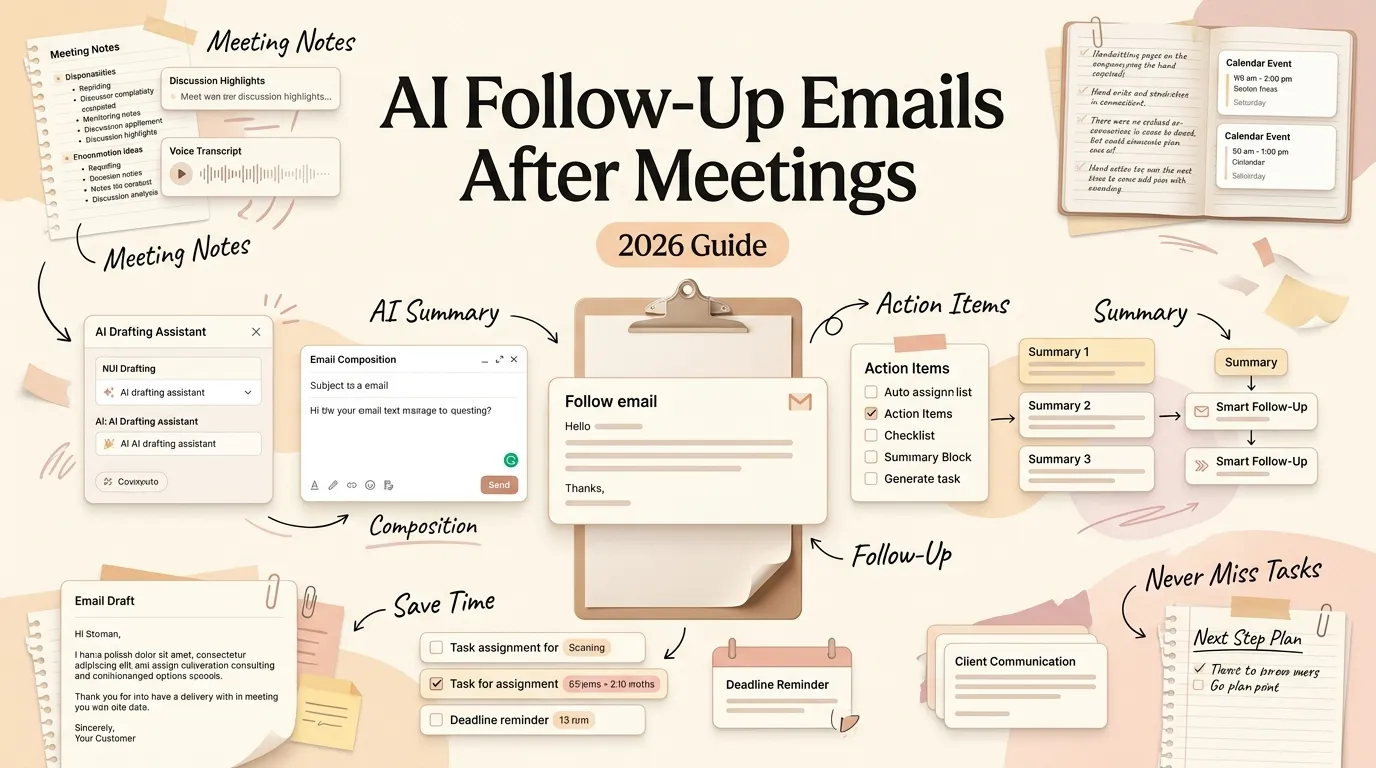
AI Follow-Up Emails After Meetings
Learn how to turn authorized meeting evidence into an AI follow-up email draft, evaluate Claude Opus 4.8 independently, and review commitments before sending.
Information checked October 13, 2026. This guide separates Anthropic's published model claims from meeting-email quality, which must be evaluated independently on representative transcripts.
An AI follow-up email is a reviewed draft built from meeting evidence. It should distinguish confirmed decisions from discussion, preserve uncertainty, and turn only supported next steps into commitments.
What the workflow needs
The safest input is a transcript or approved notes with speaker attribution and timestamps. Recording and transcription require the appropriate participant notice, consent, retention policy, and access controls. If no reliable record exists, the system should request notes or produce no factual follow-up rather than reconstructing the meeting.
A useful pipeline has five stages:
- ingest the authorized transcript or notes;
- extract decisions, owners, dates, and open questions with source evidence;
- draft the message and optional task records;
- ask a person to review recipients, tone, commitments, and sensitive details;
- send or write only after approval, then record the result.
This is related to, but narrower than, AI follow-up automation, which also covers downstream task systems and failure handling. The upstream evidence begins with a well-run meeting-preparation workflow.
What Opus 4.8 changes—and what it does not prove
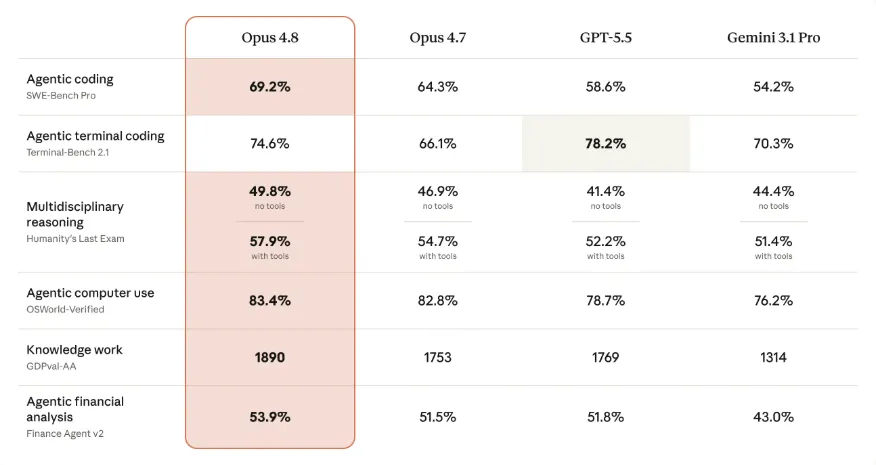
Anthropic's Opus 4.8 announcement reports improvements in agentic work, tool use, and long-running tasks. Anthropic's tool-use documentation explains how models call external functions.
Neither source establishes accuracy for meeting decision extraction or email drafting. Coding benchmarks cannot be used as evidence for this different task. A team should evaluate Opus 4.8 and any alternative model against its own labeled transcripts: measure missed decisions, invented commitments, wrong owners, wrong dates, and the edits reviewers make.
Original visual references
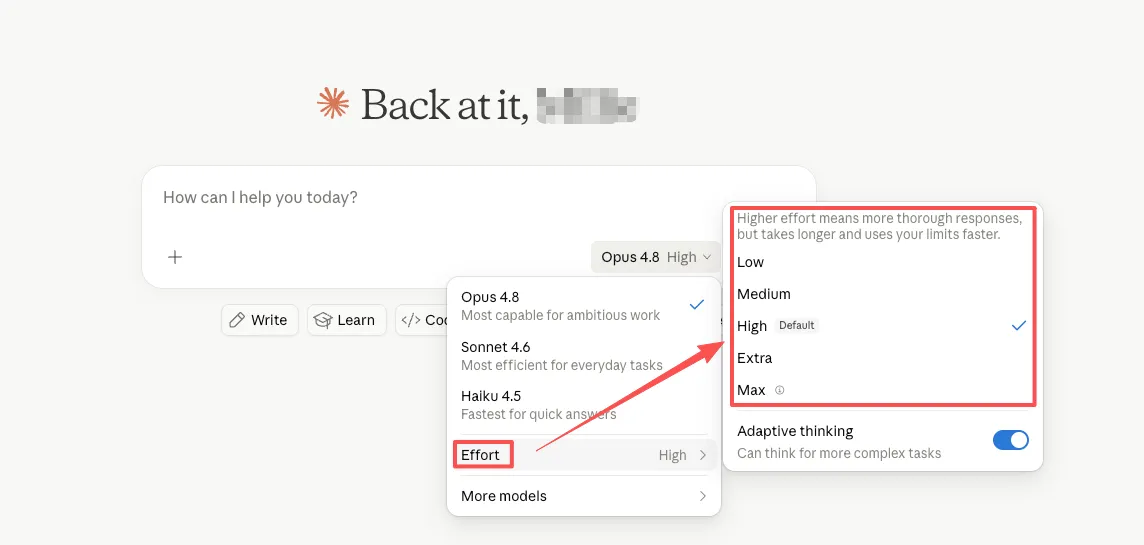
These images are restored from the article's original publication to preserve interface, workflow, and comparison context. Any product UI, pricing, benchmark result, or model availability shown is a historical capture; verify current official information before making a decision.
A review checklist
- Are recipients and confidentiality appropriate?
- Does every decision have transcript or note evidence?
- Are action, owner, and date explicit rather than inferred?
- Are unresolved items labeled as unresolved?
- Does the tone fit the relationship?
- Will sending or task creation require a separate approval?
The model can prepare a structured draft. The accountable person still decides what the organization commits to in writing.
https://floatboat.ai/blog/ai-follow-up-email-opus-4-8