What Is DeepSeek Harness — The Execution Layer for Agents
DeepSeek Harness is DeepSeek's own AI coding agent — the layer that turns V4 into an agent. Architecture, v0.1 open-source release, and benchmark results.
1. Why DeepSeek Is Building a Harness
Three months after V4 Preview shipped in April 2026, DeepSeek found itself in an awkward position. Its models were cheap enough to change the economics of agentic work, but every developer using them for coding was doing so through someone else's tool — Claude Code, OpenCode, Cline, or Codex, all reconfigured to route their API calls to api.deepseek.com. The model was the engine, but Anthropic and OpenAI owned the car.
That division of labor has a real cost. Third-party harnesses are designed around the models they were born with, so they do not exploit the things that make V4 distinctive: prefix caching that serves repeated context at a fraction of the price, a 1-million-token window, and the cheap parallel fan-out that makes running 16 sub-agents under one coordinator economically sensible. A generic harness can access those capabilities, but it was not architected around them.
The strategic pressure is bigger than API optimization. Anthropic proved in 2025 that the value in AI coding concentrates in the workflow layer: Claude Code reached a $25 billion annualized revenue run rate in under a year, and every lab in the industry noticed. The lesson DeepSeek drew was the one its senior researcher Chen Deli put bluntly in May 2026, when he posted that the company was "benchmarking Claude Code, building DeepSeek Code Harness" in a public recruiting call. When your competitor owns the layer between the model and the work, your model becomes a commodity input to their product.
The project also has an internal proof point. DeepSeek had been testing V4 against coding benchmarks for months, and the tests could not fairly run on Claude Code — measuring V4 inside Anthropic's harness conflates the model's capability with the harness's strengths and weaknesses. That is why the official V4-Flash 0731 release notes now carry a footnote: the benchmark scores were produced "using DeepSeek Harness 极简模式 (minimal mode) as the framework, coming soon." DeepSeek needed its own harness to know what its own model could actually do.
2. What DeepSeek Harness Actually Is
2.1 The Core Definition
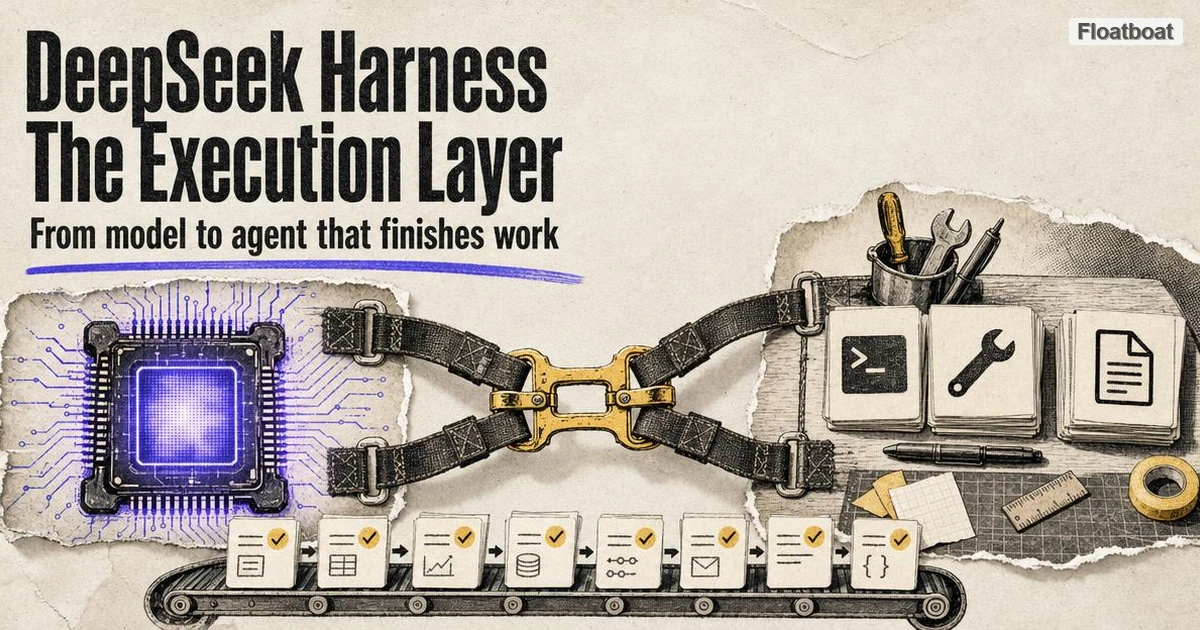
DeepSeek Harness is the execution layer between the DeepSeek V4 model and real software engineering work — the agent framework that manages context, calls tools, executes commands, and recovers from errors so the model can complete multi-step tasks instead of producing isolated code snippets. In the formula the company's own job posting uses, Model + Harness = Agent: the model is the reasoning engine, and the harness is everything else — the loop that turns reasoning into finished work.
For the product-independent version of that definition—covering context, tools, memory, sandboxes, approvals, and recovery—see what an agent harness is.
The term "harness" comes from the agent-engineering community, where it describes the scaffolding around a language model: the prompt assembly, tool definitions, execution loop, context management, and state persistence that turn a chat-completion endpoint into something that can actually act. Claude Code is a harness. OpenCode is a harness. DeepSeek Harness is DeepSeek's own version, built from scratch around V4's specific architecture rather than adapted to it.
2.2 What the Job Posting Tells Us About the Architecture
DeepSeek has not published a spec sheet, but the company's Agent Harness job postings — product manager and R&D engineer roles listed on its site since May 2026 — describe a product with a recognizable shape. The R&D role mentions KV cache exploitation and long-context pruning and compression algorithms, which point to aggressive context management: short tasks stay cheap, hard tasks get the full million-token window. It mentions vector-store selection and session state persistence, which implies a memory layer that survives restarts and remembers a project's structure across sessions. It mentions tool-use chaining with error rollback and automatic retry, and a multi-agent communication protocol with task decomposition and result aggregation — a coordinator model breaking work into sub-agents, a pattern that only makes economic sense on a model as cheap as V4. The JD even describes task-planning graph generation and online execution-path optimization, which suggests the harness plans before it acts and adjusts the plan as it goes.
The most revealing line is the last one: the JD says the goal is to make the model and the harness co-evolve. That is a direct statement that this is not a generic harness — it is a product designed around V4's specific strengths, and one that will feed what it learns back into model training. That closed loop is the structural advantage DeepSeek has over every community harness, and the reason the company needed to build its own rather than keep depending on Anthropic's.
2.3 What DeepSeek Harness Is Not
It is not a chatbot. It is not an IDE. It is not a chat-completion endpoint with function calling bolted on. The difference between a model that can call tools and an agent that completes work is the loop between the calls — the context that survives from one step to the next, the error handling that keeps a failed tool call from killing the task, and the state that lets the model pick up where it left off after an interruption. Harness is the name for that loop. In our breakdown of DeepSeek Agent function calling, we covered the raw tool-calling layer; a harness is the layer that wraps that capability into something that finishes jobs.
3. Where the Architecture Comes From
The person DeepSeek put in charge of Harness is not an AI researcher, and that choice tells you what the product is about. Cui Tianyi joined DeepSeek in March 2026 to lead the new team. Before that he spent nine years at Jane Street building quantitative trading systems, then co-founded the Hong Kong quant fund TSY Capital. Trading infrastructure is obsessed with exactly the properties an agent harness needs: execution speed measured in milliseconds, automatic recovery when a subsystem fails, comprehensive logging of every step, and deterministic state so the system never silently loses track of what it has done.
Chinese tech media reading the tea leaves have connected those dots. A quantitative execution system assumes the external world is hostile — exchanges drop connections, data feeds glitch, orders time out — and designs for recovery rather than assuming everything works. The argument is that a harness built by someone with that background will treat model failures the same way: a tool call that returns garbage is not a reason to abandon the task, it is a condition the loop handles by retrying, switching strategies, or degrading gracefully. A failed generation gets logged and replayed, so you can see which reasoning step led to the mistake. High-risk operations — deleting files, running commands with destructive flags — require confirmation before execution, the same way a trading system has circuit breakers and approval gates.
The job posting corroborates the direction. The KV cache exploitation, session persistence, tool-chain rollback, and multi-agent coordination described in the R&D role are the software-engineering translation of a quant system's requirements: keep the loop fast, keep the state consistent, recover from failures, and never lose the audit trail. None of this is confirmed product detail — DeepSeek has published no spec — but the match between the leader's background, the JD, and the architecture of every serious agent harness is close enough that the industry is treating it as the working model of what is being built.
4. Proof It Works: The V4-Flash 0731 Benchmarks
The strongest evidence that DeepSeek Harness is real software, not a recruiting exercise, sits in the official DeepSeek API changelog from July 31, 2026. The V4-Flash 0731 release notes list eight agent-focused benchmark scores — Terminal Bench 2.1 at 82.7, NL2Repo at 54.2, Cybergym at 76.7, DeepSWE at 54.4, Toolathlon verified at 70.3, Agent Last Exam at 25.2, Automation Bench (Public) at 25.1, DSBench-FullStack at 68.7, and DSBench-Hard at 59.6 — and then add a footnote explaining how they were produced: "For public benchmark agent tasks, the official V4-Flash was tested using DeepSeek Harness minimal mode (coming soon) as the framework."
Read that carefully. The benchmark scores are presented as model scores, but they were measured through a harness DeepSeek has not yet released. That is the company publishing, on its own changelog, the internal tool it has been running against coding benchmarks for months — the same tool it is now beta-testing publicly. The "minimal mode" framing suggests the version used for benchmarks is a stripped-down build, which is consistent with an internal tool being prepared for external release.
The benchmark list itself shows where the harness's emphasis sits. Terminal Bench, Cybergym, and DSBench are long-horizon agent tasks — running a terminal, navigating a cyber-gym environment, building a full-stack app — not single-turn code generation. A model can score well on those only when the surrounding harness can sustain a long loop: keep context coherent across dozens of steps, recover when a command fails, and stay on task when the work stretches over hours. The scores say as much about the harness as about V4, which is exactly why DeepSeek had to build one to measure its own model honestly.
5. The 769-Developer Community Beta
On August 1, 2026, Cui Tianyi posted on X that DeepSeek Harness was opening beta access to developers who had built open-source agent projects — applicants were asked to reply with a GitHub ID and a representative project. It was a quiet recruiting post, and it turned into something larger. By August 3, community members tallying the thread counted 769 applicants, 712 deduplicated repositories, and over 1.2 million combined GitHub stars across 18 categories, a record compiled in the community-maintained deepseek-harness-applicants repository.
The thread became a de facto map of the open-source agent ecosystem. Developers showed up with personal harnesses, coding agents, memory systems, security tools, and evaluation frameworks — the full capability surface an agent needs to work in production. Chinese tech media called it "the largest open-source agent roadshow in the history of the internet," and the description is not much of an exaggeration: in one comment thread, DeepSeek got a census of who is actually building agent infrastructure, what they are working on, and which gaps are still unfilled.
The beta itself was small and gated. Early reports describe an invitation-only group, with applicants signing confidentiality agreements before receiving access. That was consistent with a product DeepSeek kept deliberately quiet before its August 13 release. What the recruitment exercise bought DeepSeek was something more valuable than testers — a way to see which real-world workflows break, which capabilities developers actually need, and which projects in the ecosystem are worth integrating with when the product shipped.
6. What's Next: Harness and the Official V4
DeepSeek Harness was expected to ship together with the official V4 release, and on August 13, 2026, it did — both landed in the same 24-hour window. The official V4 Pro GA (build 0813) went live on the API as deepseek-v4-pro, and Harness shipped as an open-source developer preview, v0.1, under the MIT license. The release came with no ceremony, matching the model's own quiet GA: no launch event, just the code on GitHub and an npm package. Developers can try it immediately with npx @deepseek-ai/dsh web, or build from source. The repository is explicit about its state: it is a developer preview and warns that "THERE WILL BE COMPATIBILITY-BREAKING CHANGES."
The architecture matches what the job posting and the beta recruiting had pointed to. Harness is built on Cordis, a framework designed around composable plugins — nearly every part of the agent runtime can be swapped out. That plugin-first design operates at a higher level of abstraction than a standard coding loop, and it is a direct statement of how DeepSeek wants the agent ecosystem to grow: not one monolithic tool, but a harness whose behavior is defined by the plugins attached to it. For a technical deep dive into how that plugin kernel actually works — reversible effects, reactive dependencies, and runtime hot-reload — see our Cordis plugin-kernel explainer. The same release notes that introduced the official V4 Pro GA carry the benchmark footnote confirming the agent scores were produced through "DeepSeek Harness minimal mode," meaning the harness is the same code used to measure the model's agentic performance — the tool and the scorecard now come from the same repository.
The pairing makes strategic sense. V4 official added stronger agent capabilities and shipped with a first-party harness to run them through. A model update and a harness update ship together for the same reason a chip and a motherboard are validated together: each exposes the other's capabilities, and co-evolution — the goal named in the job posting — requires both to move in lockstep. For the full version-by-version breakdown of what the V4 Pro 0813 GA changed, including its agent benchmarks and the pricing window before the August 16 increase, see our DeepSeek V4 Pro 0813 analysis.
Now that Harness has shipped, it does not make the existing ecosystem obsolete. It validates the category. The community tools that have been pushing DeepSeek-native architecture forward — DeepSeek-TUI with its recursive model fan-out, Reasonix with its cache-first session loop — will remain relevant because they explore design patterns that a first-party product, with a broader user base and a more conservative release cadence, is unlikely to ship on day one. For a deeper look at how DeepSeek agents compare to the commercial benchmark, our DeepSeek Agent vs Claude Code comparison breaks down the trade-offs by task type.
7. What DeepSeek Harness Means for Solopreneurs
The practical significance of an official DeepSeek Harness is that it lowers the cost and the setup barrier of running an agentic coding workflow on DeepSeek's economics. Today, getting there means either reconfiguring an existing harness to point at V4 — a one-line change that leaves you inside someone else's product — or running a fast-moving community tool with no support. A first-party harness collapses that choice: you get the model and the framework from the same vendor, tested against each other, with the benchmark results already public.
For a solo operator the math is attractive because the price structure is the whole point. V4 Flash pricing makes long agent loops — hundreds of tool calls per task — economically practical in a way they are not on premium closed models, and the newer V4.1 Flash keeps bending that cost curve further in the same direction. The harness exists to make those loops reliable, and reliability is what separates a tool you trust to work while you are away from a demo you watch nervously. The same cost asymmetry that made DeepSeek's models interesting in April is what makes a first-party harness worth waiting for.
We should be clear about what this does not mean. Harness is a coding tool, and its beta is gated to open-source maintainers; general availability is not scheduled. It is also not a general-purpose agent that runs a business from a calendar — it works on the files and commands in front of it, not on your schedule. That distinction matters for solopreneurs evaluating tools: a coding harness is one piece of an agentic workflow, not the whole operating system. In what is a DeepSeek Agent, we map the full landscape of DeepSeek-powered agents — terminal tools, chat assistants, and desktop orchestrators — and where an official harness fits among them is a question worth revisiting once it ships.
Conclusion
DeepSeek Harness matters less as a product announcement than as a strategic signal. It is DeepSeek's declaration that it will not let the workflow layer — the most valuable layer in AI coding — be controlled by Anthropic and OpenAI. By building its own execution framework around V4, DeepSeek closes the loop between its model and the work that model does, gets honest benchmarks, and gains a direct channel to the open-source developers who will define how agents get used.
The evidence that this is real, not vaporware, is now public in two forms. First, the software itself: Harness v0.1 shipped as an MIT-licensed developer preview on August 13, 2026, installable from npm, built on Cordis's plugin architecture. Second, the proof that it works: the official V4 Pro 0813 agent benchmark scores were produced through "DeepSeek Harness minimal mode," the same code now open-sourced. The August 1 beta call drew 769 developers with 712 repositories, and the job posting's explicit goal — model and harness co-evolution — describes a product with a road map, not a recruiting slide. With the harness and the official V4 both live, the coding-agent market has a new first-party player whose price structure rewrites the economics of agentic work. Whether you build on it, beta-test it, or just watch, the harness is where DeepSeek's model story meets real work.
https://floatboat.ai/blog/what-is-deepseek-harness