
OpenAI 4-Day Work Week: What It Means for One-Person Companies
OpenAI proposed paid 32-hour pilots as an AI efficiency dividend. Here is what that policy idea does—and does not—mean for a one-person business.
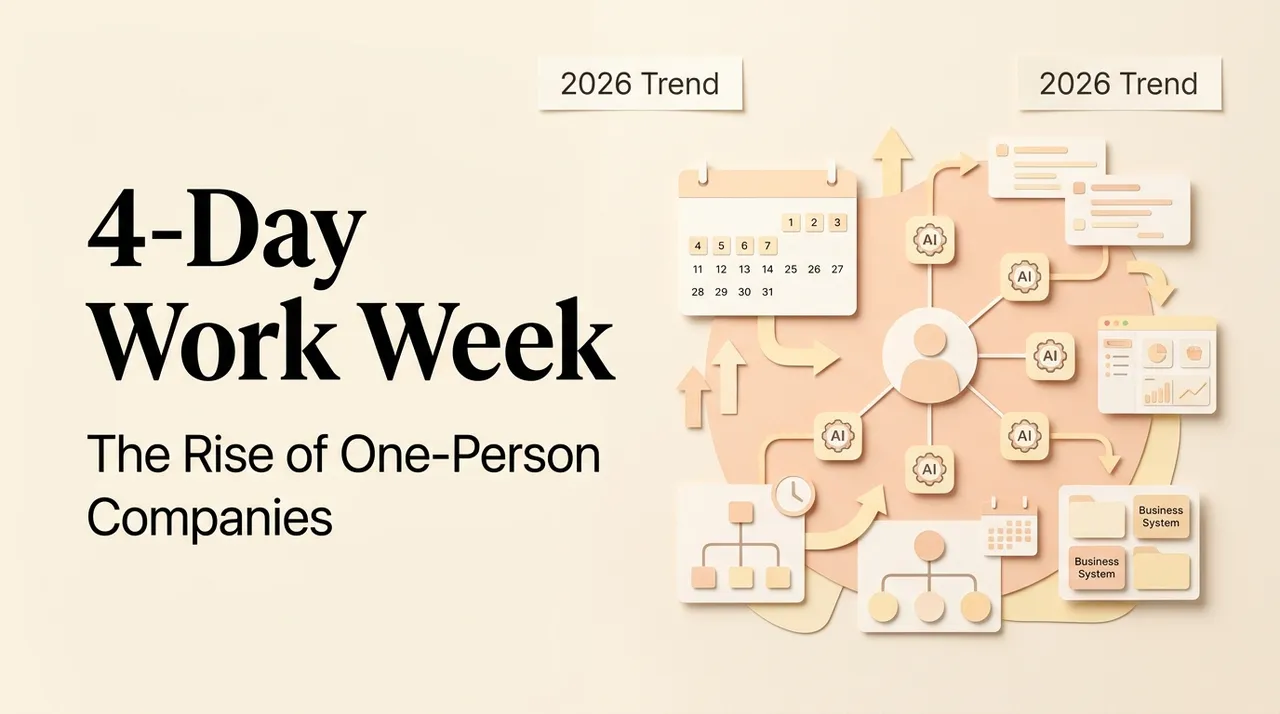
OpenAI did not announce that its employees were moving to a four-day week. It published an exploratory policy proposal asking employers and unions to test paid 32-hour schedules while holding output and service levels constant. The distinction matters: this is a proposal for evidence-building, not proof that AI has already made a shorter week possible.
The official Industrial Policy for the Intelligence Age page is dated June 9, 2026. Its linked policy document describes four-day-week pilots as one possible “efficiency dividend.” This article was re-verified on October 13, 2026 and treats the idea as a policy experiment, not an OpenAI workplace announcement.
What OpenAI actually proposed
The document recommends time-bound pilots with four conditions: 32 hours, no loss in pay, stable output and service levels, and a plan for turning reclaimed hours into a permanently shorter week or bankable paid leave. The same section also discusses healthcare, caregiving, retirement contributions, and measurement of AI’s effect on work.
For a one-person company, the interesting claim underneath it is testable: if AI reduces routine workload, can the operator preserve customer outcomes while reclaiming time?
That is stronger than asking how to work four days. A shorter calendar can hide deferred support, slower sales follow-up, weaker quality control, or a fifth day spent repairing automation. The experiment succeeds only when service and output remain acceptable.
Use a one-person-company scorecard
An employee pilot can measure hours and pay. A solo operator must also measure revenue stability, customer response time, delivery quality, risk, and recovery workload.
| Measure | What to record | Failure signal |
|---|---|---|
| Delivery | On-time accepted outputs | Work silently moves into evenings |
| Service | Median and worst-case response time | Customers wait through the off day |
| Quality | Corrections, refunds, rework | AI saves drafting time but increases review |
| Revenue | Booked and collected revenue | Fewer hours reduce pipeline activity |
| Resilience | Time to recover failed runs | Automation creates hidden weekend work |
| Well-being | Protected hours actually reclaimed | The “free day” becomes admin overflow |
Track at least four normal weeks before changing the schedule. Without a baseline, a busy or quiet month can look like proof for either side.
Reclaim work before compressing the calendar
Start with work that is frequent, rules-based, reversible, and easy to inspect: meeting-note normalization, invoice field extraction, first-pass research collection, draft preparation, status summaries, or file organization. Do not begin with payment approval, legal judgment, account deletion, or unsupervised customer commitments.
The solo-founder AI workflow guide separates collection, transformation, judgment, and approval. That matters because automation rarely removes an entire job; it accelerates stages while accountability remains.
For each candidate task, write the trigger and inputs, acceptable output and evidence, allowed and forbidden actions, review point, stop and recovery path, and minutes saved after repair. If there is no stable acceptance test, shortening the week is premature.
Run a reversible four-day experiment
1. Remove one half-day
Choose a low-demand half-day for two weeks. Keep an emergency channel and measure spillover. The goal is to expose coverage gaps, not declare victory.
2. Protect a full day
Once the half-day works, protect one full day for four weeks. Do not squeeze five days of meetings into four. Cancel, delegate, batch, or automate work before moving it.
3. Review the whole system
Compare the pilot with the baseline. Include subscription costs, failed runs, manual review, customer complaints, and work performed outside the declared schedule. A valid gain is lower total labor for stable outcomes—not merely fewer visible calendar hours.
The guide to scaling without hiring offers the same underlying rule: standardize recurring work before adding more tools or capacity.
Where AI helps—and where it does not
AI can reduce time spent searching, summarizing, drafting, classifying, transforming, and coordinating. Agents can move work between tools when permissions and approval points are clear.
AI does not remove demand uncertainty, customer trust, strategy, legal responsibility, or the need to inspect high-consequence actions. It also creates work: prompt maintenance, access reviews, evaluations, incident recovery, and vendor monitoring.
The efficiency dividend is conditional. A tool creates reclaimable time only when the complete workflow—including review and failures—takes less human effort than before.
Who should wait
A four-day experiment is a poor fit when the business lacks a delivery baseline, depends on continuous live coverage, has unstable demand, carries a large support backlog, or is still discovering its core process. First reduce volatility and document the work.
It is also a poor fit when “AI productivity” means delegating unreviewed external actions. Faster execution can amplify mistakes as easily as useful work.
Original visual references
These images are restored from the article's original publication to preserve interface, workflow, and comparison context. Any product UI, pricing, benchmark result, or model availability shown is a historical capture; verify current official information before making a decision.

Bottom line
OpenAI’s four-day-week idea is best read as a measurement proposal: test whether productivity gains can become time without reducing pay, output, or service. A one-person business can borrow that experimental logic, but not assume the result.
Baseline the work, automate bounded stages, protect a small block of time, and count review and recovery honestly. If accepted output and customer service remain stable while total labor falls, the reclaimed day is real. If work only moves out of sight, it is a reporting problem.
https://floatboat.ai/blog/openai-4-day-work-week-one-person-company