Gemini 3.8 Flash — Google's New Coding & Agent Workhorse
What Gemini 3.8 Flash changes after 3.7: model specs, thinking levels, pricing, tool behavior, token trade-offs, limitations, and a workload-based routing test.
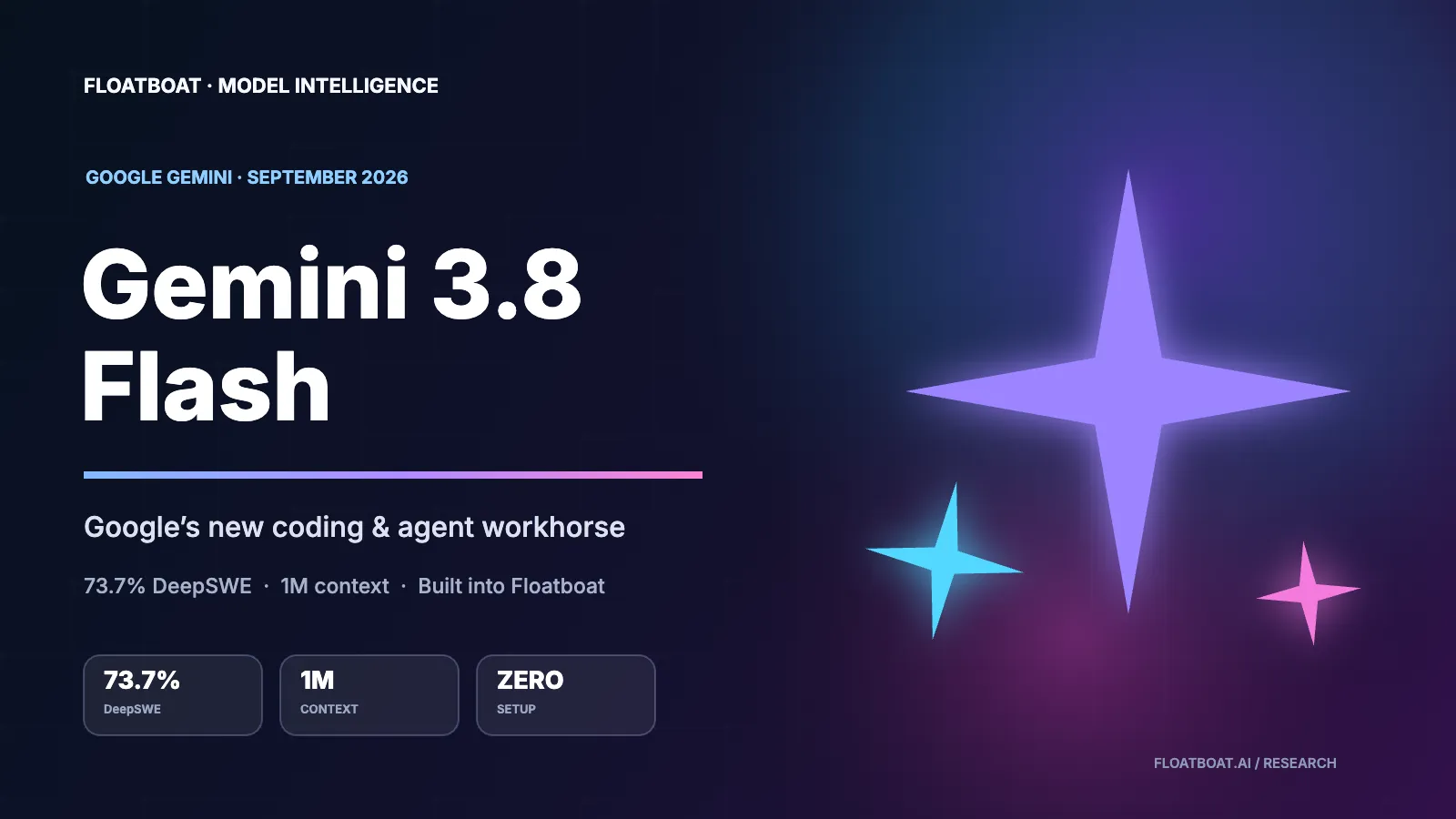
Gemini 3.8 Flash is not simply 3.7 with a higher number. Google describes a model that deliberately spends more steps on long-horizon software work, tool orchestration, and verification. The upgrade question is therefore economic: does a higher completion rate offset extra reasoning tokens and latency?
Status checked October 13, 2026. The exact API identifier is gemini-3.8-flash.
What actually changed after 3.7
Google's current 3.8 guide highlights multi-file refactoring, deterministic tool execution, resilient planning, and iterative verification. It also says plainly that 3.8 can use more tokens on longer, harder tasks. This is the central difference: 3.8 is optimized to keep working, not merely to answer faster.
The general model supports low, medium, and high thinking levels; medium is the default, while minimal returns an error. Low is the correct first experiment for high-volume drafting or incident triage. High belongs on tasks where an incomplete plan is more expensive than extra inference.
Current capacity, modalities, and tools
Google's model documentation lists a 1,048,576-token input window and up to 65,536 output tokens. Text, images, audio, and video can be inputs; the output is text. Function calling and structured outputs make it suitable for agents, but tool availability still depends on endpoint and region.
Do not confuse Gemini 3.8 Flash with the separately controlled Cyber variant mentioned in Google's announcement. Security-specialized access, evaluations, or restrictions do not automatically apply to the general gemini-3.8-flash endpoint.
Introductory price versus operational cost
The official pricing page lists standard paid pricing through December 31, 2026 at $0.75 per million input tokens and $3.75 per million output tokens, including thinking. The listed rates become $1.50 and $7.50 on January 1, 2027. Cache, batch, Flex, grounding, and storage have separate lines.
Equal unit prices do not mean equal run costs. If 3.8 makes more tool calls, emits more thinking tokens, or retries fewer failed plans, the bill can move in either direction. Measure cost per accepted task, not cost per million tokens.
A 3.8 evaluation that exposes the trade-off
Use 30–50 previously completed tasks, not synthetic trivia. Include a repository change, a long policy comparison, an ambiguous tool workflow, and a task that must recover from a failed call. Run each at low and medium; reserve high for the failures.
Capture four numbers: accepted completion, wall-clock time, total billable tokens, and human correction minutes. Also inspect tool arguments and stop conditions. AI agent workflow design explains why a plausible final answer can still hide a broken execution path; agent security questions covers permission boundaries for browser tools.
When 3.7 remains the better route
Keep Gemini 3.7 Flash for stable, latency-sensitive jobs whose acceptance rate is already high. Move to 3.8 for tasks that fail because the model stops early, misses cross-file consequences, or cannot recover from tool errors. If both pass, choose by p95 latency and accepted-task cost—not by a vendor benchmark.
Bottom line
Gemini 3.8 Flash is a stronger candidate for persistent agent work, but persistence is not free. Its best deployment is routed: lower effort for routine traffic, medium for complex work, high only when the task value justifies deeper verification.
https://floatboat.ai/blog/gemini-3-8-flash